
HomeAdvisor's house cleaning cost guide puts a standard visit at $75 to $130 for a one-bedroom home and $130 to $220 for a three-bedroom home. Bedroom count sets which band applies. Condition and the scope you book then move the price within it.
The labor underneath those figures explains why they sit where they do. The U.S. Bureau of Labor Statistics occupational outlook for janitors and building cleaners reports median pay of $17.71 per hour in May 2025, with about 321,800 openings projected annually from 2025 to 2035. That wage is only part of an invoice. Travel, supplies, insurance, scheduling, and time that can't be billed all get priced in.
So the quote that matters is a converted one. Divide the visit price by the hours the work takes and you get an effective hourly rate that makes two different providers comparable. Then multiply by the visits you plan in a year. A $130 clean booked every other week totals $3,380 annually, a number a household budget can absorb or reject before anyone signs up.
Typical House Cleaning Prices by Home Size
A standard visit in the United States usually costs $75 to $220, and bedroom count explains most of that spread. Start there, then adjust for bathrooms and condition.
| Home size | Typical standard visit | Source |
|---|---|---|
| 1-bedroom home | $75 to $130 | HomeAdvisor |
| 2-bedroom home | $100 to $180 | HomeAdvisor |
| 3-bedroom home | $130 to $220 | HomeAdvisor |
| 2,000 sq ft home | $200 to $400 per visit | Angi |
How to read the bands
HomeAdvisor's house cleaning cost guide lists $75 to $130 for a one-bedroom home, $100 to $180 for a two-bedroom home, and $130 to $220 for a three-bedroom home. Its broader estimate puts many standard jobs between $100 and $200, while deeper or one-time jobs can reach $400 or more.
These are planning ranges, not guaranteed quotes. A provider hasn't seen your kitchen, your bathrooms, or how long it's been since anyone scrubbed the shower. Treat the band as a filter. If a quote for a clean, uncluttered two-bedroom lands far above $180, ask what extra work is in it. If it lands far below $100, ask what's missing.
Place your home inside the band
Count bedrooms first, then bathrooms, then look at condition. Bathrooms take longer than bedrooms of the same size because there's more fixture scrubbing and product changes. Kitchens are similar. Grease, soap buildup, and pet hair all slow the work down.
A smaller home with severe buildup, pet hair, or extra bathrooms can cost more than a larger home that only needs light recurring maintenance. That's not a pricing trick. It's time. A cleaner working through months of bathroom buildup spends longer in one room than a cleaner wiping down a bathroom that was cleaned two weeks ago.
Publishers don't agree on one national baseline, which is worth knowing before you treat any single figure as exact. Service Autopilot's 2025 pricing guide puts standard cleaning at $60 to $180 per visit, a wider and lower band than the bedroom table. Fixr's 2025 house cleaning cost guide puts a standard one-time clean at $150 to $250, with a national average of $221 for a four-bedroom, three-bathroom home, which is a bigger job than most rows in the table.
Use the bedroom bands as your starting point and the outer ranges as context only. Write down the range for your home before you request any quote. That one step lets you tell at once whether a quote is high, typical, or low enough that something's probably been left out.
Practical rule: Write your home's band at the top of your quote sheet, then judge every number you receive against it.
What Service Type Adds to Your Bill
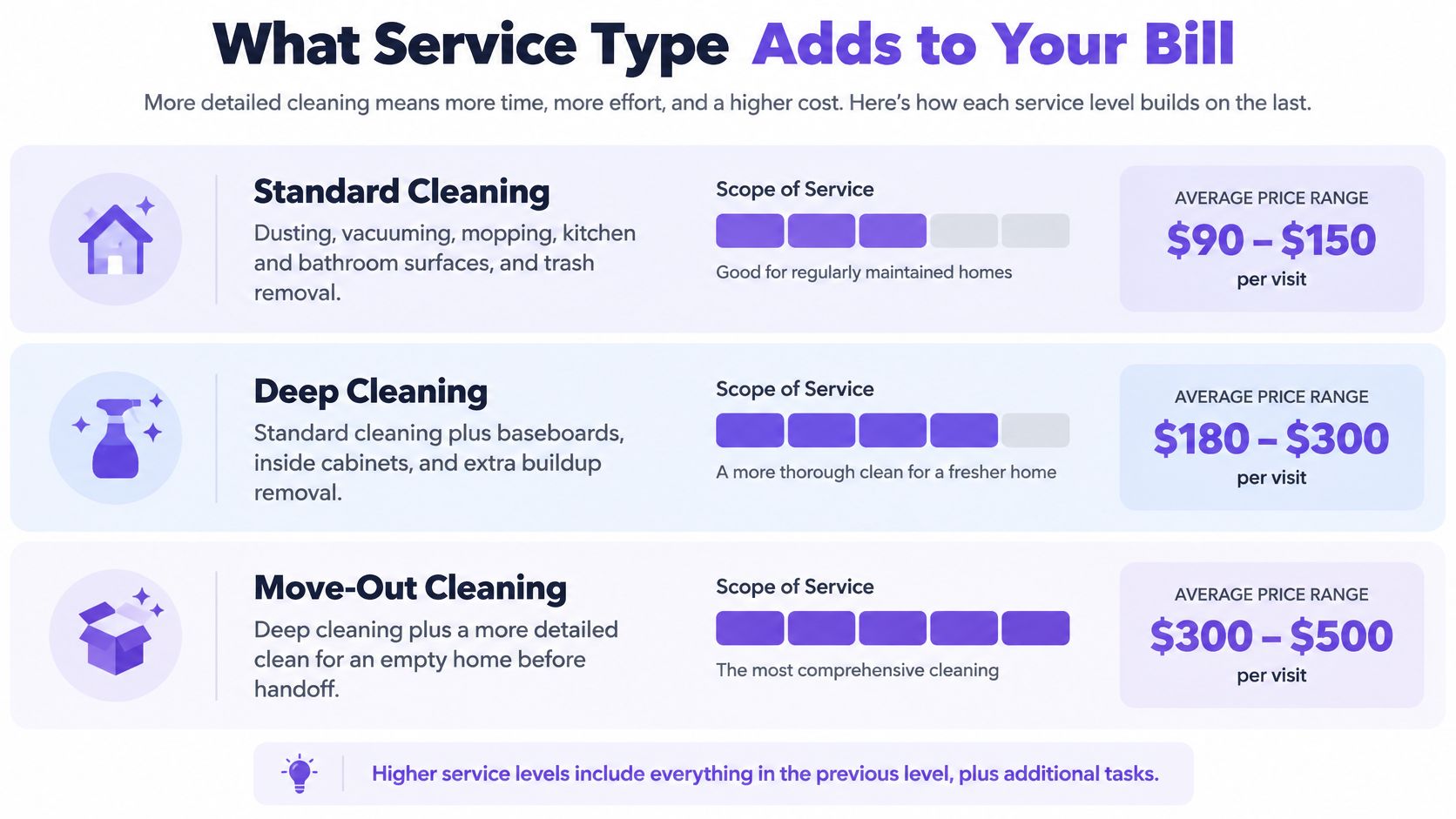
Service level changes the price more than almost anything else, because it changes the hours. Three labels cover most of the market, and they don't mean the same work.
| Service type | Typical range | Reference average | Source |
|---|---|---|---|
| Standard visit | $60 to $180 | $120 midpoint | Service Autopilot (2025) |
| Standard one-time visit, four-bedroom home | $150 to $250 | $221 national average | Fixr (2025) |
| Deep clean | $180 to $375 | about $260 | Angi |
| Deep clean | $90 to $300 | $195 midpoint | Service Autopilot (2025) |
| Move-in or move-out clean | $150 to $500 | $325 midpoint | Service Autopilot (2025) |
What each label covers
A standard visit covers dusting, vacuuming, mopping, kitchen and bathroom surfaces, and trash removal. It's maintenance work. It assumes the home is already in reasonable shape.
A deep clean adds baseboards, inside cabinets, grout, light fixtures, and appliance exteriors. Angi's deep cleaning cost guide reports an average of about $260, with common prices from $180 to $375. A move-in or move-out clean adds empty-room floors, residue removal, and detailed cabinet and appliance work, which is why it sits near the top of the range.
Why the ranges don't line up
The two deep clean rows look contradictory, but they describe different mixes of home size. A small apartment deep clean and a large house deep clean are both deep cleans. Read the range together with the home it's priced for, not on its own. The same applies to the standard rows, where the higher figure describes a one-time visit in a four-bedroom, three-bathroom home.
Crew size also moves the math. One cleaner may charge $25 to $70 per hour, while two cleaners may cost $50 to $120 per hour combined. A two-person crew finishes sooner, but you're paying for both workers. Total labor hours matter more than the clock on the wall.
For new parents, scope is where confusion starts. A standard clean usually doesn't include dishes, laundry, or nursery organizing, so it's worth understanding the line between a cleaner and postpartum doulas and light housekeeping before you book either one.
Label every quote standard, deep, or move-out before you compare it. A standard price next to a deep clean price tells you nothing except that two different jobs cost different amounts.
How Pricing Methods Change the Final Number
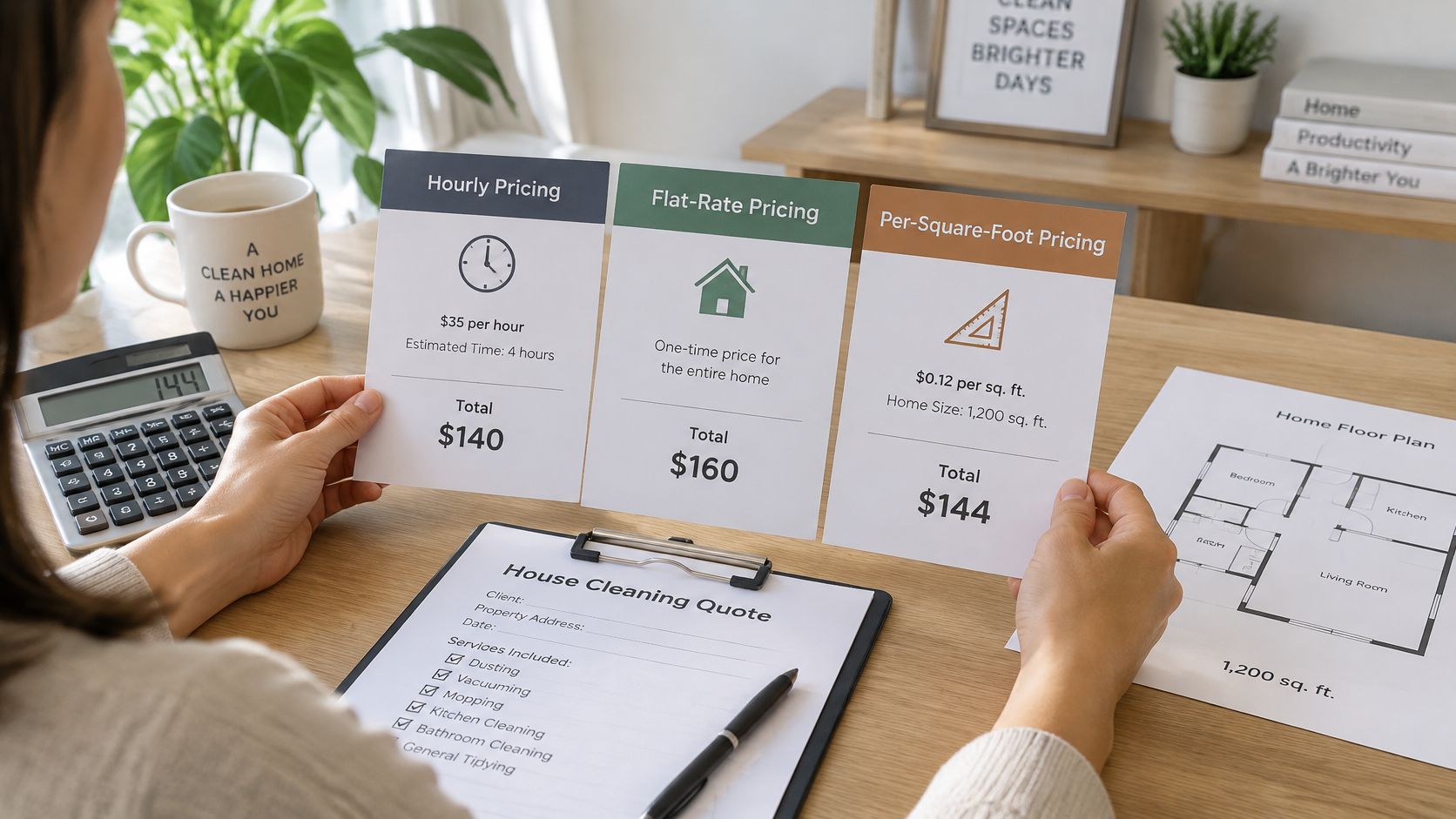
The same job can produce several different totals depending on how the provider prices it. The method decides who carries the risk when the visit runs long.
| Pricing method | Typical rate | Source |
|---|---|---|
| Single cleaner, hourly | $25 to $70 per hour | Angi |
| Two cleaners, hourly combined | $50 to $120 per hour | Angi |
| Professional company, hourly | $40 to $75 per hour | InstaCare (2025) |
| Freelance cleaner, hourly | $25 to $50 per hour | InstaCare (2025) |
| Flat fee, single-family home | $100 to $170 | FreshBooks (2024) |
| Per square foot, standard clean | $0.10 to $0.20 | Angi |
| Per square foot, deep clean | $0.10 to $0.30 | Angi |
Hourly pricing puts the overrun on you
Hourly is the most common method. InstaCare's 2025 house cleaning rates guide puts professional companies at $40 to $75 per hour and freelance cleaners at $25 to $50 per hour. The gap usually reflects insurance, supplies, screening, and someone to send a replacement when a cleaner is sick.
The risk is open-ended. If the home needs more work than expected, you pay for each extra hour, or the cleaner leaves tasks undone to protect your budget. Either way, you're the one managing the trade-off during the visit.
Flat fees move the risk to the provider
FreshBooks' house cleaning estimate guide lists a flat fee of $100 to $170 for a single-family home using 2024 figures, alongside an hourly estimate of $20 to $50 per cleaner. A flat fee suits a clearly defined scope because the provider prices in the uncertainty upfront. Your total is known before anyone arrives.
Per square foot pricing sits between the two. It can look cheap on a large home, but it doesn't see clutter. A tidy, open room and a room full of furniture and boxes have the same floor area and very different cleaning times.
A low hourly rate and a slow visit can cost more than a higher rate and a fast one. The total is what you actually pay.
Convert every quote to a comparable unit before you choose. That means either a total price for the same written scope, or an effective hourly cost you calculated yourself. Without that conversion, you're comparing formats, not prices.
Booking a Recurring Clean Through Simply Maid
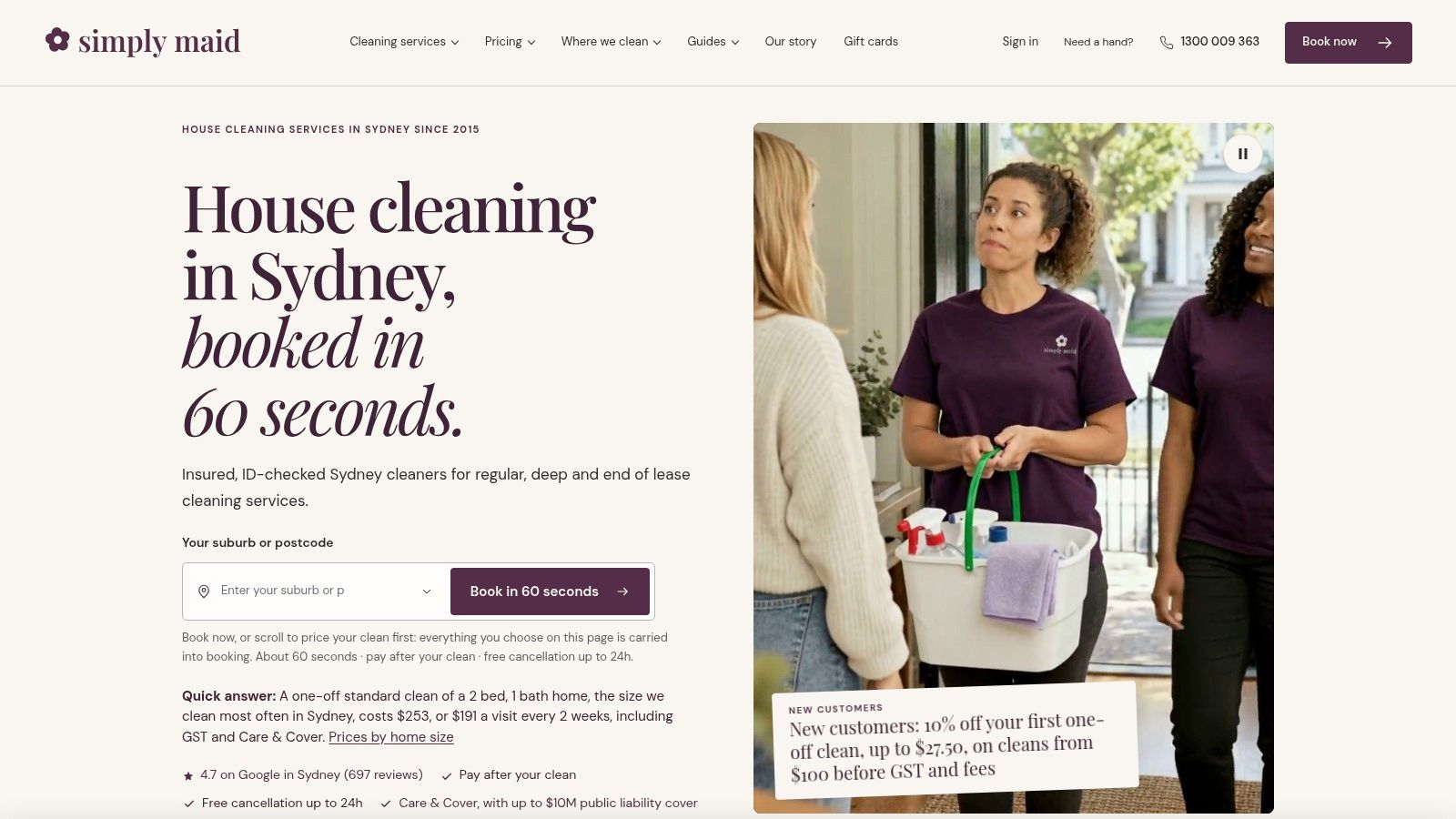
Maid is an Australian cleaning service platform that arranges residential and commercial cleaning through independent cleaning professionals, while handling bookings and customer support itself. Its service areas include Sydney, Melbourne, Brisbane, Perth, Adelaide, Gold Coast, and Canberra.
What you can book
- Standard residential cleaning: Kitchen surfaces, stovetops, bathrooms, vacuuming, mopping, and dusting, booked one-off, weekly, fortnightly, or four-weekly.
- Deep cleaning: Extra detail on ovens, rangehoods, dishwashers, skirting boards, door frames, grout, fans, and window tracks.
- End-of-lease and move-in cleaning: Empty homes, including cupboard and wardrobe interiors, ovens, refrigerators, and interior windows.
- Carpet and furniture cleaning: Hot-water extraction for carpets, plus sofas, mattresses, rugs, and upholstery where the material allows.
- Commercial cleaning: Offices, retail premises, gyms, and shared spaces, starting at two cleaner-hours with schedules up to four visits weekly.
Self-managed NDIS cleaning, selectable extras, and gift cards are also available.
Pricing and cover
Residential prices are set by bedroom and bathroom count rather than dwelling type, which matches how cleaning time scales. Published prices include GST, supplies, and the Care & Cover fee. Property condition and chosen extras can still raise the total, so check the current house cleaning cost figures against your own room counts before booking.
Cleaners are independent service providers rather than employees, described as insured and identity-checked, with the platform managing arrangements and support. You pay after the clean, and cancellation is free at least 24 hours ahead. Recurring plans include discounts and let you pause, skip, or move visits.
Care & Cover bundles public liability cover with a re-clean policy, and both carry conditions. Check the platform's current Care & Cover terms on its pricing page before booking, since cover limits and reporting windows set the value of that protection.
Turning the quote into an annual budget
A room-based quote converts cleanly into a yearly figure. Multiply the per-visit price by the schedule: weekly means 52 visits a year, fortnightly means 26, four-weekly means 13. Apply the recurring discount to that total and you have a single line item to weigh against hourly or flat-fee quotes from other providers.
For a household that wants a fixed schedule without rebooking each visit, with scope and price set by room counts upfront, that structure is the main reason to consider it.
How Location Changes the Price
Local prices differ, but the differences created by geography are smaller than the differences created by home size and service level. One published city example shows the scale.
| City | Average visit | Typical range |
|---|---|---|
| Phoenix, Arizona | about $172 | $120 to $231 |
Reading the Phoenix example
Angi's Phoenix house cleaner cost guide reports an average professional visit of about $172, with a typical range of $120 to $231. A basic clean for an average three-bedroom, two-bathroom Phoenix home is listed at $164 to $205, and a deep clean for the same home at $290 to $350.
Two comparisons matter more than any cross-city average. First, the spread inside one city: the typical range runs $111 from the lowest to the highest visit price, before scope is even discussed. Second, the spread inside one home: the deep clean's low end sits $85 above the basic clean's high end for the same property. Scope and condition move the bill more than the city on your address does.
The average visit also converts cleanly into an annual budget. At $172 per visit, a weekly schedule works out to $8,944 a year, and a visit every two weeks to $4,472. Where your household lands in that range depends on your rooms and condition, not on regional pricing alone.
What drives the gap
Local wages are the main driver, because labor is the largest input in every quote. Operating costs, travel time, and demand add to that. So does the hiring route. An individual you book directly carries different overhead than an agency that handles screening, scheduling, and replacement cover.
One city's figures can't stand in for a national pattern. If you live somewhere else, check a local cost guide or get quotes from two providers in your own area before assuming a regional premium applies to you.
Location sets the starting rate. Home size and scope still decide where your household falls inside it.
Hidden Costs That Raise a Cleaning Quote
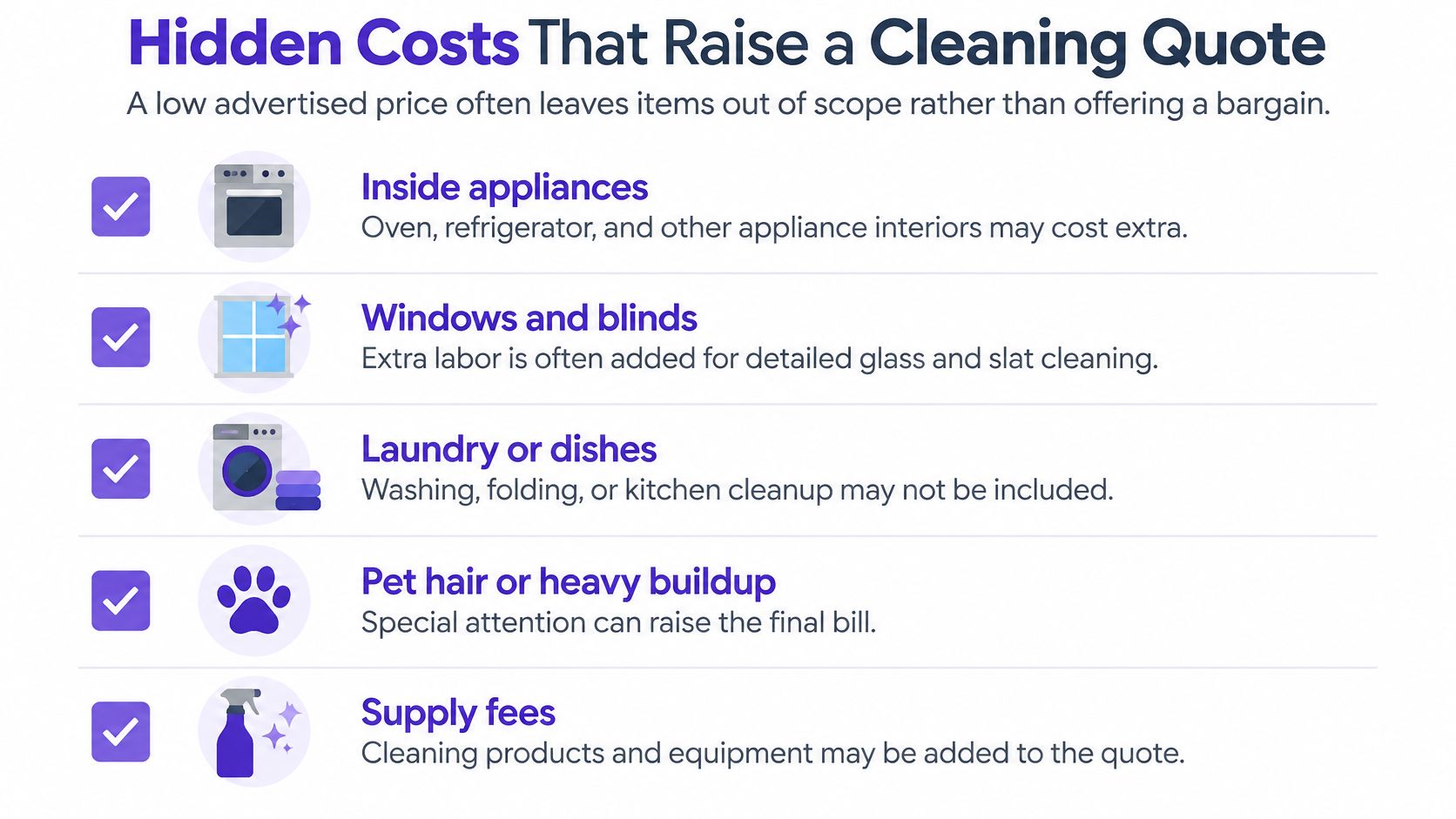
A low advertised price often leaves items out of scope rather than offering a bargain. The final bill rises when those items get added back in.
Add-ons to confirm before you book
- Inside appliances: Oven and refrigerator interiors are often priced separately from exterior wiping.
- Inside cabinets: Cabinet interiors belong to deep and move-out cleans, not standard visits.
- Laundry and dishes: Frequently excluded entirely, because they change the job from cleaning to household help.
- Pet hair: Hair on furniture and in corners takes extra passes with vacuum attachments.
- Clutter moving: Time spent picking up is time not spent cleaning, and it's still billed time.
- Stairs and multiple levels: Equipment and supplies travel between floors, which slows everything down.
- Supplies and equipment: Some providers include them, others expect yours, others add a fee.
- Travel distance: Homes outside a provider's normal area can attract a separate charge.
Families arranging help after a birth run into this gap often, since laundry, dishes, and basic tidying sit closer to postpartum doulas and household support than to a standard clean. Naming the tasks in advance prevents paying for one service while expecting another.
The cost that never reaches the invoice
Your own preparation time is part of the actual cost. A household that spends two hours decluttering before the cleaner arrives is paying in time, even though nothing appears on the bill. For a new parent, that preparation can be the hardest part of the whole arrangement. A quote that includes general tidying may be worth more than a cheaper one that requires a ready home.
Cancellation and late-change fees matter too. Many providers charge when a visit is moved inside a short window, since the cleaner loses work that can't easily be refilled. Tipping is another separate line. Many households tip on top of the quote, so plan for it instead of treating it as a surprise.
Worth checking in writing: Whether a re-clean is included if something is missed, and how long you have to report it.
Every quote should state what's included and what's excluded, in writing, before you pay a deposit. If a provider won't put the task list in writing, the advertised price isn't really a price. It's a starting point.
How to Compare Quotes on the Same Basis
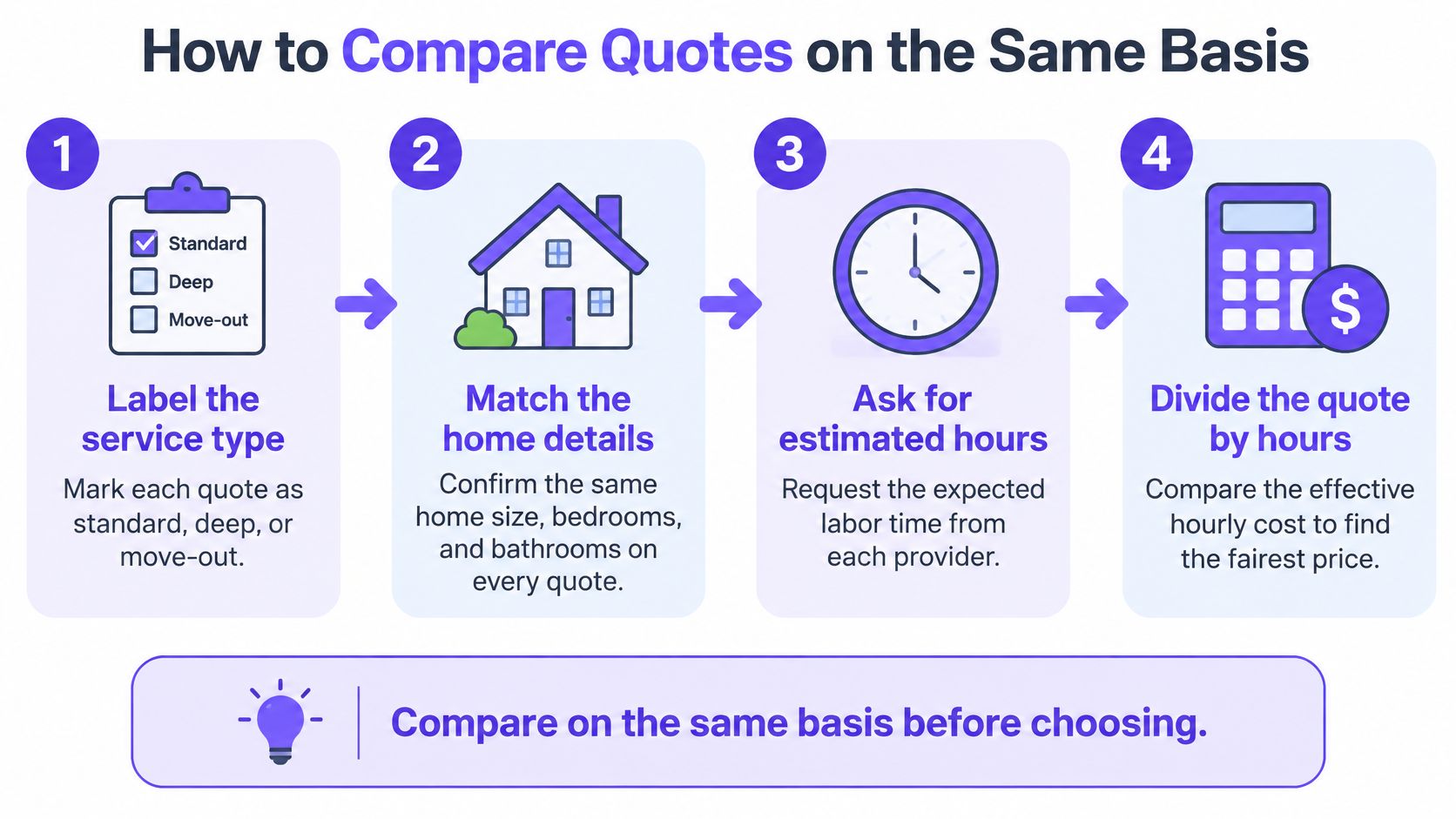
Comparing quotes only works when each one describes the same job. Seven steps turn a pile of differently formatted numbers into one basis you can judge.
The seven steps
- Label the service type: Mark each quote standard, deep, or move-out, and set aside any that don't match the job you want.
- Match the home details: Confirm the same home size, bedrooms, and bathrooms appear on every quote.
- Ask for estimated hours: Request expected labor time and crew size, since two cleaners for two hours is four hours of labor.
- Divide the total by hours: That gives you an effective hourly rate you can compare across flat fees and hourly quotes.
- Check scope against a written task list: Line up the tasks side by side and note anything one quote includes that another doesn't.
- Confirm protections: Ask about insurance, background screening, and the re-clean policy.
- Compare matching quotes only: Same scope, same date range, same frequency. Nothing else is a fair comparison.
A worked example
Say one provider quotes $160 and estimates four hours. That's $40 per hour, which sits inside the published Orlando range. Another quotes $120 but needs six hours. That's $20 per hour. The cheaper total hides a longer visit, a shorter task list, or a wage that leaves little room for insurance and supplies. All three are worth a question.
Angi's house cleaner cost guide reports that a 2,000-square-foot home typically costs $200 to $400 per visit, and places the average visit between $118 and $237, with a typical one-time visit costing about $175. Use those anchors to sanity check your own numbers after the conversion.
Because a fixed quote and an hourly quote can differ widely, the effective hourly figure is the most reliable way to compare them. It's the one number every format can be reduced to.
Set Your Budget Before You Book
A $150 standard visit reads as a modest expense until you multiply it. Frequency, more than the per-visit price, decides what cleaning costs your household.
The annual arithmetic
Take a standard visit at $150 as a planning example. Visits every two weeks mean about 26 cleanings a year, or $3,900. Monthly visits mean 12 cleanings, or $1,800. Weekly visits roughly double the biweekly figure. The same service at a different frequency is a very different budget commitment, which is why the annual total belongs in the decision before the per-visit price does.
A one-time deep clean can sit on top of a recurring plan before a birth, a move, or a busy season. Adding one deep clean at around $260 to a monthly plan brings that year to roughly $2,060, still below the biweekly schedule. For families planning help around a due date, Bornbir's guide to postpartum support is a useful place to start thinking about household help alongside other care.
Once the quotes come back, two conversions matter. The effective hourly rate tells you which price is fair for the scope. The annual figure tells you which plan you can keep paying for.
A sequence that works
- Pick the frequency by how fast your home falls behind, and write down the annual cost that choice implies before requesting a single quote.
- Set a monthly cap from the band that matches your home size, and treat any deep clean as a separate one-time line item rather than part of the recurring figure.
- Request three written quotes with identical rooms, tasks, and frequency.
- Ask each provider for the frequency price directly. Published ranges do not quantify the per-visit discount for biweekly or monthly plans, so the only way to price it is to ask what the same visit costs at each schedule.
- Book one trial visit at the planned scope before committing to a schedule.
The lowest total is rarely the best value. The right plan is the one whose annual cost fits the household budget and whose scope holds up visit after visit.
Start with one small step today. Write down your bedroom and bathroom count, pick the matching price band, and request three written quotes on the same task list. If you are expecting or newly postpartum, add household help to the same plan: share your needs once on Bornbir, get matched with vetted postpartum providers near you, compare their services and starting rates side by side, and message them directly to build support that fits your budget.