
You're up at 2 a.m., the baby finally fell asleep, and your phone is still open to three therapist profiles you meant to compare earlier. Or you're 34 weeks pregnant, the town you live in doesn't have a perinatal specialist, and you're trying to decide whether a video session can help, or just add another tab to your life. That's the core question behind online counselling Canada. It isn't whether virtual care exists, it's whether you can find the right person, with the right licence, in the right format, for the right stage of pregnancy or postpartum.
Canadian parents already use virtual health care at a high rate. A CIHI report drawing on Canada Health Infoway's 2021 survey found 73% of Canadians had at least one virtual health care interaction in 2021, and 90% of virtual-care users said they were satisfied with the care they received (CIHI virtual care report). That matters because the barrier now isn't basic acceptance. It's matching, which provider fits your symptoms, your province, your privacy needs, and your budget.
Practical rule: Treat virtual counselling like a matching problem, not a directory problem. A long list of therapists doesn't help if none are licensed where you sit, none handle perinatal issues, or none offer a schedule that survives feeds, naps, and school pickups.
Why Online Counselling Matters for Canadian Parents Right Now
A parent doesn't need another perfect system. They need help that fits a life that's already broken into short windows. Virtual counselling does that better than in-person care for many families because it cuts out the commute, the parking hunt, and the logistical mess of leaving a newborn or pregnant body to sit in traffic for a 50-minute appointment.
Canadian virtual care is already normalized, and the same pattern shows up in mental health. The 2022 Canadian Digital Health Survey reported that 57% of Canadians were interested in e-mental health services, up from 51% in 2021. Among users, 42% used telephone-based support, 32% used websites, and 19% used mobile apps. The same survey found 88% said the tools were easy to use and 84% were satisfied with virtual care (Canadian Digital Health Survey summary). That's a strong signal that the format itself is no longer the problem.
For parents, the stronger argument is continuity. A new baby doesn't care that you moved provinces, went to stay with family, or can only talk after bedtime. Online counselling also broadens access to specialists who don't practice in every city, which matters in rural communities and smaller centres where perinatal support can be thin.
What virtual counselling solves, and what it doesn't
It solves friction. It does not solve every access problem. Canadian data still shows people face mental health gaps, and that's why online support should be part of a wider plan with prenatal care, family doctors, midwives, peer support, and postpartum follow-up. If you're coping with intrusive thoughts, breastfeeding stress, or postpartum panic, coping with postpartum anxiety can sit alongside therapy, not instead of it.
It also doesn't replace fit. A parent can have great internet and still land with the wrong person. That's why the rest of this guide focuses on the questions that decide whether virtual counselling helps, licensure, modality, cost, privacy, and whether the provider understands pregnancy, birth, feeding, sleep deprivation, and identity shifts.
Types of Online Counselling and When Each One Fits
The best counselling style for a pregnant or postpartum parent depends on what's happening. A lot of people start with “I need therapy,” but the sharper question is whether the issue is perinatal mood, trauma, relationship strain, or something more structured like panic, perfectionism, or intrusive thoughts. Different modalities handle those problems differently.
The main fit differences
Perinatal mental health counselling makes the most sense when the distress is tied to pregnancy, birth, loss, or the postpartum window. That includes grief after miscarriage, fear around birth, mood swings, identity disruption, and the emotional fallout from a hard delivery. It's the clearest choice when you want someone who already understands the terrain instead of having to educate them from scratch.
Cognitive behavioural therapy, or CBT, fits parents who want structure. It works best when you want goals, exercises, and practical tools between sessions. If you're depleted and need concrete steps for anxiety or low mood, CBT is often easier to use than open-ended therapy because it gives you something to do when your brain is spinning.
EMDR and trauma-focused therapy are better for distressing birth experiences, older trauma that resurfaces during pregnancy, or fear of childbirth that feels stuck in the body. This isn't a casual add-on. You want someone trained in the method, because trauma work done badly can leave a parent more activated, not less.
Relational and psychodynamic therapy suits relationship strain, attachment questions, identity shifts, and the deeper emotional changes that show up when someone becomes a parent. It's usually less checklist-driven and more exploratory. That can be a better fit when the issue isn't just symptoms, it's how your whole role in the family is changing.
A sleep-deprived parent usually does better with a clear structure, shorter homework, and a therapist who can move fast. A parent with unresolved trauma may need slower work, more grounding, and a provider who knows when to pause.
The session format matters too. A model that asks for long between-session reflection may be too much during the newborn phase. A model that pairs well with family doctor or psychiatrist support can be smarter if medication is part of the plan. Some parents also benefit from group perinatal counselling, especially when isolation, shame, or repeated feeding struggles are part of the picture.
For families comparing options, Bornbir virtual doula services can sit beside counselling when the need is practical support plus emotional steadiness. The right mix depends on whether you need coaching, trauma work, symptom management, or all three in sequence.
| Counselling modalities compared for Canadian parents | |||
|---|---|---|---|
| Modality | Best for perinatal situations | Session style | Fit considerations |
| Perinatal mental health counselling | Pregnancy, postpartum mood concerns, birth trauma, loss, identity shifts | Often flexible, can be short-term or longer-term | Strong choice when the provider understands the perinatal window |
| CBT | Anxiety, intrusive thoughts, low mood, structured coping goals | Clear agenda, homework, skills practice | Good for parents who want tools and measurable steps |
| EMDR and trauma-focused therapy | Distressing birth experiences, resurfacing trauma, tokophobia | Phased, body-aware, often more intensive | Best with a trained clinician and enough emotional bandwidth |
| Relational and psychodynamic therapy | Attachment, relationship strain, deeper identity questions | More exploratory, often less directive | Useful when the issue is less symptom-driven and more relational |
Licensing and Provincial Rules You Should Check First
Virtual counselling in Canada isn't governed by one national rulebook. Provinces and territories regulate practice differently, and that's not a technicality. If the clinician isn't authorized where you are physically sitting during the session, you've already made a bad choice, no matter how polished the website looks.
What credential actually matters
A registered psychologist is regulated by a provincial college and is often the easiest credential to understand for insurance purposes. Registered social workers and registered counsellors can also provide legitimate care, but the title and billing rules vary. In Ontario, registered psychotherapists are regulated by the CRPO, and psychotherapy is a controlled act. Unregulated coaches, peer supporters, and “wellness guides” may be helpful in a narrow sense, but they're not the same as regulated mental health care and usually can't issue insurance receipts.
If you're in Ontario, Quebec, British Columbia, Alberta, or one of the Atlantic or Prairie provinces, check the relevant college first. Ontario has CRPO for psychotherapists. Quebec has its professional orders for psychologists and social workers. British Columbia registers many practitioners through the College of Health and Care Professionals of BC. Alberta has the College of Alberta Psychologists. The names differ, but the principle doesn't. You verify the person before you pay them.
Practical rule: Don't trust a website bio alone. Search the provincial register, confirm the status is active, and check whether the person's designation matches what your insurer expects.
Cross-border practice is where people get tripped up
A counsellor usually has to be authorized where the client is sitting, not just where the counsellor's office is. That matters for people who move, travel, or split time between provinces. If you're booking from a cottage, a relative's home, or a temporary work assignment, ask whether the provider can legally see you there.
Ontario guidance also stresses informed consent for telepsychology. Psychologists and psychological associates are expected to explain telepsychology services clearly, including costs, benefits, limitations, and to obtain and document informed consent (Ontario psychology telepractice guidance). Privacy is also credential- and sector-dependent. Canadian counselling guidance notes that PIPEDA applies to private-sector organizations, while British Columbia practitioners may fall under PIPEDA or B.C.’s Personal Information Protection Act depending on sector (Canadian Counselling and Psychotherapy Association privacy guidance).
For a broader plain-language overview of practice boundaries, are doulas regulated in Canada is a useful companion read when you're comparing support roles around the birth window.
How Interactive Counselling Can Help
A good counsellor won't just “do virtual.” They'll make the format work for a real family schedule and a real issue. That's where a practice like Interactive Counselling can be relevant, because it offers in-person, phone, and secure virtual sessions, along with daytime, evening, and weekend availability. For parents who can't reliably protect a mid-day appointment, that flexibility is often the difference between starting care and postponing it again.
Their team works with individuals, couples, families, children 5 and up, and youth. The practice covers anxiety, depression, grief and loss, trauma and PTSD, parenting and co-parenting, step-parenting, relationship and marriage counselling, family counselling, life transitions, divorce support, and mediation. It also offers ICBC-funded counselling for clients recovering from motor vehicle accidents, which matters if a pregnancy or postpartum period overlaps with physical recovery or accident-related stress.
If you're comparing providers, the value is in how broad the service menu is, because perinatal stress often spills across categories. A new parent may need individual support for intrusive thoughts, couple sessions for division of labour, and family work when the home environment is making things harder. A practice that can handle those layers without making you restart the process somewhere else is easier to live with.
If you want to review a provider page that lays out those options in one place, online counselling in Canada is the relevant starting point for this practice. The key question isn't whether they advertise virtual care. It's whether they can meet the issue you're facing, in a time slot you can keep, with a format that feels manageable.
What to ask before you book there, or anywhere else
Ask three things in the first message. Ask whether they've worked with pregnancy, postpartum, or family-transition issues. Ask whether they offer brief consults before intake. Ask how they handle virtual privacy and whether they coordinate with physicians or midwives when needed.
If a practice can answer those questions clearly, that's a better sign than a polished homepage. If they can't, keep looking.
How to Find, Vet, and Book the Right Counsellor
Start with a short list, not a giant search. Three to five candidates is enough if you pick them from verified Canadian registries or credible directories. A long list just adds decision fatigue, especially when you're feeding, healing, or sleeping in fragments.
A useful search order is simple. First, filter by licence. Then check perinatal experience. Then look at modality. Only after that should you compare price, language, and availability. The question is not, “Who seems nice?” It is, “Who is authorized, competent, and reachable in the way I need?”
Ask for a short consultation before you book a full intake. Fifteen minutes is enough to hear how they talk about postpartum anxiety, whether they rush, and whether they stay steady when you ask about birth trauma, intrusive thoughts, or partner conflict.
Practical rule: If the provider cannot explain their scope in plain language, they are not ready for your first appointment.
Use a quick scorecard to narrow the field:
- Licensure: Is the clinician active on the provincial register, and does the designation match the service?
- Fit: Do they list perinatal, trauma, relationship, or anxiety work that matches your issue?
- Access: Do their session times work with your baby's schedule, and do they offer phone or secure video if needed?
- Cost: Does the fee fit your coverage, and do they spell out cancellation rules up front?
Confirm the money before you book
Virtual counselling costs vary by province and clinician, and you should expect out-of-pocket fees unless coverage is confirmed in advance. Coverage can come through extended health benefits, an EFAP, or direct billing by some clinics, but the insurer's rules decide what gets paid. Registered psychologists are often covered more broadly than other designations, while registered counsellors and psychotherapists depend on the plan.
Check whether the provider can work with your insurer before the first paid session. If they cannot direct bill, ask for a receipt with the exact designation your plan requires. If you are comparing marketplace options, benefits of using Bornbir also helps parents compare providers and messaging options in one place, which can shorten the search without replacing your own verification.
Costs, Insurance, and Coverage in Canada
Counselling fees in Canada usually sit in a wide band, and that's normal. The exact price depends on the province, the clinician's designation, and whether the session is individual, couple, or family-focused. What matters more than the sticker price is whether the provider is covered under your actual plan.
How payment usually works
There are three common paths. The first is extended health benefits, usually through an employer plan. The second is an Employee and Family Assistance Program, which often offers short-term support at no cost to the employee or family. The third is direct billing, which some clinics offer, though not all do.
Insurance plans do not treat every credential the same way. A psychologist often has the easiest path to reimbursement. A registered counsellor or psychotherapist may be covered under some plans and not others. You need to check the exact designation, not assume “therapy” is therapy to the insurer.
Practical rule: Call or log in to your benefits portal before booking. Ask whether the provider's credential is eligible, whether a referral is required, and whether there's a yearly cap or per-session cap.
Here's a simple comparison of the usual paths:
| Typical Counselling Coverage Paths in Canada | ||
|---|---|---|
| Provider Type | Common Fee Range | Typical Coverage |
| Registered psychologist | Varies by clinic and province | Often covered more broadly under extended health plans |
| Registered counsellor or psychotherapist | Varies by clinic and province | Covered under some plans, not universal |
| EFAP provider | Usually no direct charge to the client for the allotted sessions | Short-term access through employer or benefits program |
| Private clinic with direct billing | Varies by clinic and province | Billing handled with insurer if the clinic is set up for it |
There are also provincial programs in some settings, including OHIP-covered psychotherapy in Ontario or reimbursement pathways in Quebec, but those options depend on eligibility and location. Ask about missed-session fees too. Those fees matter when a baby is sick, a nap collapses, or a parent is too overwhelmed to log on. If you want to compare benefits language with a birth-support lens, doula insurance guide 2026 is a useful companion for understanding how benefit plans handle perinatal support more generally.
Privacy, Technology, and Your Home Setup
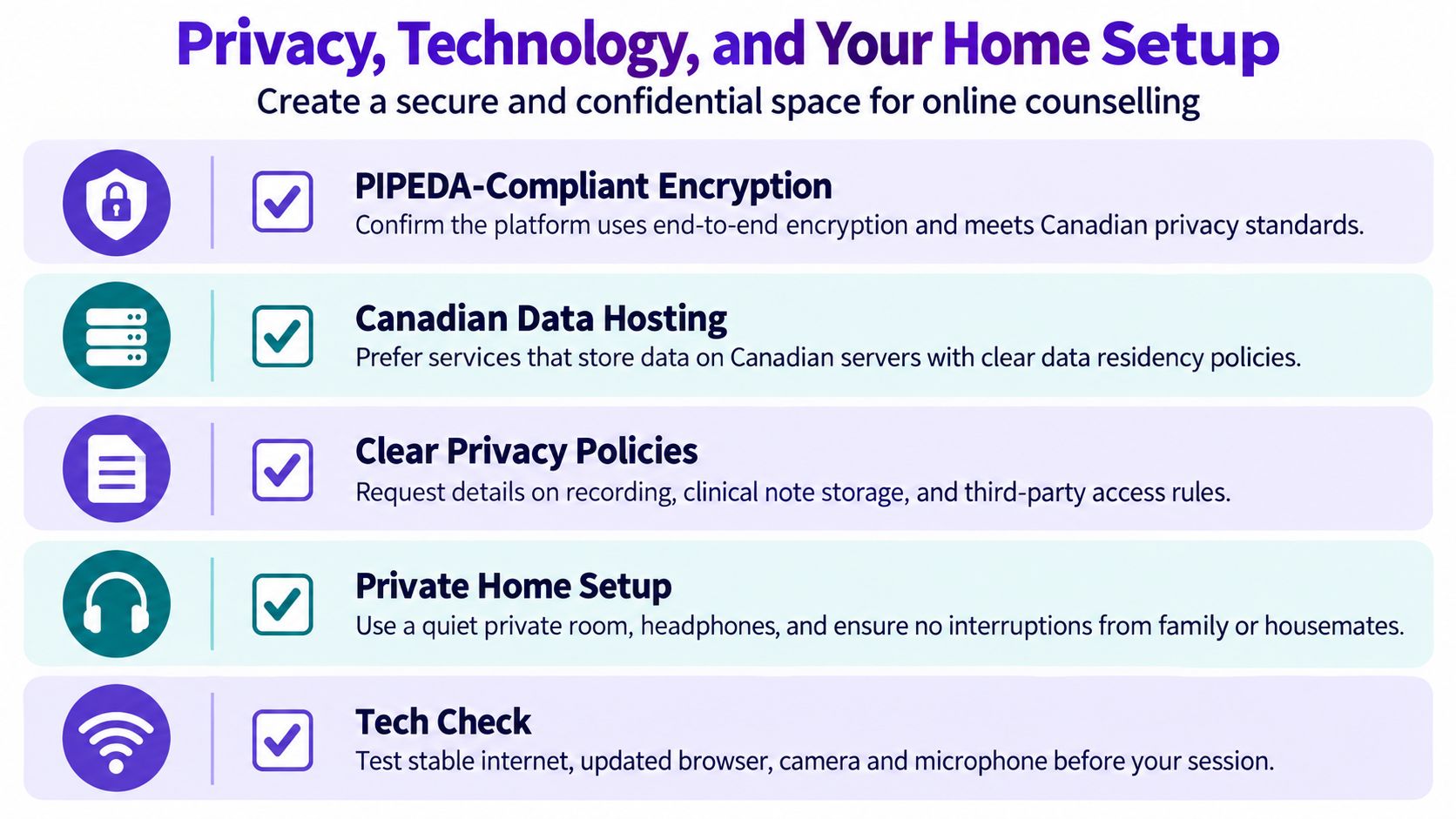
A virtual session can only feel safe if the setup is private. That starts with the platform, but it doesn't end there. The clinic should be able to explain how session notes are stored, who can access them, and whether the platform uses encryption and clear data-handling rules.
Build the privacy layer first
Ask directly whether the service uses PIPEDA-compliant privacy practices and how it handles recordings, note storage, and third-party access. If the counsellor can't explain that without jargon, keep moving. Canadian privacy expectations are not optional just because the session is online.
Then fix the room. Use headphones, shut the door if you have one, and choose a spot with a neutral background. If you live in a small apartment or a busy house, set expectations with the people around you before the appointment starts.
Make the tech boring
Boring tech is good tech. A stable connection, a working camera, and a microphone that doesn't cut out are enough. Close unrelated apps, silence notifications, and turn off smart speakers if they can hear the session. Test the link early so you're not spending the first five minutes troubleshooting while your baby fusses in the next room.
Keep water, tissues, and a notebook nearby. Save the counsellor's contact information in case the connection drops mid-session. The goal isn't a perfect studio. It's a private, steady space where you can talk without feeling exposed.
If you're choosing between a beautiful room and a quiet one, choose quiet.
The same setup also helps you coordinate counselling with a doula, lactation consultant, sleep coach, or family doctor, because each person can focus on their own lane without crossing wires. That keeps you from repeating the same story five times and paying twice for overlapping support.
Combining Counselling With Other Perinatal Support
Counselling works best when it's part of a small team, not the only support in the room. Parents often use multiple services at once because one provider can't solve emotional distress, feeding pain, sleep deprivation, and medical questions all at the same time. The trick is to avoid overlap that wastes money and time.
Who does what, and when to bring them in
A counsellor handles emotional processing, symptom assessment within scope, coping strategies, and coordination with other professionals when appropriate. A family doctor or psychiatrist handles diagnosis and medication decisions. A lactation consultant handles feeding mechanics. A pelvic floor physiotherapist handles physical recovery. A doula gives non-clinical support around birth and early parenting. Peer groups help with isolation and normalization.
Use this as a rough trigger map:
| When to layer each perinatal support alongside counselling | ||
|---|---|---|
| Situation | Primary support | Counsellor's role |
| Postpartum anxiety or intrusive thoughts | Counsellor, with family doctor if symptoms are severe | Help regulate fear, build coping routines, and assess whether additional clinical care is needed |
| Breastfeeding pain or feeding distress | Lactation consultant | Process the emotional strain and reduce shame while the feeding issue is addressed |
| Sleep deprivation and overwhelm | Sleep coach or practical postpartum support | Help with emotional regulation, boundaries, and partner communication |
| Birth trauma or fear of future birth | Perinatal counsellor or trauma therapist | Trauma processing, grounding, and pacing |
| Medication questions or escalating symptoms | Family doctor or psychiatrist | Support the mental-health side of care, while counselling addresses coping and follow-up |
A good coordination pattern is simple. Pick one clinical lead, usually the counsellor or family doctor, and give written consent for information-sharing when it helps. That way, nobody is duplicating the same work, and nobody is making decisions in a silo.
A seven-day action sequence that gets you moving
- Day 1, name the issue. Decide whether the main problem is anxiety, low mood, trauma, feeding stress, relationship strain, or something else.
- Day 2, shortlist providers. Pull two or three names from verified directories or registries.
- Day 3, verify the licence. Check the provincial register and confirm the designation and status.
- Day 4, send one short message. Ask about perinatal experience, session format, and cancellation policy.
- Day 5, confirm coverage. Check your insurer, EFAP, or direct billing options before paying.
- Day 6, set up the space. Test the tech, privacy, and lighting.
- Day 7, attend and reflect. After the session, ask yourself whether you felt understood, rushed, or more settled.
That's the matching test. Not whether the provider has the prettiest calendar, but whether the care lowers chaos. If you need French or Indigenous-language support, ask early and keep asking until you get a direct answer. If you're in crisis, use emergency services or your local crisis line right away, because therapy supports recovery, it doesn't replace urgent care. Some provinces also use 988, and local crisis lines still matter where 988 isn't the route.
Short FAQs that parents ask all the time
How fast can I book? Some providers can see you quickly, others have a waitlist. Ask before you invest time in forms.
Can a counsellor prescribe medication? No. Medication decisions belong with a physician or psychiatrist.
Can I find French or Indigenous-language support? Sometimes, yes. Ask directly about language access and cultural safety.
What if I'm in a mental health crisis? Call emergency services or your local crisis line. Don't wait for a therapy booking.
Can I switch counsellors if it's not working? Absolutely. Poor fit is a valid reason to move on.
Can my partner join? Many clinicians offer couple or family sessions when the issue affects the home system.
For quick-start resources, check your provincial regulatory college, the Pacific Post Partum Support Society, the Postpartum Support International, PSI Canada chapter, and the BestBabysleep.com directory note. Use public crisis lines alongside therapy, not instead of it.
The right virtual counsellor should make life feel more manageable, not more complicated. If the fit is solid, you'll know it in the first few conversations, and that's enough to keep going.