
You're staring at a search results page late at night. A few boxes are half-packed. Your spouse's lawyer has sent an email you don't fully understand, and your child's next-week schedule is suddenly part of a legal dispute. The fear isn't only that the marriage is ending. It's that one rushed decision could cost you control of your home, your parenting time, or money you can't replace.
Hiring a divorce attorney isn't just a matter of finding the most aggressive person with the best-looking website. It's a decision-design problem. You're choosing how much legal help you need, which issues deserve professional judgment, how you'll pay for the work, and when negotiation should give way to litigation. Parenting schedules, support calculations, pregnancy, postpartum recovery, property, safety, and deadlines all change the answer.
Some people need full-scope counsel. Others need a lawyer to review an agreement, prepare a filing, or attend one critical hearing. The right choice protects your options without paying for work you don't need.
The Moment You Realize You Need a Divorce Attorney
The moment usually arrives without warning. You may not have a court date yet. You may still be living in the same home, sharing school pickups, or telling relatives that you're “working through things.” But then your spouse mentions moving out, opens a separate bank account, or sends a proposed parenting schedule that looks harmless until you notice what it would mean for holidays, overnights, and support.
That's when many people search for a divorce lawyer without knowing what they are buying. They compare hourly rates, courtroom photos, and promises about “fighting for you.” Those signals matter less than whether the lawyer understands your specific risks and can explain a practical path through them.
A lawyer should help you answer questions such as:
- What needs protection now? Bank records, housing, health insurance, parenting time, and important documents may require immediate attention.
- Which issues are genuinely disputed? A cooperative divorce with clear finances is different from a case involving hidden assets, relocation, domestic violence, or a business.
- What work do you need the lawyer to perform? You might need full representation, limited-scope advice, or a review of documents you prepare yourself.
- What can you afford without creating another crisis? A retainer is only the beginning of the financial conversation.
Practical rule: Don't hire a lawyer because you're scared. Hire the lawyer who can turn that fear into a prioritized list of decisions.
Legal help can make a meaningful difference when court access, paperwork, service, deadlines, or procedural rules are blocking progress. In a randomized 2018 study reported by the Access to Justice Lab's divorce research, people who received legal representation were 87% more likely to achieve a divorce than those who didn't. After 18 months, 54.1% of represented participants had a case on record, compared with 13.9% of the control group. The study involved low-income litigants facing access barriers, so it doesn't mean every divorce requires a lawyer. It does show why procedural help can matter.
Don't confuse urgency with a need for maximum representation
You may need advice quickly, but that doesn't automatically mean you need a large retainer or a lawyer handling every email. A short consultation can clarify whether you need immediate court protection, a financial records plan, or a careful conversation before filing.
The parenting context matters, too. A parent recovering from birth, managing feeding, or dealing with severe emotional strain may need coordinated support alongside legal advice. If your mental health feels unsafe or unmanageable, find help through Bornbir and speak with an appropriate health professional.
The best first move is simple. Write down the decision you're facing, the deadline you know about, the people affected, and the result you're trying to avoid. Then look for counsel who can address that decision directly.
How to Find and Screen the Right Divorce Attorney
Start with fit, not fame. Choose a lawyer licensed where your case belongs, available for the dispute you face, and willing to explain the work before asking you to sign. Your goal is not to hire the most impressive name. It is to choose the right level of help for your parenting, financial, and procedural decisions.
Before sharing sensitive facts, provide the names of both spouses and any related businesses so the office can run a conflict check. The American Bar Association also advises comparing lawyers' qualifications and typical charges before engagement. Keep its guidance on professional fees available while you compare answers.

Start with jurisdiction and conflicts
Ask where the lawyer regularly practices and whether your filing location is appropriate. Divorce rules vary by state and sometimes by county. Familiarity with the local court's procedures can matter more than a high rating from a lawyer who rarely appears there.
Share enough information for the firm to determine whether it represents your spouse, a related business, or another person with competing interests. Do not disclose detailed strategy until the office confirms that no conflict prevents a consultation.
Match experience to the actual problem
“Family law” covers too much to guide your choice. Ask about the issues that will drive your case:
- Custody and relocation: Has the lawyer handled disputed parenting schedules, school changes, or travel restrictions?
- Financial complexity: Does the team understand business valuation, retirement accounts, tax consequences, and tracing separate property?
- Safety: Can the lawyer respond to domestic violence, coercive control, threats, or emergency custody concerns?
- Perinatal realities: Has the lawyer worked with newborn schedules, breastfeeding considerations, pregnancy, or postpartum recovery?
A lawyer who mainly handles uncontested filings may suit a simple agreement and fail to meet the needs of a business owner facing contested valuation. Read biographies for specific experience, not broad adjectives such as “dedicated” or “aggressive.” Ask how the lawyer would account for feeding schedules, school logistics, support calculations, or recovery after birth when building a workable case strategy.
Compare two qualified candidates
One consultation gives you information. Two give you a comparison. Speak with lawyers with similar qualifications, then compare their proposed scope, communication standards, staffing, and billing practices.
Ask each lawyer to explain the first decisions they would make, the documents they need, and the events that could increase cost. Listen for structure. A strong lawyer separates urgent work from later work and explains what would trigger a strategy change. Ask whether full-scope representation is appropriate or whether limited-scope help could cover specific tasks, such as reviewing an agreement, preparing a filing, or advising on a custody schedule.
A foundational study of 567 divorce cases filed in 2005 found that 56.1% of husbands and 62.3% of wives had lawyer representation, while 43.9% of husbands and 37.7% of wives represented themselves (Marquette Law research). The figures come from one jurisdiction and filing period, so they should not be treated as a national pattern. They do show that hiring counsel is a case-specific decision, not a universal requirement or a sign of failure.
Use local referrals, bar directories, and legal-aid programs as starting points, not final proof. Apply the same careful judgment when researching family support as when learning how to choose a virtual doula. Credentials and reviews narrow the field. Your consultation should determine whether the lawyer's scope, communication style, and strategy fit your family.
Understanding the Real Cost of Hiring a Divorce Attorney
The hourly rate is the easiest number to compare and often the least useful one. Recent fee guidance places the 2025 U.S. average family-law attorney rate at $344 per hour, while emphasizing that total cost depends on hours, staffing, billing practices, and case complexity (fee guidance on divorce-lawyer costs).
A lawyer billing at that rate for a moderately contested case can produce a five-figure bill once meetings, drafting, negotiation, discovery, hearings, and support from other professionals accumulate. That isn't a prediction of your cost. It's a reminder that the rate alone can't answer the question.
Know what the retainer does
A retainer is usually advance money held in a trust account and applied as the lawyer bills for completed work. It isn't automatically the total price. The final bill can exceed it, and the agreement should explain whether unused funds are returned.
A refundable retainer generally returns the remaining balance after billed work is paid. A nonrefundable retainer is kept by the attorney under the terms of the agreement, and state rules differ on whether that arrangement is allowed. Don't rely on a verbal explanation. Read the trust-account treatment, refund terms, billing rate, and expense provisions before signing.
Ask when replenishment occurs. Some agreements require you to restore the retainer when the balance falls below a stated threshold. That can become a serious cash-flow problem during discovery or a custody dispute.
Request a phase-based estimate
Ask for a written estimate with assumptions. It should distinguish negotiation, document preparation, discovery, mediation, hearings, and trial preparation. It should also identify the hourly rates for partners, associates, paralegals, and other billable professionals.
Look for costs that sit outside the lawyer's headline rate:
- Communication: Calls, emails, conferences, and document review may all be billed.
- Court activity: Filing fees, service, court reporters, and hearing preparation may be separate.
- Evidence: Business valuators, financial experts, custody professionals, and interpreters can add expense.
- Settlement work: Mediation fees and repeated negotiation rounds may not be included in an initial retainer.
- Travel and administration: Mileage, copying, records requests, and other expenses should be clearly described.
If you're expecting a baby or managing a new household budget, add pregnancy and postpartum cost planning to your financial preparation. Legal expenses compete with housing, childcare, medical care, and income changes.
| Fee Structure | How It Works | Best Fit |
|---|---|---|
| Hourly billing | You pay for recorded work, often from a retainer | Cases with uncertain scope or changing disputes |
| Flat fee | You pay a set amount for clearly defined tasks | Specific uncontested filings or document reviews |
| Limited scope | You hire the lawyer for selected tasks while handling others | Clients who can manage routine steps but need legal judgment |
| Full scope | The lawyer manages the case from filing through resolution | High conflict, complex finances, safety concerns, or difficult procedure |
Choose the structure that matches the uncertainty in your case. A low rate with unlimited conflict can cost more than a higher rate paired with clear settlement boundaries.
How The Law Office of John P. Sherman, PLLC Can Help
The Law Office of John P. Sherman, PLLC is a Miami-based firm serving clients throughout Florida in family law and personal injury matters. Led by John Sherman, the practice focuses on clear guidance and strategic advocacy during difficult transitions.
For divorce and related family-law concerns, the firm handles separation, child custody and support, alimony, complex asset division, domestic violence injunctions, and prenuptial agreements. That range matters if your case combines parenting, support, property, or safety issues instead of fitting neatly into an uncontested filing.
The firm may be a practical choice for someone who wants a South Florida lawyer to evaluate the whole situation before recommending a path. Ask whether your matter is appropriate for full representation, limited-scope help, negotiation, or litigation. Also ask who will handle daily communication, what bilingual service in English and Spanish looks like in practice, and whether flexible payment options apply to your case.
The practice also handles personal injury matters involving auto and rideshare crashes, slip and falls, premises liability, negligent security, and wrongful death. Those cases use a different fee model, with no fees unless a recovery is made. That arrangement shouldn't be confused with family-law billing, where domestic-relations fees generally can't depend on obtaining the divorce or a particular support or property result.

Before calling, write down these questions:
- What facts make my case simple or complex?
- Which immediate protections should I consider?
- What level of representation do you recommend, and why?
- Who will work on the case each day?
- What billing structure fits the issues involved?
For a broader screening framework, read this practical guide on how to choose a divorce attorney. Use it to prepare, then judge the firm by the answers you receive.
| Comparison Point | Lawyer A | Lawyer B |
|---|---|---|
| Jurisdiction and local experience | ||
| Custody and support experience | ||
| Complex asset experience | ||
| Recommended strategy | ||
| Scope of work | ||
| Primary day-to-day contact | ||
| Billing and retainer terms |
Questions to Ask During the Consultation
Use the consultation to test the lawyer's judgment, not just their willingness to take your case. Ask whether they can connect legal strategy to your custody schedule, support calculations, financial records, and immediate safety concerns without turning the meeting into a sales pitch.
Begin with a decision question: “What are the first decisions you'd make if you represented me?” A useful answer should identify urgent documents, temporary parenting or support issues, safety concerns, and missing financial information. It should also explain what needs attention first and what can wait. Promises about winning are a warning sign.
Ask, “Which parts of my case could settle, and which might require court involvement?” The lawyer should describe a practical decision path rather than declare your spouse impossible after hearing a short account. Follow up with, “What evidence would change your recommendation?” That answer shows whether the attorney can adjust strategy as facts develop.
Clarify the working relationship:
- Who returns my calls and emails? Get the name and role of the person responsible.
- Who appears at hearings? Confirm whether the consulting lawyer, an associate, or another attorney will represent you.
- How often will you update me? Look for a stated communication standard.
- What work is delegated? Ask who performs each task and at what rate.
- What would make the budget increase? Ask for likely triggers, such as discovery disputes, emergency parenting requests, or preparation for trial.
- What is included in the initial scope? Confirm whether the representation covers negotiation, mediation, hearings, or only selected tasks.
Give enough personal information for a conflict check, then compare the lawyers' qualifications and typical charges before signing an agreement. As noted in the fee guidance discussed earlier in this guide, the written engagement terms should make the billing arrangement and scope understandable.
Listen for strategy, not bravado
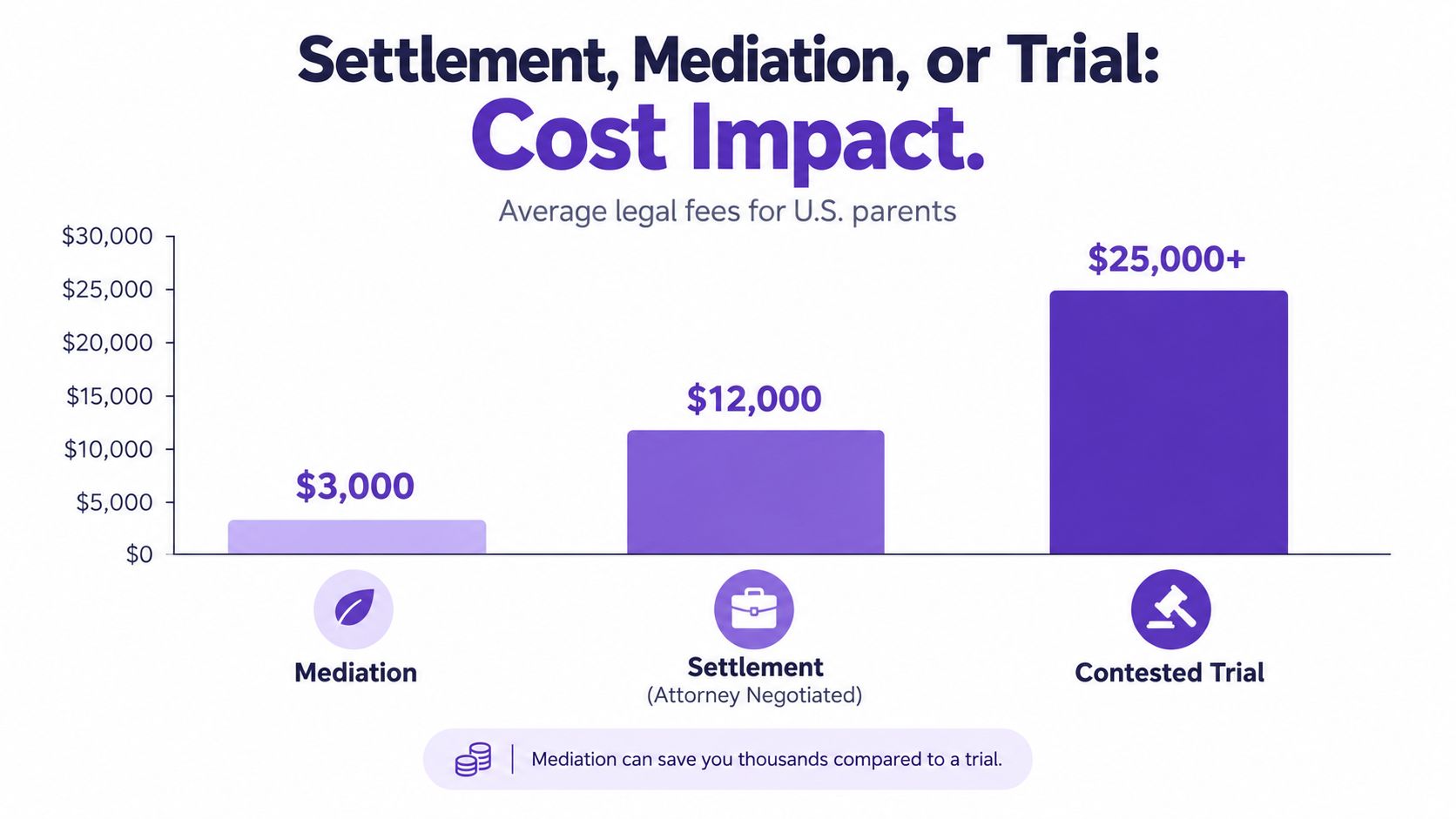
Ask, “How do you approach settlement?” A strong lawyer will explain how to protect your required terms while limiting disputes that add work without improving the parenting or financial result. Ask, “What would cause you to recommend trial?” The answer should connect trial preparation to safety, material financial disagreement, parenting risk, or an issue negotiation cannot resolve.
You can use Bornbir's guide to choosing a midwife as a reminder to judge communication by specific answers. Apply that standard directly to legal scenarios. Clear explanations matter more than polished introductions.
| Question | Lawyer A | Lawyer B |
|---|---|---|
| First recommended action | ||
| Settlement approach | ||
| Trial trigger | ||
| Day-to-day contact | ||
| Estimated scope | ||
| Major cost risks | ||
| Concerns or red flags |
Choose the lawyer whose explanation makes your next decisions clearer. Confidence helps. Clarity protects your time, money, and family. For more preparation, review how to choose a divorce attorney before comparing consultations.
Settlement, Mediation, or Trial and How Strategy Drives Cost
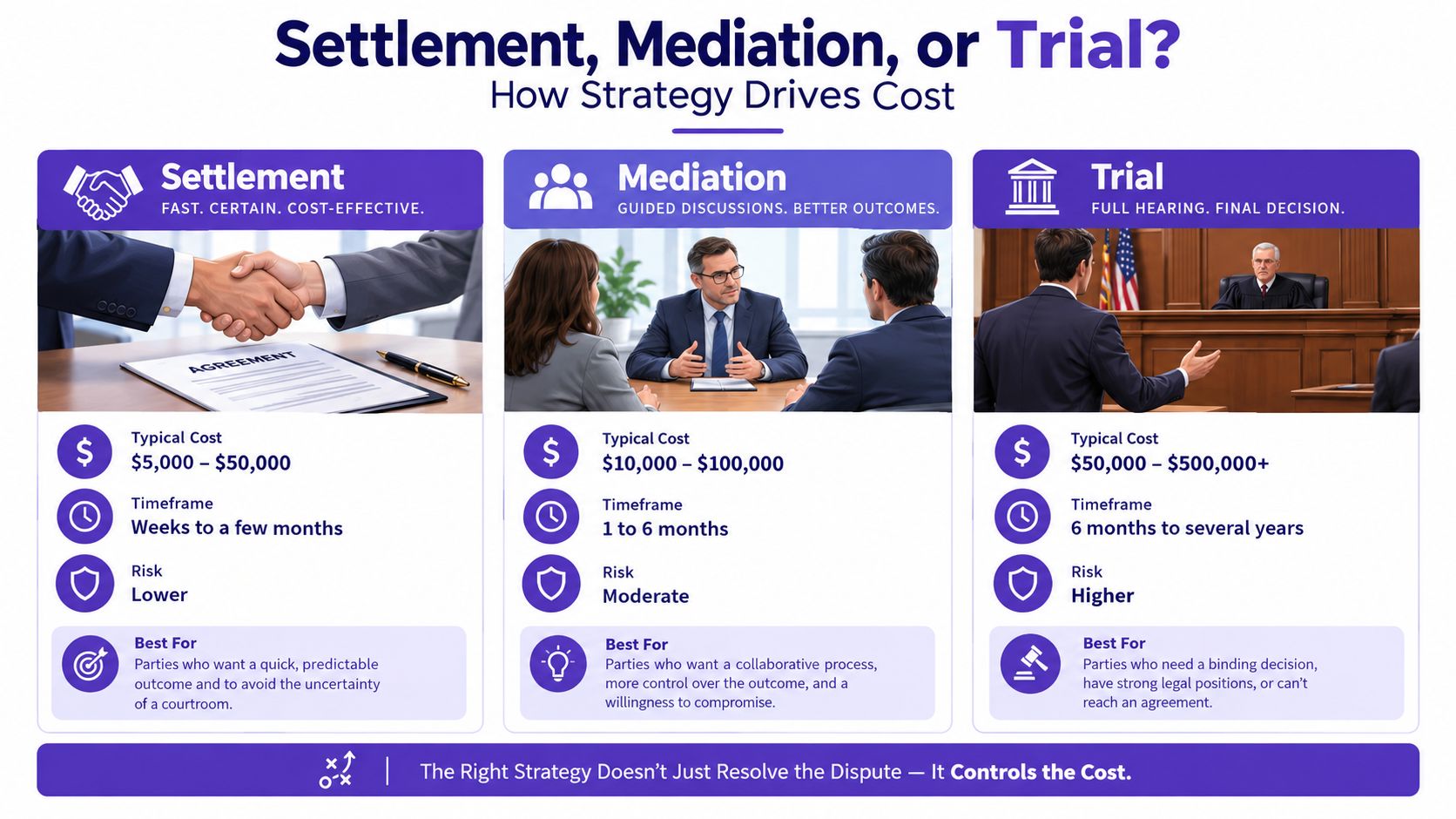
Your representation choice shapes the process, but the process also shapes the cost. A lawyer who treats every issue as a battle may increase work that doesn't improve your parenting plan or financial result. A lawyer who pushes settlement despite coercion, missing disclosures, or safety concerns may expose you to a worse problem.
A U.S. survey of 1,000 adults who recently completed divorces involving child custody found that cases settled in 86% of situations where both parents had attorneys, compared with 63% when only one parent had counsel. The median process costs were $18,000 for the two-attorney group and nearly $8,000 for the one-attorney group (the published divorce settlement research). These are observational results, not proof that hiring two lawyers causes settlement. More complex cases may be more likely to involve two attorneys.
The figures still offer a useful planning lesson. Representation can improve structure and negotiation, but more professional involvement can also cost more. The right question isn't “Which option is cheapest?” It's “Which option protects the issues that matter without creating avoidable work?”
Use a decision tree
Mediation may be a sensible starting point when both people can speak freely, disclose finances, negotiate without intimidation, and keep the children's needs separate from marital anger. Each person should still consider independent legal advice before signing a final agreement.
Limited-scope representation can fit when the facts are fairly organized and you can handle routine filing or communication. A lawyer might review a proposed parenting plan, explain support provisions, draft a settlement document, or prepare you for a hearing while you remain responsible for other tasks.
Full-scope counsel is the safer choice when you face hidden assets, business ownership, serious custody conflict, relocation, domestic violence, international assets, or a spouse who uses procedure to exhaust you. These cases can change quickly, and missed steps can affect more than the final judgment.
Trial preparation becomes necessary when negotiation can't resolve a material dispute or when the other party won't provide reliable information. Trial doesn't mean you must go to trial. It means your lawyer is preserving evidence and deadlines so settlement pressure doesn't leave you unprotected.
| Strategy | Settlement Likelihood | Typical Cost Range | Best Use Case |
|---|---|---|---|
| Mediation | Often suitable when both parties can negotiate safely and disclose information | Varies with mediator, preparation, and disputes | Cooperative cases with manageable financial and parenting issues |
| Attorney-negotiated settlement | Depends on cooperation, disclosure, and counsel's strategy | Varies with correspondence, drafting, and negotiation rounds | Cases needing legal structure without a trial |
| Contested trial | Settlement may occur before trial, but preparation is extensive | Varies widely with evidence, hearings, experts, and courtroom work | Safety, custody, financial, or procedural disputes that remain unresolved |
Ask every candidate to identify the likely path, the evidence needed, and the event that would trigger trial preparation. That answer tells you more than an “aggressive representation” slogan.
Special Considerations for Parents and Perinatal Timing
A lawyer who understands property division may still miss the practical realities of caring for an infant. If you're pregnant, recently gave birth, breastfeeding, or recovering from a difficult delivery, your parenting plan and litigation schedule need more careful design than a generic alternating-week arrangement.
Ask early about temporary orders. A temporary plan may address where the child stays, how parents exchange care, who pays household or child expenses, and how medical information is shared while the divorce continues. The plan should reflect the child's age, feeding needs, sleep patterns, childcare arrangements, and each parent's actual availability.
Parenting schedules need real-life detail
A newborn's needs can make broad promises about equal time impractical. The lawyer should help you discuss gradual transitions, daytime contact, overnights, transportation, illness, pumping or feeding logistics, and how the schedule will change as the child develops. The goal isn't to reward one parent or punish the other. It's to create terms people can follow safely and consistently.
Support calculations also need more than a headline income figure. Ask how the process handles childcare, health insurance, uncovered medical expenses, work-related care, and changes in income during leave or reduced work. If one parent owns a business or receives irregular compensation, the lawyer should explain what financial records may be necessary.
Safety and recovery change the legal plan
Domestic violence, coercive control, stalking, threats, or financial restriction can make mediation unsafe. Tell the lawyer what has happened, even if you're unsure whether it “counts.” Ask about secure communication, separate waiting areas, emergency orders, supervised exchanges, and protecting your address or contact details where permitted.
Pregnancy and postpartum recovery also affect your capacity. A lawyer should be willing to schedule communication around medical appointments, recovery, feeding, childcare, and sleep rather than treating every delay as a lack of cooperation. Legal advice can be paired with practical perinatal care with Bornbir, especially when you need support that a law office isn't designed to provide.

Before your consultation, gather:
- Parenting facts: Work schedules, childcare arrangements, feeding needs, medical appointments, and current routines.
- Financial records: Pay information, bank statements, debts, insurance, retirement accounts, and business documents.
- Safety information: Threatening messages, incident dates, police reports, protective orders, and safe contact methods.
- Timing limits: Birth plans, postpartum recovery, travel, work obligations, and court dates you already know about.
A lawyer who asks about these details is designing a workable case. A lawyer who talks only about winning property may not be equipped for your family's most immediate needs.
Red Flags, Timelines, and Your Next Steps
Some warning signs are easy to spot. Others appear as small gaps in the consultation that become expensive later.
Walk away from outcome promises. Under ABA Model Rule 1.5, fees must be reasonable, and domestic-relations fees generally can't be contingent on obtaining the divorce or the amount of alimony, support, or property settlement. A lawyer can discuss likely scenarios. They shouldn't guarantee custody, a specific financial result, or a fast ending.
Timelines follow local law
Your lawyer can prepare filings, service documents, settlement terms, and evidence. They usually can't erase statutory waiting periods. Utah requires at least 30 days between filing the petition and the judge signing the decree, unless the court grants a waiver under the applicable law (Utah Courts divorce guidance). California's court self-help guide says a divorce takes at least six months to finish. Those rules are different, and neither supports a universal promise about timing.
| Red Flag | What a Better Lawyer Does Instead |
|---|---|
| Guarantees a custody or money result | Explains possible outcomes, risks, and evidence |
| Pressures you to sign immediately | Gives you time to review scope and fees |
| Uses a vague engagement agreement | Lists tasks, exclusions, rates, expenses, and replenishment rules |
| Focuses only on the hourly rate | Explains staffing, expected work, and cost triggers |
| Won't identify the daily contact | Names who handles communication and court appearances |
| Pushes trial without a decision path | Separates negotiable issues from disputes needing litigation |
| Dismisses safety or postpartum concerns | Builds communication and parenting plans around real risks |
Take these steps this week
- Gather documents. Save financial records, parenting information, account details, relevant messages, and court papers in a secure location.
- Book two consultations. Choose lawyers with experience that matches your custody, financial, safety, and jurisdiction issues.
- Ask for written estimates. Request scope, staffing rates, billing intervals, retainer rules, expenses, and assumptions.
- Confirm daily responsibility. Find out who will answer questions, draft documents, negotiate, and appear in court.
- Protect your decision-making space. Don't sign because someone says the offer expires today. Review the agreement and ask questions.
Hiring a divorce attorney should leave you with a clearer plan, not a larger fog of promises and invoices. Choose the level of help that matches your risks, insist on written terms, and make sure the strategy works for the family life you'll still be managing during the case.
If you're pregnant, newly postpartum, or parenting through separation, use Bornbir to compare vetted doulas, midwives, lactation consultants, night nannies, and sleep coaches by services, availability, pricing, and reviews. Find practical support for the daily work your legal team can't provide at Bornbir.