
Lactation consulting offers one-on-one coaching for your unique feeding journey. It’s all about getting expert, hands-on support to help you and your baby find a comfortable rhythm, whether you're breastfeeding, pumping, or doing a little bit of both. Taking this step is incredibly common and a great way for parents to build confidence and work through any feeding challenges that pop up.
Your Guide to Lactation Support
Think of a lactation consultant as a supportive guide for one of the most important, and sometimes stressful, parts of early parenthood. Their main job is to provide evidence-based care and practical, real-world solutions. Instead of scrolling through forums at 3 AM trying to figure it all out, you get a partner who understands both the science and the emotions behind feeding your baby.
This kind of personalized support has become a go-to for parents looking for reliable information. In fact, the global market for lactation consulting services was valued at around $1.3 billion and is projected to hit $3.1 billion by 2033. That growth says a lot about how much families value getting professional guidance they can trust.
What Does a Lactation Consultant Do?
At its heart, a consultant's job is to help you meet your personal feeding goals, whatever they might be. They don't just zoom in on one thing; they look at the whole picture. This includes you, your baby, and your family's specific situation.
Their work usually involves:
- Assessing Latch and Positioning: A consultant will often watch a feeding to see how your baby is latching on. From there, they can suggest small adjustments that make a world of difference in your comfort and how much milk your baby gets.
- Creating a Care Plan: After listening to your concerns and goals, they'll work with you to create a personalized plan with clear, actionable steps you can start using right away. No guesswork involved.
- Providing Reassurance: Sometimes, you just need an expert to tell you that what you're going through is completely normal. A consultant offers that calm, reassuring presence that can quiet a lot of new-parent anxiety.
A great lactation consultant empowers you with the knowledge and tools you need to feed your baby confidently. The goal is always the same: a healthy parent and a thriving baby, supported by a plan that feels right for you.
For parents just getting started, understanding how milk production works is a fantastic first step. You might find our guide on the fundamentals of lactating helpful for more background.
This supportive, hands-on approach leads to so many positive outcomes for families. Here's a quick look at the main benefits you can expect when you bring in a professional.
Core Benefits of Lactation Consulting at a Glance
Working with a lactation consultant can turn a stressful experience into a positive one by offering targeted, expert help exactly when you need it. This table breaks down the key ways they support families.
| Area of Support | How a Consultant Helps | Typical Outcome |
|---|---|---|
| Latch & Comfort | Observes feeding and suggests gentle adjustments. | Pain-free feeding sessions for you and more effective milk intake for baby. |
| Milk Supply | Creates a plan to increase or manage milk production. | Confidence in your milk supply and a well-fed, growing baby. |
| Feeding Challenges | Troubleshoots issues like slow weight gain or fussiness. | Clear solutions to specific problems and less stress for the family. |
Ultimately, this support system is designed to help you navigate feeding with less worry and more joy, ensuring both you and your baby get off to the best possible start.
Common Signs You May Need Feeding Support
Deciding you might need a little extra help with feeding your baby is a sign of incredible strength, not failure. So many parents hit bumps in the road, and knowing what to look for can help you get support before small issues turn into major sources of stress. Think of these signs as friendly nudges letting you know that professional guidance is right there when you need it.
It’s easy to feel like you're the only one struggling, but feeding challenges are unbelievably common. A lactation consultant is trained to help you work through these exact situations with practical, supportive advice.
Pain and Discomfort During Feedings
One of the most immediate signs that you might need support is physical pain. While some initial tenderness can be normal as your body adjusts, persistent pain is not. It’s your body’s way of telling you something isn’t quite right.
If you’re experiencing any of the following, it’s a good idea to seek help:
- Sore, Cracked, or Bleeding Nipples: This often points to a shallow latch, where the baby isn't taking enough of the breast into their mouth.
- Pinching or Biting Sensations: A correct latch should feel like a gentle tug or pull, never a sharp pinch. That's a huge red flag.
- Breast Pain or Engorgement: Some fullness is expected, but breasts that feel hard, hot, or painful to the touch might signal a deeper issue like a clogged duct or even an infection.
A consultant can quickly assess the latch and suggest positioning changes that can bring immediate relief, sometimes in the very first session.
Concerns About Your Baby’s Health
Your baby’s health and happiness are everything, and certain behaviors or physical signs can indicate they aren't getting enough milk. It's so easy to worry about every little thing, so knowing the key indicators is helpful.
Keep an eye out for these signals:
- Poor Weight Gain: Your pediatrician will track your baby’s weight, but if they aren't back to their birth weight within about two weeks or their growth curve has flattened, it’s a clear sign to get a feeding assessment.
- Infrequent Wet or Dirty Diapers: A well-fed newborn should have a predictable number of wet and poopy diapers each day. If your baby isn't meeting those minimums, it could mean they need more milk.
- Constant Fussiness or Lethargy: A baby who is always crying and seems unsatisfied after feedings, or one who is overly sleepy and hard to wake for feeds, might be struggling to get what they need.
You know your baby best. If your gut tells you something is off with their feeding patterns or general contentment, trust that instinct. Seeking out lactation consulting is a powerful, proactive step.
Many parents also worry about their milk production. If you're concerned, you can learn more about the common causes of low milk supply and how an expert can help you create a plan to address it.
Navigating Special Circumstances
Sometimes, your family’s unique situation calls for specialized support right from the start. Certain circumstances can make feeding more complex, but a consultant has the experience to guide you through them.
Consider reaching out for support if you are:
- Feeding a Premature Baby: Preemies often have a weaker suck and get tired more easily, requiring specific strategies to ensure they get enough nutrition.
- Managing Multiples: Feeding twins or triplets comes with its own logistical hurdles. A consultant can help you find a sustainable routine for tandem feeding or a combination approach that works for your family.
- Recovering from a C-Section: The recovery from major surgery can make certain feeding positions really uncomfortable. A consultant can show you comfortable ways to hold your baby that protect your incision.
- Dealing with a History of Breast Surgery: Past surgeries can sometimes impact milk production or ductal systems, making an expert assessment incredibly valuable.
No matter the reason, reaching out for support is about giving yourself and your baby the best possible start. A lactation consultant provides a personalized roadmap, helping you feel confident and in control of your feeding journey.
Navigating the Different Types of Lactation Support
When you start looking for feeding help, you'll quickly run into a bunch of different acronyms. It can feel a little confusing at first, but figuring out who's who makes it much easier to find the right person for your specific needs. Not all lactation support professionals have the same level of training or can tackle the same types of challenges.
Think of it like this: If you have a simple question about a workout, you might ask a knowledgeable friend at the gym. For a structured fitness plan, you'd hire a personal trainer. But for a complex injury, you'd need to see a physical therapist. Each one offers valuable support, but their expertise and scope are worlds apart.
The Gold Standard: IBCLC
The highest level of certification in this field belongs to the IBCLC, which stands for International Board Certified Lactation Consultant. An IBCLC is a healthcare professional who has gone through extensive training and logged thousands of hours of hands-on clinical experience. They're certified by an international board and have to recertify every five years to prove they're up-to-date.
Because of this deep clinical background, IBCLCs are equipped to handle the full spectrum of feeding issues, from the straightforward to the medically complex.
They are the specialists you’d want to see for challenges like:
- Diagnosing and managing a low milk supply.
- Helping babies with significant weight gain struggles.
- Supporting parents with a history of breast surgery or hormonal conditions.
- Assisting babies with anatomical issues like tongue-ties.
Their rigorous training means they can work in hospitals, clinics, and private practice, often collaborating directly with pediatricians and other medical providers. This makes them the go-to for situations that need a deeper, clinical level of expertise.
This simple decision tree can be a good starting point for thinking about whether support could be helpful for you.
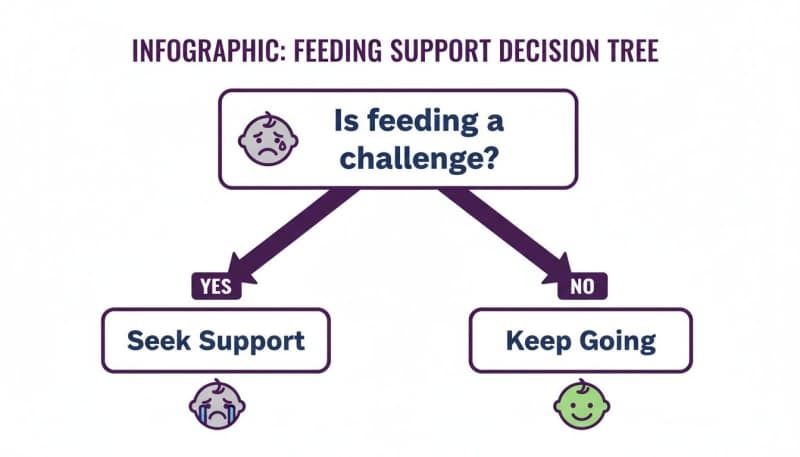
The key takeaway is that just acknowledging a challenge is the first step toward finding a solution and getting the support you deserve.
Other Valuable Support Professionals
Beyond the IBCLC, you’ll find other wonderful professionals who provide essential support. A CLC, or Certified Lactation Counselor, is another common credential you'll see. CLCs complete a certification program that gives them the skills to provide education and support for common breastfeeding issues.
Think of a CLC as a foundational support expert. They are fantastic for helping with positioning, establishing a good latch with a healthy newborn, and providing encouragement and education to new parents.
While CLCs are incredibly valuable, their training isn't as clinically intensive as an IBCLC's. They are perfectly suited to help families get off to a good start and navigate typical challenges. However, they will almost always refer clients to an IBCLC if a more complex medical issue pops up. If you're looking for a deeper comparison, our article on choosing between a CLC or IBCLC breaks it down even further.
You may also come across peer counselors, like those from La Leche League or WIC. These are often parents who have breastfed their own children and have received training to offer mother-to-mother support. They are a wonderful source of community, encouragement, and shared experience, especially for common questions and day-to-day concerns.
Comparing Lactation Support Professionals
Choosing the right professional really just depends on your situation. A parent facing a medical challenge with their premature baby has different needs than a parent with a healthy newborn who just wants to double-check their latch.
This table breaks down the main differences to help you decide.
| Credential | Training & Scope | Best For |
|---|---|---|
| IBCLC | Thousands of clinical hours and a rigorous board exam. Can manage complex medical feeding issues. | Medically complex situations, significant weight gain concerns, or unresolved feeding pain. |
| CLC | A specialized training course and certification exam. Focuses on common challenges and education. | Getting started, basic latch and positioning help, and general feeding education and support. |
| Peer Counselor | Personal experience plus organization-specific training. Offers community and encouragement. | Emotional support, community connection, and answers to common, non-medical feeding questions. |
Ultimately, the goal is to build a support team that makes you feel confident and cared for. Knowing who to call for different levels of support ensures you get the most effective help right when you need it most.
What Happens During a Lactation Consultation?
The idea of a lactation consultation can feel a little intimidating, especially the first time. You might be picturing a formal, clinical appointment, or maybe you're just nervous about someone watching you feed your baby. But the reality is so much warmer and more supportive than that.
Think of your consultant as a detective and a coach rolled into one. Their job isn’t to judge you. It’s to work with you to figure out what’s going on and build a plan that actually helps. It's a collaborative session focused entirely on you, your baby, and your goals.
Starting the Conversation
The first thing you’ll do, whether in person or online, is just talk. Your consultant needs to understand your whole story to connect the dots, so expect them to ask a lot of questions. This isn't just small talk; it's the foundation for the entire visit.
You’ll likely cover topics like:
- Your Health History: Things about your pregnancy, the birth itself, and any health conditions that might play a role in lactation.
- Your Baby’s History: They’ll ask about your baby’s birth weight, how they’ve been gaining, and yes, even their diaper output (it’s a key piece of the puzzle!).
- Your Feeding Journey So Far: This is your chance to share. What’s been hard? What’s working? And most importantly, what are your goals for feeding your baby?
This conversation helps the consultant see the big picture and understand what brought you here today.
The Feeding Observation
Next up is the part that most parents feel a little anxious about: watching you feed your baby. Try to relax. This is a judgment-free zone, and its only purpose is to gather information. It’s like a mechanic listening to an engine. They need to see it in action to diagnose the problem.
Your consultant is looking for tiny clues. They’ll watch how your baby latches on, how you're positioned, and whether milk is actually transferring. They’re listening for swallows and paying attention to your baby’s cues to see if they seem comfortable and satisfied or frustrated and struggling.
One of the most powerful tools in an in-person consultation is the weighted feed. The consultant uses a hyper-sensitive infant scale to weigh your baby just before and immediately after a feeding. This gives you concrete, undeniable data on exactly how much milk your baby took in.
This single step can turn frustrating guesswork into clear, actionable information.
Gentle Physical Assessments
With your permission, the consultant will also likely do a quick, gentle assessment of both you and your baby. This helps them understand the physical side of the equation.
For you, they might:
- Look at your breasts for any signs of swelling, clogged ducts, or other issues.
- Check your nipples for signs of damage, which often points to a latch problem.
For your baby, they will:
- Gently check inside their mouth to assess their palate, tongue movement, and how they suck. This is how they can spot physical issues, like a potential tongue-tie, that might be getting in the way.
- Observe your baby’s overall muscle tone and condition.
These painless checks provide the final pieces of the puzzle needed to create a plan that works.
Creating Your Personalized Care Plan
At the end of the visit, everything comes together. Your consultant won’t just send you off with a vague "try this." They’ll sit down with you and create a clear, personalized care plan with specific, actionable steps.
This written plan becomes your roadmap. It will spell out any new positions to try, tweaks to your latch technique, or changes to your feeding or pumping schedule. You'll leave knowing exactly what to focus on over the next few days.
And the support doesn't stop when you walk out the door. Your consultant will explain how they'll follow up. This might be a phone call, a secure message, or another visit, to see how things are going. Having that ongoing backup can make all the difference as you start putting your new plan into practice.
How to Find the Right Lactation Consultant
Knowing you need help is one thing, but finding the right person to provide it can feel like a daunting task, especially when you're already exhausted. You’re looking for someone with serious skills who you also feel completely comfortable with during a very vulnerable time.
A great consultant becomes a trusted member of your support team, so it’s worth taking a little time to find a great fit for your family. Think of it less like a formal interview and more like a conversation to see if you click.
Where to Start Your Search
The good news is, you don’t have to rely on a random Google search and hope for the best. Many trusted sources can point you toward vetted, experienced professionals in your area.
Here are some of the best places to begin your hunt:
- Your Pediatrician or OB-GYN: Your doctors are on the front lines and often have a go-to list of lactation consultants they know and trust. They've seen their work firsthand.
- Hospital Referrals: The hospital where you delivered is another fantastic resource. Many have IBCLCs on staff or keep a curated list of recommended providers for new parents.
- Trusted Online Directories: Modern platforms like Bornbir are specifically designed to connect parents with vetted perinatal professionals, including top-notch lactation consultants. You can easily compare providers, read real parent reviews, and find someone whose specialty matches your needs.
- Word-of-Mouth: This is huge. Ask friends, family members, or people in your local parent groups for recommendations. A personal referral is powerful because it comes with a real story and firsthand experience.
The goal is to find someone whose approach and personality make you feel comfortable and supported. A good personal connection is just as important as impressive credentials, so trust your gut.
Key Questions to Ask a Potential Consultant
Once you have a few names, it's a great idea to have a quick chat before booking a full session. This is your chance to get a feel for their style and make sure they’re the right person to help with your specific situation.
Think of it as a mini-consult to ensure your goals align with their expertise.
Here are some essential questions to have in your back pocket:
- What are your credentials? Confirm if they are an IBCLC, CLC, or another type of professional. This helps you understand their level of training and whether it fits your needs.
- What is your experience with [your specific concern]? If you’re dealing with low milk supply, a premature baby, tongue ties, or a history of breast surgery, ask if they have deep experience in that area.
- What is your general feeding philosophy? You want a consultant who will support your goals, whether that's exclusive breastfeeding, combo-feeding with formula, or exclusive pumping. There's no room for judgment here.
- What does a typical consultation with you look like? This will give you a clear picture of what to expect during the visit and help you prepare.
- How do you handle follow-up support? This is a big one. Ask if texts or phone calls are included in the initial fee or if follow-up visits are a separate service. Knowing you can reach out with questions later is so reassuring.
- What are your fees, and do you accept insurance? Get the money talk out of the way upfront. If they don’t bill insurance directly, ask if they provide a superbill you can submit for reimbursement.
For a more detailed walkthrough, our guide on how to find a lactation consultant offers even more tips to help you in your search.
Taking the time to ask these questions will help you feel confident that you’re investing in the right support for your family's unique journey.
Frequently Asked Questions About Lactation Consulting
Even after you've decided to get help, a lot of practical questions can pop up. Getting those answered upfront helps you move forward with confidence. Here are the straight answers to the questions we hear all the time from parents just like you.
How Much Do Lactation Consultants Cost and Is It Covered by Insurance?
The cost for a lactation consultant can really vary. It depends on where you live, the consultant's specific credentials, and whether you're meeting in person or online. You can expect a single visit to run anywhere from $100 to over $400.
The good news? Under the Affordable Care Act (ACA), many U.S. insurance plans are required to cover lactation support. But the details can be a little tricky. Your best bet is to call your insurance provider directly and ask specifically about your "preventive lactation counseling benefits."
Make sure you confirm a few key things:
- Do they cover visits with an IBCLC specifically?
- How many visits does your plan include?
- Do you need to get pre-authorization before your appointment?
If your consultant doesn't bill insurance directly, ask them for a superbill. This is just a detailed receipt you can send to your insurance company yourself to get reimbursed. Digging into whether your HSA can cover lactation consultants is another great way to get a handle on the financial side of things.
What Is the Difference Between Virtual and In-Person Support?
The biggest difference boils down to the hands-on element. During an in-person visit, a consultant can physically help you and your baby get into a better position, and they can do a physical check of your baby’s mouth for things like a tongue-tie. They can also use a highly sensitive scale for a "weighted feed" to see exactly how much milk your baby is transferring.
This makes an in-person visit the gold standard for tackling more complex latch problems or milk supply concerns.
A virtual consultation, on the other hand, is incredibly convenient. They are fantastic for follow-up appointments, doing a quick visual check on your latch, and helping you create or tweak your feeding plan without you having to leave the house.
A skilled virtual consultant can see a surprising amount over video and provide amazing guidance. They just can't do the physical assessments that an in-person visit allows for. Many families end up loving a hybrid approach: an initial in-person visit to sort out the big stuff, followed by virtual check-ins for ongoing support.
When Is the Best Time to See a Lactation Consultant?
Honestly, you can reach out at any point. It is never too early or too late to get the support you need. Some parents even schedule a prenatal visit to get their questions answered and feel more prepared before the baby even arrives.
The most popular time for a first visit is within the first few weeks after birth. This is usually when feeding challenges start to show up as you and your baby are figuring things out together.
But lactation consultants can also be a huge help with issues that come up months down the road, like getting ready to go back to work and pump, dealing with a sudden nursing strike, or navigating the emotional process of weaning. The right time to get help is whenever you feel like you need it.
What if My Goal Is Not Exclusive Breastfeeding?
A great lactation consultant supports your feeding goals, whatever they are. Their job is to help you feed your baby in a way that feels sustainable and joyful for your family, not to push one specific method.
If your plan is to combo-feed with formula, exclusively pump, or do something in between, a consultant will give you the tools and information to do it successfully. They can show you how to protect your milk supply while supplementing or help you map out a pumping schedule that actually fits your life.
Their focus is on a healthy, happy parent and a thriving baby, not on a rigid definition of success. They are there to support you. And as you're getting your home ready, you might also be interested in finding the best baby safe cleaning products to create the healthiest environment for your little one.
Finding the right support shouldn't be another source of stress. At Bornbir, we connect you with thousands of vetted doulas, lactation consultants, and postpartum professionals. Compare providers, read real parent reviews, and find the perfect match for your family in minutes.