
A nature print above the crib can make a nursery feel calmer at dusk. In the family room, a botanical piece can give the sofa wall a sense of order while toys, books, and laundry compete for attention. Parents usually start by asking whether the colors work. The better question is whether the artwork is safe, durable, easy to clean, and suited to the way the room is typically used.
Nature wall art can do more than fill an empty wall. It can act as a biophilic design choice, bringing visual references to trees, water, leaves, wildlife, or natural patterns into rooms where a real outdoor view isn't available. That doesn't make every fern print a wellness product. The material, placement, light, humidity, and maintenance still matter.
This guide covers size, sightlines, framing, material safety, toxicity questions, cleaning, and sourcing. You'll finish with practical rules for choosing artwork that can live with children, not just look good in a styled photograph.
Setting the Scene for Nature Wall Art at Home
Consider a nursery with a pale forest print on the wall opposite the changing table. The baby can't understand the picture, but the adults can. That quiet visual field gives tired parents something less chaotic to look at during feeds, and it helps the room feel intentional without relying on loud characters or intense color.
A family room needs a different solution. A large botanical composition above the sofa can anchor the seating area, while a small framed print may disappear beside a wide piece of furniture. The right choice depends on the wall, the viewing distance, and the likelihood of a toy, sticky hand, or curious toddler reaching it.
Practical rule: Choose nature wall art for the room's daily behavior, not for an imaginary version of the room.
The appeal of nature imagery is understandable. An outdoor scene can suggest open space, a woodland view can create visual softness, and a simple botanical line drawing can add interest without making the room feel busy. Parents looking for ways to how to calm fussy baby may also be thinking about the whole sensory environment, including lighting, sound, color, and what the baby sees during quiet periods.
That doesn't mean a print will make a baby sleep or guarantee a calmer household. The evidence behind biophilic design concerns broader environments, not every individual artwork. A global study of 7,600 office workers across 16 countries found that employees exposed to natural elements reported well-being levels 15% higher than employees without that exposure, as summarized in this biophilic design workplace review. The finding supports the relevance of nature cues, but it doesn't prove that one framed print produces the same result at home.
Parents therefore need more than style inspiration. Before buying, decide:
- What the room needs: Calm visual interest, a focal point, or a personal connection to a place.
- Who can reach it: Infants, toddlers, pets, and visiting children change the safety requirements.
- What the wall can tolerate: Humidity, sunlight, cooking residue, and frequent cleaning all affect the artwork.
- How permanent it should be: A nursery may need flexible pieces that can move as the child grows.
Nature wall art is worth choosing when it solves a real design problem and meets the room's practical limits. The recommendations below focus on those limits, so you can make a clear decision instead of collecting vague inspiration.
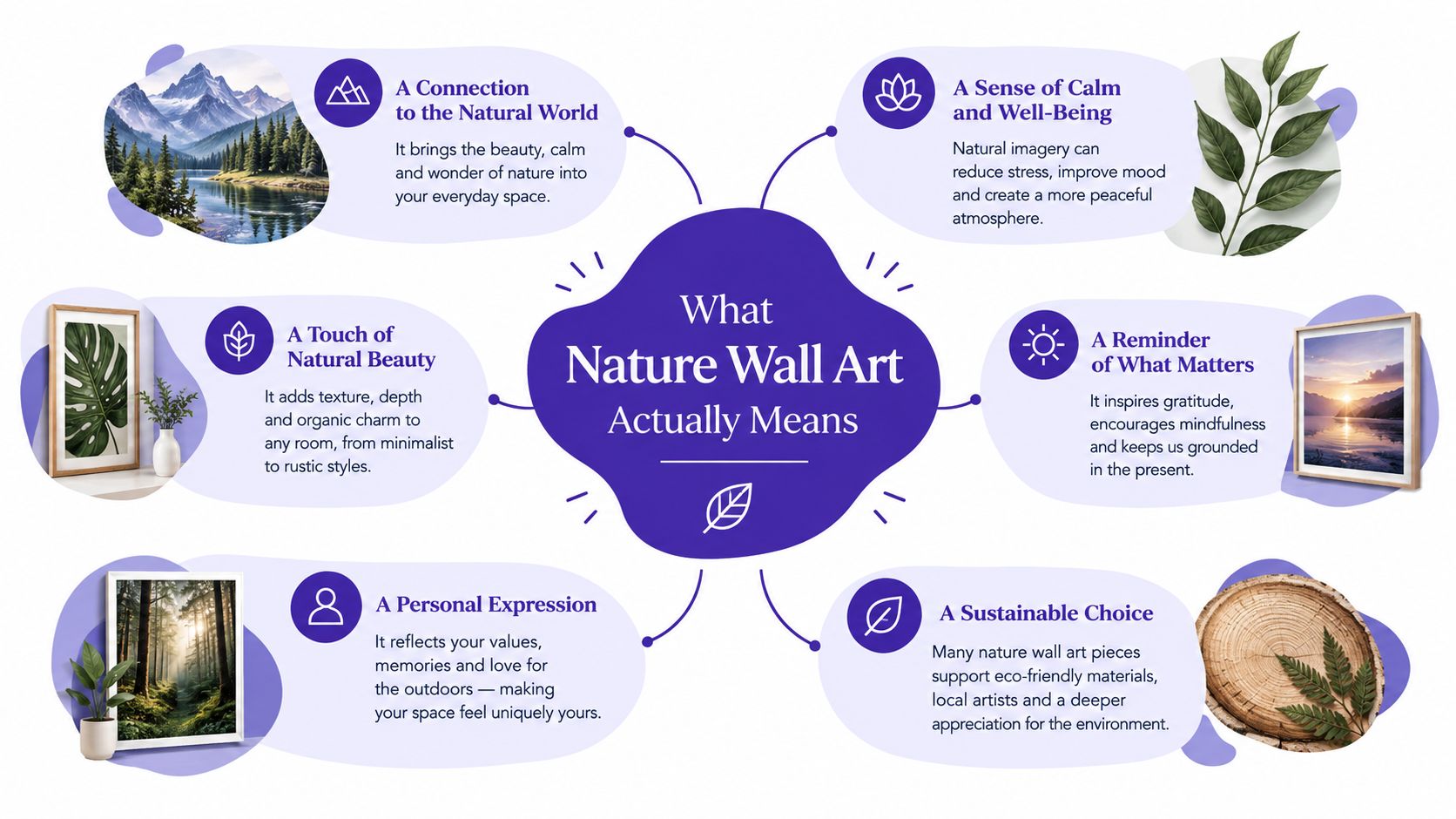
What Nature Wall Art Actually Means
Think of nature wall art as planting a view you can't visit every day. It may show a misty forest, a close-up leaf, a shoreline, an animal, or an organic pattern. It may also use wood, pressed plant material, moss, or another natural texture. The common thread is a visible or tactile connection to the natural world.
This fits within biophilic design, a broader approach that uses nature, representations of nature, and natural patterns in interiors. A framed scene isn't the same as a window. A preserved moss panel isn't the same as a living wall. Still, both can change the visual character of a room and give occupants a nature reference where real greenery or an outdoor view isn't practical.
The main formats are easy to separate:
- Photographic nature scenes create depth and can work like a visual window.
- Botanical illustrations and pressed specimens bring detail and a quieter, more collected feel.
- Abstract organic art uses curves, water-like movement, stone shapes, or plant-inspired forms without showing a literal scene.
- Wildlife pieces add personality and often become a conversation point.
- Natural-material work uses wood relief, preserved botanicals, moss, fibers, or other tactile elements.
A living wall belongs in a separate category. It includes real plants, irrigation, drainage, light requirements, and ongoing maintenance. In one monitored office-building comparison, corridors with an indoor living-wall system had 12% to 17% lower CO₂ concentrations and 8% to 14% lower PM2.5 concentrations than corridors without the system. Relative humidity increased by approximately 3.1% to 6.4%, while the average temperature difference was only 0.13°C, according to this study of indoor living walls. Those results support treating a living wall as a supplementary feature, not as a replacement for ventilation or filtration.
Parents should also separate emotional value from health claims. A gentle image may feel calming because of its color, subject, or personal meaning. That response is real for the person experiencing it, but it isn't a guaranteed medical or productivity effect. Broader evidence gives nature-inspired interiors a credible design rationale. It doesn't turn every green-themed product into a wellness intervention.
A controlled office-planting study found significant changes after plants were introduced into individual offices and breakout spaces, including perceived attention with p = 0.018, creativity with p = 0.019, and productivity with p = 0.023. Removing plants was associated with higher perceived stress with p = 0.008 and lower attention, efficiency, and productivity, as reported in this office-planting study. Because that research concerns real plants and workplace settings, use it as context, not as proof that a nursery print will create the same outcome.
Style Categories Worth Knowing
The best style is the one that matches the room's energy and the amount of visual noise already present. A family room with patterned rugs and colorful toys usually benefits from quieter artwork. A plain nursery may handle a stronger botanical or animal piece, provided the colors aren't too intense for the space.
| Style | Mood | Best Room Fit | Watch Out For |
|---|---|---|---|
| Photographic landscapes | Open, calm, spacious | Family rooms, bedrooms, wide sofa walls | A realistic scene can feel generic if it has no personal meaning |
| Botanical and floral prints | Gentle, collected, detail-rich | Nurseries, bedrooms, reading corners | Dense leaves or strong contrast can overwhelm a small wall |
| Abstract organic art | Soft, modern, flexible | Family rooms, home offices, shared spaces | The shapes are easy to like but can be harder to coordinate with other patterns |
| Wildlife and animal pieces | Playful, personal, characterful | Playrooms, kitchens, family rooms | A large face or dramatic animal may dominate a quiet nursery |
| Textured natural-material works | Tactile, warm, handmade | Adult spaces, entryways, supervised family areas | Fibers, moss, and loose specimens need more careful maintenance |
Photographic nature scenes are the safest starting point for parents who want a calm focal point. A forest, shoreline, or mountain view can sit comfortably with many furniture styles. The trade-off is individuality. A widely used piece may look polished but fail to say anything about your family or the room.
Botanical prints are more intimate. A restrained fern study or pressed-flower composition can suit a nursery without leaning into a childish theme. Choose fewer, larger shapes rather than a crowded arrangement if the wall is narrow. Bold leaves can add personality, but they need breathing room.
Abstract organic art works well when you don't want a literal forest or animal. Curves, layered forms, and muted earth colors can echo nature without dictating a theme. This is the most forgiving category for a changing home, although matching an abstract palette to existing furniture takes more judgment.
Wildlife art belongs where personality is welcome. A bird, rabbit, deer, or friendly farm animal can make a playroom or family room feel distinct. Keep highly dramatic or visually dark pieces away from a sleep area if your goal is a soft bedtime atmosphere.
Textured works deserve the closest inspection. A wood relief or carefully framed pressed specimen can feel special, but it may have more edges, dust traps, and maintenance needs than a sealed print. If you're choosing a present for a growing family, the same practical questions apply when comparing art with the best gifts for new moms and dads.
Choose the most literal style when you want a clear subject. Choose abstract organic art when you want flexibility. Choose natural materials only when you're prepared to care for them.
My rule is simple. Start with the room's sensory level, then choose the subject. Quiet room, expressive artwork. Busy room, restrained artwork. If the piece will hang within a child's reach, prioritize a sturdy, cleanable surface over fragile texture.
Sizing and Placement That Actually Works
A simple sizing rule prevents most disappointing purchases. Aim for artwork that covers about two-thirds to three-quarters of the empty wall area above furniture or within a defined wall zone. A tiny print above a large sofa looks accidental, while an oversized piece squeezed between windows can make the room feel crowded.
For general standing-eye viewing, center the artwork roughly 57 inches from the floor. That measurement isn't a law for every home. Nursery sightlines are lower because parents and babies spend time sitting, feeding, changing, or lying down. In those rooms, a center point around 40 to 48 inches can make more sense, as long as the installation remains safely out of reach.
Above a crib, don't treat the wall as a normal gallery zone. Avoid heavy frames, glass, thick wood, stone, loose botanicals, and anything with detachable pieces. The safest artwork is light, securely fixed, and positioned where neither the child nor bedding can reach it. Parents should also follow the wider principles in this guide to blackout curtains for infants, especially when coordinating wall art with window coverings and sleep-area sightlines.
Use these placement checks before drilling:
- Mark the furniture: Measure the sofa, dresser, or changing table and use painter's tape to outline the artwork.
- Test the viewing height: Sit where the child or parent will spend time, then adjust the center point to the actual sightline.
- Leave visual breathing room: Grouped frames need consistent gaps. Tight spacing makes separate pieces read as one cluttered block.
- Check reach and climbing routes: Don't place tall work above furniture that a toddler can use as a step.
- Inspect doors and windows: A frame that collides with a door, curtain, or blind won't stay secure or look balanced.

Family rooms often need a larger piece or a carefully spaced set to balance a sofa and nearby windows. Nurseries usually benefit from one clear focal point rather than a busy gallery wall. The common mistakes are predictable: artwork that's too small for the wall, pieces hung too high above a sofa, and groupings so tight that they look like a single messy shape.
How Galleryy Can Help
Galleryy is an online art marketplace where buyers can purchase original art, prints, and wall art directly from independent artists. Its catalog includes millions of indexed and searchable artworks across painting, photography, sculpture, digital art, and other formats. For a parent searching for a specific combination, such as a muted botanical print in a narrow size, that breadth can be more useful than browsing a small décor collection.
The platform lets shoppers search by subject, style, medium, color, dimensions, availability, and budget. Its AI wall-scan tool adds a more practical layer. You can photograph a wall or room, then receive recommendations matched to the wall color, décor style, available dimensions, and space. A room visualizer and augmented-reality preview can show a piece framed and hung at true scale before you commit.

That matters when the problem isn't finding attractive art. It's avoiding a piece that's wrong for the wall. Personalized feeds, curated collections, artist profiles, and virtual three-dimensional exhibitions can also help you move from generic leaf imagery toward work with a real creator and a clear material description.
Galleryy is a good choice when you want to compare independent artists, original work, limited-edition prints, and framing options in one browser-based marketplace. It also addresses trust concerns through buyer protection, secure checkout, worldwide shipping, transparent artist payouts, and artist profiles with biographies and studio information. Buyers should still read the specific listing carefully, confirm glazing and mounting details, and check return terms before ordering.
For a focused starting point, shop nature wall art on Galleryy after measuring the wall. Use the filters for dimensions and medium first, then judge the image. That order prevents you from falling in love with a piece that can't be installed safely or balanced properly.
Materials, Durability, and What Holds Up
Parents should choose the surface before choosing the frame color. Paper, canvas, wood, acrylic, metal, and living materials behave differently around fingerprints, humidity, sunlight, dust, and toys.
| Material | Durability | Fade Resistance | Cleaning | Best Room |
|---|---|---|---|---|
| Archival or matte paper print | Protected when framed, vulnerable at exposed edges | Needs light control and suitable glazing | Clean the glazing, not the paper | Nursery or bedroom |
| Canvas wrap or stretched canvas | Soft surface can tolerate normal room use but can dent or mark | Depends on inks, coating, and light exposure | Dust gently, spot-clean carefully | Family room or home office |
| Wood panel | Sturdy and tactile, but responds to humidity | Finish and pigment determine performance | Dry dusting is safest | Family room or supervised play area |
| Framed acrylic | Light and practical, though it can scratch and show fingerprints | Depends on the print and glazing | Use a soft cloth and gentle cleaner | Nursery and busy family spaces |
| Moss or preserved botanicals | Delicate and maintenance-sensitive | Can discolor under strong light | Dust carefully, avoid wet cleaning | Dry, stable, supervised areas |
Paper prints offer the widest range of botanical illustrations, photographs, and vintage-style work. Archival or matte stock reduces glare, but paper still needs protection. Art UK recommends keeping light levels for works on paper at no more than 50 to 80 lux, because light can bleach pigments and discolor paper, as explained in its preventive conservation guidance. Use acrylic glazing in a nursery if breakage is a concern.
Canvas has a softer, more forgiving look and works well at larger sizes. It can suit a family room where the artwork sits farther from small hands. It isn't indestructible. A thrown toy can mark the surface, and cleaning a textured canvas is less straightforward than wiping a smooth glazing panel.
Wood panels feel substantial, but organic materials respond to humidity. Framed acrylic is usually the most practical nursery combination because it reduces breakage risk and makes surface cleaning easier. Ask about the print coating and mounting method rather than assuming every acrylic-faced product has the same performance.
Living elements need the most caution. Preserved moss and botanicals can provide genuine texture, but they need stable conditions and should stay away from damp rooms, direct sun, and areas where children can pull at them. Conservation guidance warns that relative humidity above 65% increases the risk of mold, mildew, and pests, while paper, canvas, wood, and other organic materials expand and contract as humidity changes. The care guidance for paintings and frames supports using stable conditions, indirect light, and appropriate framing.
For canvas or wood artwork, the Canadian Conservation Institute identifies 40% to 60% relative humidity as the safest stable range for paintings. It also advises avoiding locations near air vents, radiators, and exterior walls, as described in its environmental display guidelines. In practical terms, don't put fragile nature art beside a radiator just because the wall is empty.
Safety, Non-Toxic Choices, and Smart Placement
A nursery wall should pass two separate tests. The artwork must be safe to touch, and it must be safe if the child eventually pulls, climbs, or throws something at it. Parents often focus on inks and overlook the frame, fasteners, weight, and detachable decoration.
Ask sellers for clear material information:
- Print process: Look for non-toxic inks, water-based pigments, or soy and water-based printing processes when those options are available.
- Material documentation: Ask what the paper, backing board, adhesive, coating, and frame finish contain.
- Art-material compliance: Sellers may be able to provide information about ASTM D4236 compliance for art materials. Treat a vague “eco-friendly” label as a prompt for more questions, not as proof of safety.
- Frame sourcing: FSC-certified wood is a useful sourcing question if you want wood from a more responsible forestry system.
- Installation hardware: Confirm the weight, fixing type, and whether the mount is appropriate for drywall, masonry, or a stud.
Avoid ordinary glass directly above a crib or in a high-impact play zone. Acrylic glazing is lighter and won't shatter like glass, although it can scratch and may attract fingerprints. Heavy frames should be anchored into studs where possible, or fixed with hardware rated for the wall and load. Adhesive strips can help with light décor in suitable conditions, but they shouldn't be your only safety plan for heavy or valuable work.
Nursery standard: If you wouldn't want the object landing near a sleeping child, don't hang it above the crib.
Use a room-by-room check:
- Crib zone: Choose light, securely fixed work with acrylic glazing or a protected, frameless surface. Keep heavy wood, stone, driftwood, thick shadow boxes, and loose specimens elsewhere.
- Changing area: Put art outside the reach of a child who can twist, grab, or kick. Select a surface that can be dusted without disturbing the mount.
- Family room: Anchor frames near sofas and play areas. Keep climbing furniture away from tall pieces and picture ledges.
- Kitchen: Avoid unsealed paper and delicate botanicals near steam, grease, and splashes. Metal or sealed glazing is easier to manage.
- Bathroom: Treat the room as a humidity challenge. Use sealed construction, keep paper away from direct moisture, and don't assume preserved plant material belongs there.
For broader sleep-area planning, use this practical safe sleep for infants as a companion resource. Nature wall art should support the room without becoming part of the sleep hazard.
Framing, Hanging, and Display Options
Framing changes how the artwork survives family life. A frameless poster hanger is light and inexpensive, but it offers little protection from fingerprints, humidity, or bent corners. It can work in an adult home office, not as my first choice near a crib or toddler play zone.
A traditional wood or metal frame gives paper prints structure and makes them easier to remove for inspection. Warm wood suits earthy rooms and natural furniture. Cool metal looks cleaner with black-and-white photography or modern abstract work. Painted white keeps a nursery feeling light, but it shows marks more readily.
Floating frames suit canvas and create separation between the artwork and the wall. They look polished in a family room, though the construction can add weight and cost. Deep shadow boxes are the right choice for pressed botanicals and three-dimensional pieces because they protect the material and prevent it from being pressed against glazing. They also create a deeper object that needs stronger mounting.
Picture ledges make rotating artwork easy as children grow. That convenience comes with a safety trade-off. A ledge can become a climbing or grabbing target, and leaning frames can fall if the furniture below is accessible. Use ledges in adult-controlled areas, secure the ledge properly, and don't place them above a crib.
Command Strips are convenient for very light pieces on suitable painted surfaces. They can damage some finishes and shouldn't replace mechanical fixing for heavy work. A French cleat distributes weight well for substantial pieces, but installation takes more care and usually requires strong wall attachment.
| Method | Best For | Pros | Cons |
|---|---|---|---|
| Frameless mount | Lightweight posters and simple prints | Light, inexpensive, easy to change | Limited protection and lower impact resistance |
| Gallery frame | Paper prints and photography | Structured, versatile, easy to coordinate | Adds weight and may use glass |
| Floating frame | Canvas | Modern finish and clear edge detail | Heavier and less quick to swap |
| Shadow box | Pressed plants and raised pieces | Protects depth and delicate material | Bulky, costly, and harder to mount |
| Picture ledge | Rotating displays | Flexible and renter-friendly | Can invite grabbing and climbing |
| French cleat | Heavy framed work | Strong, stable installation | Requires careful measuring and wall fixing |
For nursery artwork, I favor a light frame with acrylic glazing, secure mechanical hardware, and a flat surface that's easy to inspect. For a family room, canvas or a well-mounted wood panel gives more visual warmth. The best display method is the one that protects the piece without creating a new risk.
Care, DIY Ideas, Sourcing, and Common Questions
Light damage adds up over time. Museum guidance describes exposure as illumination multiplied by exposure time, or lux-hours. A print exposed to 50 lux for 10 hours receives 500 lux-hours, while the same print at 100 lux for 10 hours receives 1,000 lux-hours, according to this museum light-exposure guidance. Keep watercolors, paper botanicals, and dye-based pieces away from direct daylight, and use UV-filtering glazing when the artwork is valuable or especially light-sensitive.
Humidity matters just as much. Museum of Western Australia guidance recommends displaying paintings at 15 to 25°C and 45% to 55% relative humidity, with changes limited to a maximum of 4°C and 5 percentage points within 24 hours. It advises restricting highly light-sensitive watercolors and dye-based works to 50 lux and no more than 30 microwatts per lumen of ultraviolet radiation. The same guidance says oil, tempera, and acrylic paintings can generally tolerate up to 200 lux and 75 microwatts per lumen, while direct daylight shouldn't fall on paintings. Read the painting conservation guidance before placing valuable work in a bright room.
Cleaning should stay gentle:
- Framed paper: Dust the glazing with a clean microfiber cloth. Don't spray cleaner near the frame edges.
- Acrylic glazing: Use a soft cloth and a cleaner suitable for acrylic, since abrasive products can scratch it.
- Canvas: Dust lightly and spot-clean only when the maker gives instructions.
- Wood: Dry-dust first and avoid soaking unfinished surfaces.
- Botanicals and moss: Keep dry and remove dust carefully. Don't mist them.
For a low-cost project, refresh a thrifted frame, create a coordinated set of botanical prints, press leaves in a proper frame, or use a photo-to-painting service. Families who enjoy making practical items can also browse free burp cloth patterns, although fabric projects and wall art have different safety requirements.
Common questions
Is nature wall art safe above a crib?
Only use a light, securely mounted piece with no detachable parts, brittle glazing, or heavy natural material. Many parents should place the main artwork on an adjacent wall instead.
Should I rotate the art as my child grows?
Yes. Keep a quiet botanical or nature scene piece during infancy, then move it to a reachable but supervised area when the child is old enough to engage with art safely.
What's the best starter piece for a small nursery wall?
Choose a modestly sized, flat botanical or soft scenery print in a secure frame with acrylic glazing. It offers visual interest without the weight and maintenance of a deep or textured installation.
If you want help finding perinatal support while preparing your home for a new baby, visit Bornbir to compare independent providers, reviews, availability, and services in your area. A safer room starts with practical decisions, and trusted support can make those decisions easier to manage.