
You've been pumping for a week, but the bottles seem to hold less than they did before. It's natural to wonder whether adding a longer session might help. Power pumping can be a short trial for some parents, but it makes the most sense after regular milk removal, pump comfort, and the baby's feeding have been checked.
The key is to treat it as an experiment, not a guaranteed fix. Keep your usual schedule, track the whole day rather than judging one session, and stop to reassess if you're in pain or the baby may not be getting enough milk.
The One-Hour Power Pumping Routine at a Glance
A commonly used power-pumping session fills one hour with repeated pumping and rests, much like a baby's cluster feeding pattern. The breaks are part of the routine: they separate bursts of stimulation rather than extending one continuous pumping session.
| Segment | What to do |
|---|---|
| First | Pump for 20 minutes |
| Rest | Take 10 minutes off |
| Second | Pump for 10 minutes |
| Rest | Take 10 minutes off |
| Final | Pump for 10 minutes |
That adds up to 60 minutes, including 40 minutes of active pumping. Choose a time you can manage consistently. A U.S. military hospital handout suggests pumping in the morning, when milk production is often higher, while also advising parents to keep their usual pumping routine at other times. The handout suggests trying the pattern for two or three days, continuing only if supply improves; if it doesn't, stop and reassess what may be affecting milk removal. (U.S. military hospital handout on power pumping)
Judge the trial by the broader pattern, not the first session. A gradual rise in your 24-hour total while your usual routine stays in place may be a useful signal. If your baby also feeds directly at the breast, consider whether those feeds seem more effective. Power pumping is a practical routine, not a guaranteed way to increase supply.
How to Set Up Each Power Pumping Session
A comfortable, well-fitted session matters more than using strong suction. Poor flange fit can contribute to pain or ineffective pumping, but it isn't the only possible reason for discomfort or low output. If you're not sure whether your pump setup is right, a lactation professional can help assess it.
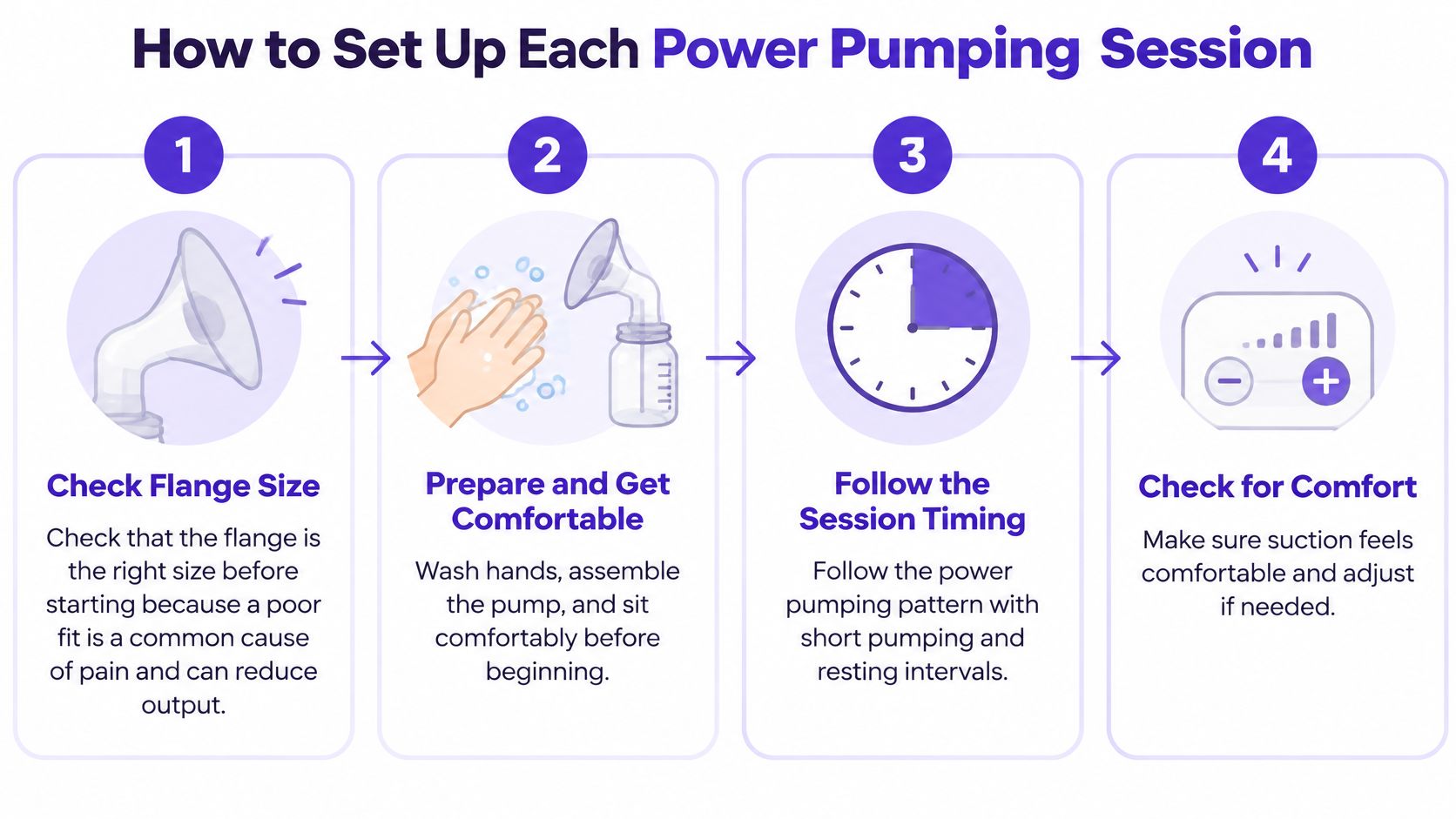
Check the flange fit. The nipple should move in the tunnel without rubbing or being pulled in uncomfortably. A poor fit can cause pain and may reduce effective milk removal, so get help checking the fit if symptoms persist.
Wash your hands and assemble the pump. Sit somewhere supported, and centre each flange over the nipple. A comfortable position makes it easier to stay relaxed through the full hour.
Begin gently. Start with low suction and fast cycles for about two minutes to encourage let-down. Then move to a slower rhythm and increase suction only to the highest level that remains comfortable.
Use gentle breast massage. Massage before pumping and while the pump is running to help milk flow. If flow slows between segments, you can use hand expression before starting the next pumping block.
Keep the settings comfortable throughout. You don't need to keep increasing suction to get more milk. Stop and adjust if pain continues, the nipple turns white, or the skin swells. For a refresher on choosing a timing window around feeds, see when to pump after breastfeeding.
Track each segment. Record the amount collected during each pumping block, as well as the total for the hour. Segment notes can show whether flow changes over the session, but your daily total is more useful for judging the trial.
Use the rest periods to reset. Have water nearby, and use the breaks to relax rather than checking messages or watching the clock. A drink can make the hour more comfortable, though hydration doesn't replace regular milk removal.
Flow often slows during the final segment, and that alone doesn't mean the session failed. If you finish sore, lower the suction next time and reassess the flange fit. Pumping shouldn't be painful.
Where Power Pumping Fits Into Your Daily Pumping
The total number of effective milk removals across the day matters more than adding one long block. During early supply establishment, pumping guidance describes 8 to 12 expressions in 24 hours, including at least one overnight session. After the early period, at least five sessions may be needed, with six to eight preferred. (Academy of Breastfeeding Medicine protocol on milk expression)
| Stage | Sessions per 24 hours | Overnight session | Role of a power-pumping hour |
|---|---|---|---|
| First 7 to 10 days of supply establishment | 8 to 12 | At least one | Add it to the schedule, never use it to replace sessions |
| After the early period | At least 5, preferably 6 to 8 | Keep one | Optional short trial if output is low |
| Exclusive pumping, separated from infant | About 8 or more, 10 to 12 in early establishment | Keep one | Monitored trial only after frequency is adequate |
If you're separated from your baby and pumping at work, a sample day might include a morning power-pumping hour, your usual midday and afternoon sessions, and an overnight session that stays in place. Plan the hour around the rest of your day rather than removing several ordinary sessions to make room for it. Replacing multiple sessions with one block can lower total stimulation, even if the hour feels productive. For a practical starting point, use this guide to scheduling pumping around your workday.
Before adding power pumping, check whether your current daily frequency is already adequate. The trial makes more sense when it's an extra, time-limited strategy, not a substitute for missed sessions or help with milk transfer. A lactation assessment may include infant weight and stool output, and a clinician may use test weighing, weighing the baby immediately before and after a feed under the same conditions. The American Academy of Family Physicians' overview of breastfeeding describes lactogenesis II, when milk volume rises and becomes thinner, as typically occurring about 32 to 96 hours after birth. Delayed milk coming in, ineffective feeding, or a medical issue can look like a pumping problem, so more pumping alone may not address the cause.
Count your day's total sessions first. Then decide whether a power-pumping hour can fit without displacing regular milk removal.
What the Research Shows About Expected Results
A randomized trial conducted in Mumbai and published in 2024 measured more milk per power-pumping session by the end of the trial, but it didn't show a statistically significant improvement in exclusive breastfeeding at hospital discharge. The study involved mothers of very-low-birth-weight infants with low milk output, so its findings don't automatically apply to parents of healthy full-term babies. (2024 pilot randomized trial on power pumping)
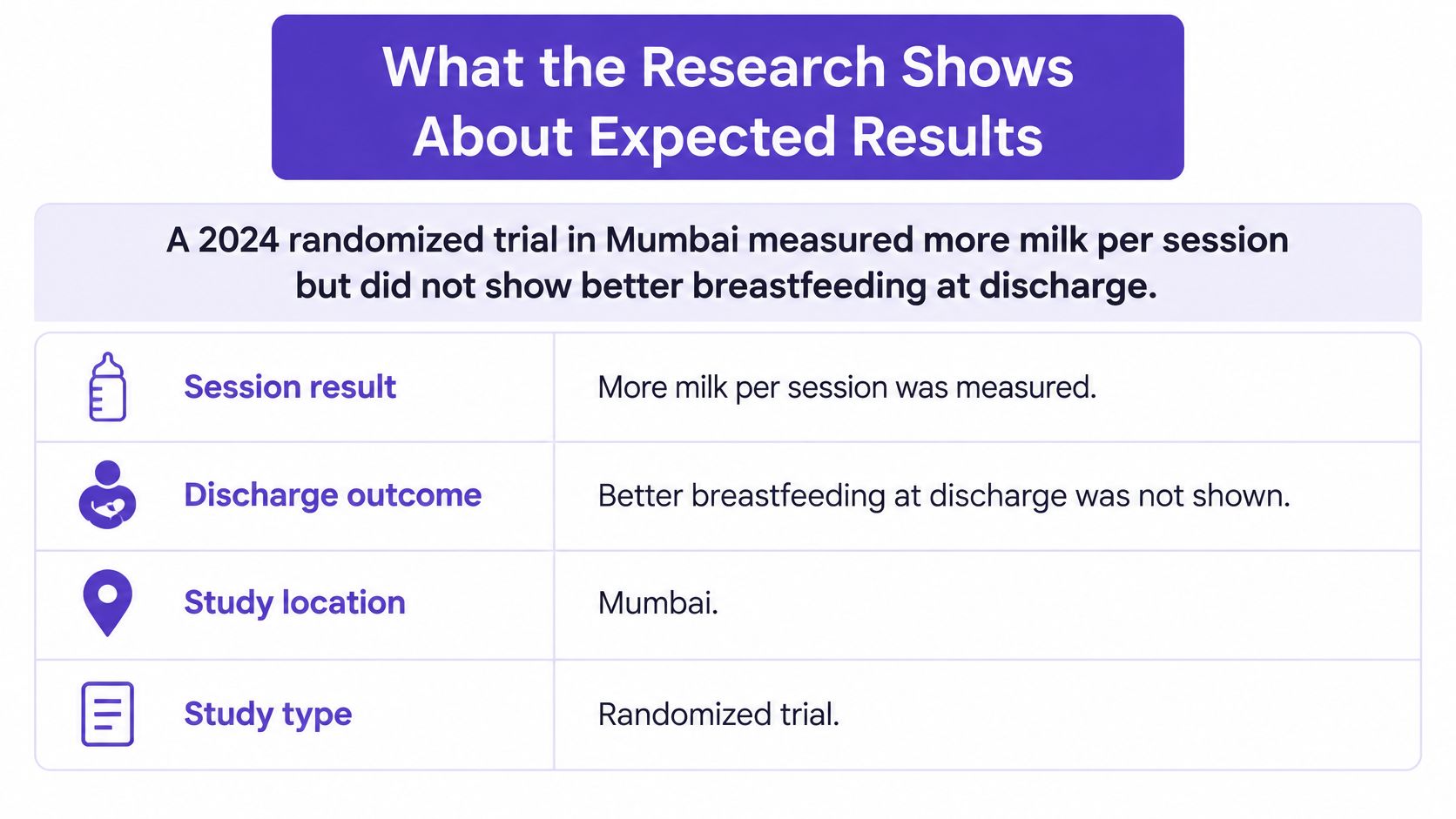
The trial enrolled 78 mothers, with 72 analyzed: 36 in each group. Each group followed its assigned pumping strategy once daily for seven days. Both groups also received routine lactation support and hand expression every three hours. Their median 24-hour expressed milk volumes at enrollment were similar.
| Measure | Power pumping group | Routine pumping group | Reported result |
|---|---|---|---|
| Baseline 24-hour expressed volume | 89 mL | 91 mL | Similar at enrollment |
| Single-session volume on day 7 | 50 mL | 27 mL | Significant (p = 0.014) |
| Cumulative volume across 7 sessions | 305 mL | 213 mL | Narrowly missed significance (p = 0.054) |
| Exclusive breastfeeding at discharge | 61.1% | 50.0% | Not significant (p = 0.477; RR 1.2; 95% CI 0.76 to 2.17) |
The session result means the power-pumping group collected a higher median volume during an individual session on the seventh intervention day. The cumulative result was also higher in that group, but it narrowly missed conventional statistical significance. The trial's feeding outcome didn't establish that power pumping increased the chance of exclusive breastfeeding at discharge. The difference between the groups could plausibly have been due to chance.
The study offers a reason to consider power pumping as a possible short-term way to increase milk collected per session for some parents in similar circumstances. It doesn't prove that the method improves breastfeeding outcomes for every parent, or that the same results will happen at home. The observed session benefit appeared later in the trial, so a large increase after the first hour isn't a fair expectation.
Judge a trial by the pattern across the day, not one bottle. Track the 24-hour total alongside how your baby is feeding and, when relevant, weight and diaper trends.
Troubleshooting Low Output and When to Stop
Check the basics before adding more pumping. Low bottle volume doesn't always mean your body is making too little milk. Pump fit, how often milk is removed, and how well your baby transfers milk all matter.
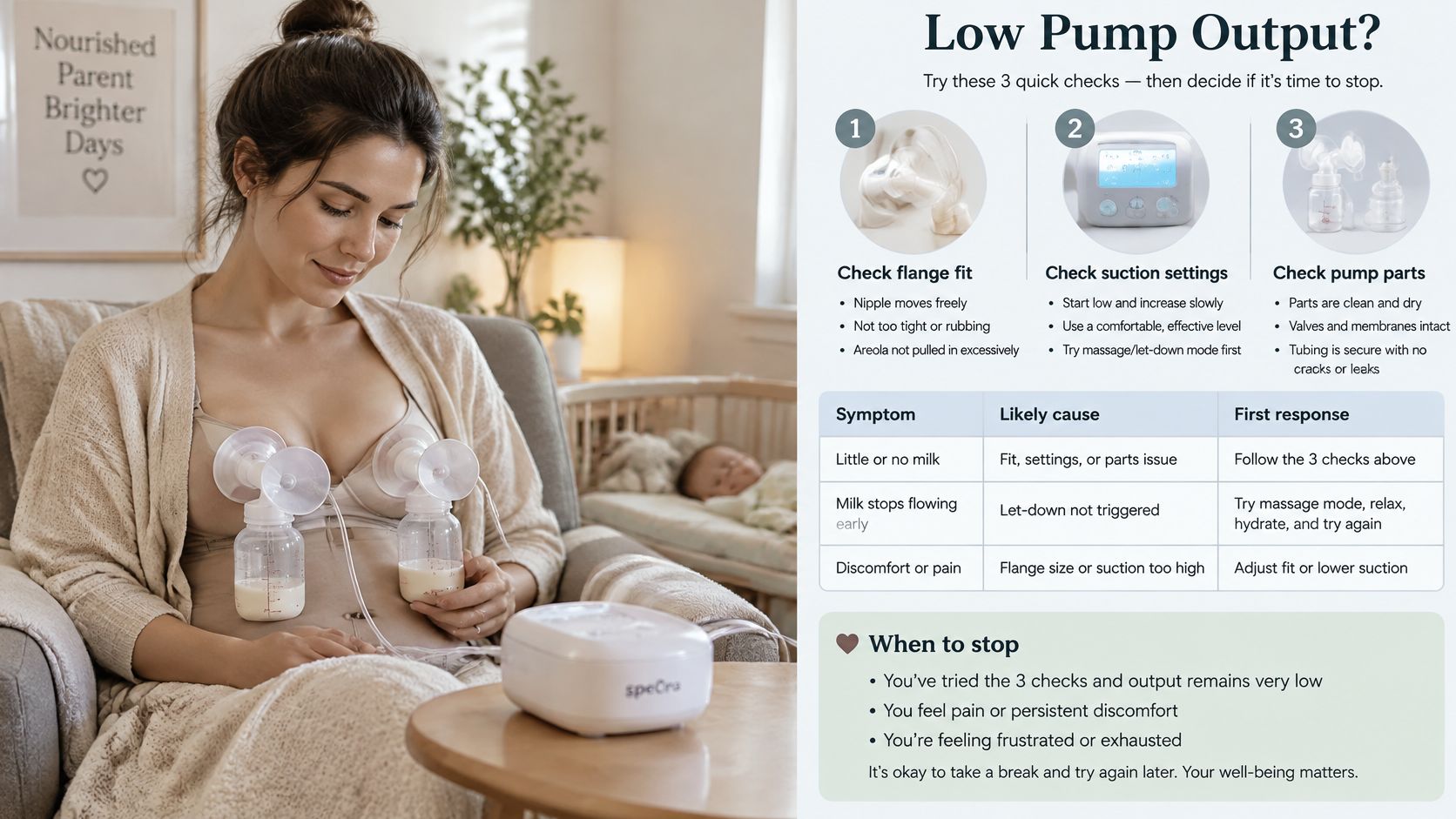
| Symptom | Likely cause | First response |
|---|---|---|
| Output stays flat after several days | Ineffective transfer or too few total sessions | Check total daily sessions and infant transfer before adding more pumping |
| Pain, nipple whitening, or swelling | Suction too high or flange fit problem | Lower suction, recheck flange fit, and stop the session if symptoms continue |
| No increase after the trial period | Pump-fit issue, retained placental tissue, thyroid disease, PCOS, prior breast surgery, or medication | Stop the trial and book an assessment |
| Engorgement or leaking with adequate supply | Possible oversupply | Stop power pumping and reduce extra sessions |
| Red, hot, painful area or fever | Possible mastitis or blocked duct | Pause the trial and contact a clinician promptly |
| Poor infant weight gain or few wet diapers | Possible transfer problem or low intake | Seek same-day clinical review |
Start with the equipment: check that the flange is centred and comfortable, and that suction feels manageable. Next, count the day's sessions and note any missed overnight milk removal. Then consider the baby's feeding and weight, rather than assuming a pump bottle tells you exactly how much milk a baby takes at the breast.
A clinician or lactation professional may assess milk transfer by weighing the baby immediately before and after a feed under the same conditions. Each gram of weight gain is treated as approximately one milliliter of milk intake, as described by the American Academy of Family Physicians. This can help distinguish a milk-production concern from a milk-removal or transfer problem.
Stop the trial and seek advice if pain continues, or if you notice redness, fever, or a hard, painful lump. If output hasn't improved after several days, don't just extend the trial. A clinician may review possible contributors such as retained placental tissue, thyroid disease, polycystic ovary syndrome, prior breast surgery, or some medications. If your supply is already meeting your baby's needs and you're engorged, extra pumping may add discomfort rather than help.
Poor weight gain, few wet diapers, or fewer stools deserve same-day clinical review. Bring a log of pumping times, segment volumes, and feeds when you seek support. If you're unsure about knowing when to consult a breastfeeding specialist, an IBCLC or a clinician skilled in breastfeeding management can help you choose the next step.
Complementary Steps That Support Milk Supply
Power pumping is only one part of a feeding plan. When direct breastfeeding is possible and comfortable, it can be a useful way to remove milk; you can also offer skin-to-skin contact between feeds. If you're working out how to combine nursing and pumping, this guide to ways to boost breast milk production can help you consider options alongside a lactation professional.
Gentle breast compression during a feed or pumping session may help milk flow. Use light pressure, and stop if it hurts. Keep your pump in working order, too: check the motor, valves, and tubing, since worn or damaged components can affect how the pump works. If you pump several times a day, ask a lactation professional whether a hospital-grade pump makes sense for your situation.
Rest, regular meals, and drinking to thirst support your wellbeing, but they can't replace effective milk removal. The same goes for galactagogues, including herbs and medications often discussed online. Evidence for these options is limited and uneven, and some may cause side effects or interact with health conditions or medicines. Talk with a clinician before trying one, especially if you take medication or have an ongoing health condition.
A simple log can bring these pieces together: record infant feeds, pumping sessions, and how much you express. If you're also arranging help at home, Superstar Nannies explains maternity nursing and the kind of practical support a maternity nurse may provide during the early weeks.
Supportive steps don't make up for missed sessions. Layer them onto an appropriate frequency plan rather than adding them by default to an already demanding power-pumping hour.
Decide Whether a Trial Fits and How to Judge It
A power-pumping trial may fit if you're already removing milk regularly, your sessions are comfortable, your baby is feeding well and gaining weight, and you have a specific reason to test it, such as flat expressed output. During early supply establishment, guidance describes 8 to 12 expressions in 24 hours. Before starting, check flange fit and suction comfort, and get clinical advice if you have pain, a blocked duct, mastitis symptoms, or signs of oversupply.
Set up a short, trackable trial
Pick a start date and a morning window. Choose a time you can keep without disrupting regular sessions.
Record the details. Note the volume from each pumping segment and the total number of milk removals that day. Track your 24-hour total as well, since one session's output can vary with the time of day, recent feeding, stress, and pump type.
Set your stop point first. Decide when you'll pause and reassess rather than continuing indefinitely. A short checkpoint after two or three days without a clear gain is a reasonable way to keep the trial time-limited.
Some consumer guidance describes improvement within a few days, while other material suggests maximum effects may take up to 14 days. That difference is one reason not to treat a fixed timeline as a promise. Look for a rising daily total and better feeding, not a dramatic first-session number. For signs your baby may be getting enough, see this milk intake guidance for new parents.
Bornbir offers a free Pumping Schedule Generator to draft a day that keeps regular sessions in place and shows where a timed hour might fit. Review any plan with an IBCLC, midwife, or clinician who can consider your feeding situation. Persistent low output, pain, or poor infant weight gain is a reason to book an assessment, not to keep pumping longer.
A trial is a short experiment, and you can stop if it isn't helping or is making you uncomfortable.
If you're deciding how to fit pumping around feeding and daily life, Bornbir connects families with independent lactation consultants and other perinatal support providers. Use the free Pumping Schedule Generator to sketch a routine, then review it with a qualified professional who understands your needs.