
A membrane sweep, also called membrane stripping, stripping the membranes, or a cervical sweep, is a procedure where your doctor or midwife gently separates the amniotic sac from the lower part of the uterus with a gloved finger during a cervical check. The goal is to release your body's own labor hormones (prostaglandins) and nudge labor to start naturally, usually at or after 38-39 weeks. It's not a full medical induction; think of it as encouraging what your body is already preparing to do.
Here's what the procedure involves, what it feels like, how often it actually works, who's a good candidate, and the risks worth weighing before you say yes.
What Is a Membrane Sweep, Really?
Imagine trying to gently peel a sticker off a wall. The sticker is your amniotic sac (the bag of waters), and the wall is the inside of your uterus. During a sweep, your provider inserts a gloved finger through your cervix and sweeps in a circular motion to separate the sac from the lower uterine wall.
Membrane Sweep at a Glance
| Aspect | What it means for you |
|---|---|
| Procedure | Manual separation of the amniotic sac from the uterine wall |
| Also called | Membrane stripping, stripping the membranes, cervical sweep |
| Method | A gloved finger, during a routine cervical check; no tools or medication |
| Timing | Typically offered at or after 38-39 weeks |
| Purpose | Release prostaglandins that ripen the cervix and may start contractions |
| Where | Your provider's office, during a routine prenatal appointment |
| Pain level | Mild discomfort to quite painful; like strong period cramps, but brief |
The Goal of the Procedure
A sweep isn't meant to force your body into labor. The gentle separation releases prostaglandins right where they're needed, at the cervix, where they soften and thin the cervix (ripening) and encourage the uterus to begin contracting.
For many parents-to-be, it's appealing because it uses your body's own chemistry instead of medication: a middle ground between waiting it out and a formal induction. After a sweep, it helps to know the signs that labor is near so you know what to watch for.
How Is a Membrane Sweep Done?
The procedure is quick, over in a minute or two, and happens during a standard cervical check. It starts with a conversation: your provider should explain why they're offering it, the potential upsides, and the risks, and they won't (and shouldn't) proceed without your explicit permission.
You can say "no" or "stop" at any point. A membrane sweep is an offer, not a requirement, and your consent is the most important part of the process.
The Step-by-Step Procedure
- Preparation: you lie back on the exam table, as you would for a Pap smear or cervical check.
- Internal exam: your provider gently inserts gloved fingers to assess your cervix: its position, softness, and dilation.
- The sweep: if your cervix is open even a little, they insert one finger through the opening and sweep in a circular motion to separate the lower amniotic sac from the uterine wall.
What Does a Membrane Sweep Feel Like?
Let's be direct: comfort isn't the first word that comes to mind. Most people describe it as uncomfortable or intense, like strong period cramps or a much more assertive cervical check, with pressure, deep cramping, and a strange stretching feeling. Thankfully it's brief. Slow, deep breaths help you relax through it.
Light bleeding or spotting afterward is common and, along with mild cramping, can continue for up to 24 hours. Many people also notice they lose part of their mucus plug afterward; our guide to the mucus plug explains what that signals.
How Successful Is a Membrane Sweep?
The honest answer: it improves your odds, but it's not a magic button.
- If it works, it usually works fast. When a sweep triggers labor, contractions most often begin within 48 hours, sometimes within the first 24.
- It reduces the need for formal induction. Reviews of the research have estimated that roughly 1 in 8 people who have a sweep avoid a formal medical induction they would otherwise have needed.
- A favorable cervix improves the odds. The softer, thinner, and more open your cervix already is (your Bishop score), the more likely the sweep is to tip you into labor.
- It can be repeated. If the first sweep doesn't start labor, your provider may offer another a few days later.
Sometimes a sweep starts contractions that fizzle out, and sometimes it does nothing at all. Managing expectations going in makes the waiting game easier.
Who Is a Good Candidate?
A sweep isn't one-size-fits-all. Providers consider several factors first, and the first checkpoint is timing: most offer it only at or after 38-39 weeks, since the whole point is to encourage a full-term labor.
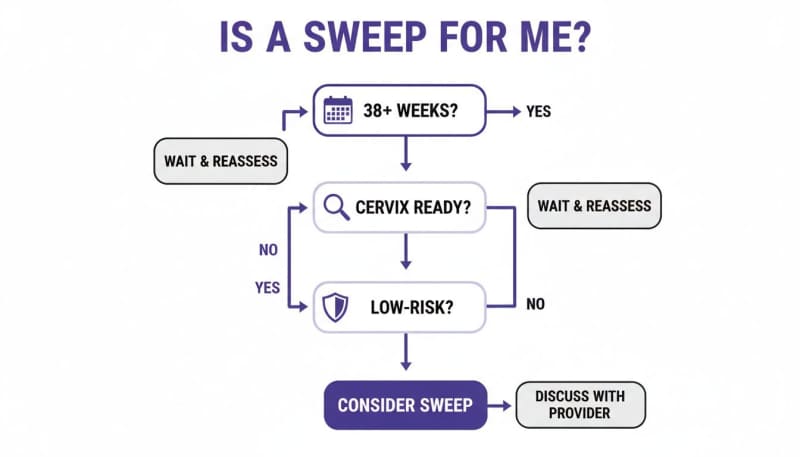
Key Eligibility Factors
Beyond timing, your cervix needs to be "favorable": already softening, thinning (effacing), or open 1-2 centimeters. If it's firm, high, and completely closed, a provider physically can't perform the sweep. The ideal candidate also has a low-risk pregnancy:
- Baby settled head-down, ready for a vaginal birth
- Placenta in a normal position, not covering the cervix
- No active infections
When a Membrane Sweep Is Not Recommended
- Your baby is breech. The procedure is only for head-down babies.
- You have placenta previa. With the placenta blocking the cervix, a sweep could cause dangerous bleeding.
- You have an active infection, including genital herpes. With an active outbreak, a sweep isn't safe; and if you're a Group B Strep (GBS) carrier, some providers prefer to skip it (see the FAQ below).
- Your water has already broken. Introducing anything into the vagina after rupture raises infection risk.
Talking it through with your doctor or a midwife is the best way to know whether it's an option in your specific situation.
Weighing the Benefits and Potential Risks
For many, the biggest draw is the chance to get labor started with your body's own hormones and sidestep medications like Pitocin.
A membrane sweep is an attempt to trigger spontaneous labor, which could reduce the need for other induction methods and pave the way for a more hands-off birth experience.
The Downsides
The most common complaints are discomfort and uncertainty: the procedure can genuinely hurt for a minute, cramping and spotting can follow for up to 24 hours, and there's no guarantee it works. Two small but real risks:
- Accidental rupture of membranes: a slight chance your provider breaks your water during the procedure.
- Infection: any internal exam carries a very small risk of introducing bacteria.
Pros and Cons at a Glance
| Potential benefits | Potential risks and disadvantages |
|---|---|
| Can help labor start naturally | Procedure can be quite uncomfortable or painful |
| May reduce the need for medical induction | Cramping and spotting for up to 24 hours |
| Low-tech, done in-office, no medication | No guarantee it will work |
| You stay in control of the decision | Small risk of accidentally breaking your water |
| May start contractions that don't progress | |
| Very slight risk of infection |
A Look at the Safety Evidence
Studies generally show membrane sweeping is safe. In one study of 147 women past their due date, 93.9% had zero maternal complications after a sweep; 4.8% experienced postpartum hemorrhage and 1.3% reported sepsis, with all patients discharged in good health (safety findings at jcgo.org). Complications aren't impossible, but they're uncommon; and having a birth professional in your corner helps you navigate choices like this. If you're building your support team, here are the benefits of having a doula.
What to Expect After Your Membrane Sweep

Once the sweep is done, the waiting game begins. Cramping that feels like period pain, light spotting, or brownish discharge are all normal, and actually a sign the procedure stimulated your cervix. You may also lose your mucus plug (or pieces of it) over the following hours or days.
Comfort Measures and Early Labor Signs
- Warmth is your best friend: a warm bath, or a heating pad on your lower back or abdomen.
- Relax as much as possible: deep breathing, calming music, a favorite movie. Stress won't help things along.
- Go for a gentle walk: if irregular contractions have started, light activity can sometimes encourage a consistent rhythm.
The big question is "Is this it?" The cramping from a sweep can feel suspiciously like early labor, but true labor contractions get stronger, longer, and closer together over time; they don't fade away. Our guide to the symptoms of labor pains covers what to watch for, and if labor does kick in, you'll be glad your hospital bag is packed.
When to Call Your Doctor or Midwife
- Heavy bleeding: spotting is expected; bleeding like a period needs immediate attention.
- Your water breaks: a dramatic gush or a slow, steady trickle both count.
- Intense, constant pain: cramping that comes and goes is normal; severe pain that doesn't let up is not.
- Reduced fetal movement: you know your baby's patterns best; any significant decrease should be checked.
If a Sweep Isn't Right (or Doesn't Work): Other Options
Some parents first try gentle, non-medical approaches at home, though the evidence for these is mixed:
- Walking: upright movement helps your baby settle deeper into the pelvis, putting natural pressure on the cervix.
- Eating dates: a few studies suggest dates in the final weeks may support cervical ripening.
- Acupuncture or acupressure: stimulating specific points to encourage contractions and blood flow to the uterus.
Medical Induction Alternatives
A medical induction is a much more involved process than a membrane sweep. It often involves several steps and continuous monitoring to keep you and your baby safe.
- Cervical ripening: a Foley balloon (a small catheter inflated to press gently on the cervix) or prostaglandin medication softens and opens a firm, closed cervix.
- Artificial rupture of membranes (AROM): "breaking your water" with a small hook so the fluid release triggers stronger, more regular contractions.
- Pitocin: the synthetic version of oxytocin, given by IV to start, strengthen, and regulate contractions.
Common Questions About Membrane Sweeps
Does a Membrane Sweep Hurt?
It's different for everyone. Most describe it as uncomfortable or intense rather than outright painful, like a very assertive cervical check or strong period cramps. The intense part lasts only a minute or two, with possible lingering cramps for a few hours. Slow, deep breathing during the procedure genuinely helps.
How Quickly Does a Membrane Sweep Work?
If it's going to kickstart labor, it most often happens within 48 hours, and not uncommonly within the first 24. If nothing happens, your provider may offer another sweep a few days later, or discuss next steps.
Can I Have a Sweep if I Am GBS Positive?
Ask your provider directly, because approaches vary. Some avoid sweeps for Group B Strep carriers over a theoretical, very small infection risk (especially if your water breaks soon after); others consider the risk low enough to offer it. Your provider will weigh your specific situation.
What Should I Ask My Provider Before a Sweep?
- Why am I a good candidate for this right now?
- What are the specific benefits and risks in my situation?
- What is my Bishop score, and how "favorable" is my cervix?
- What should I do if my water breaks afterward?
- If this doesn't work, what's our plan for the next step?
The last weeks of pregnancy are easier with the right people around you. Bornbir helps you find a birth doula or midwife near you: compare local providers, read reviews from other parents, and message them for free.