
You've got a birth preferences sheet, a partner who wants to help, and maybe a doula you're about to hire. Now you're wondering what happens when everyone walks into the hospital together. Will your doula work comfortably with the nurse and OB, or will you spend labor managing tension between the people supporting you?
The useful question isn't whether your doula is friendly. It's how doulas collaborate with medical teams when a shift changes, a recommendation needs explaining, or the plan takes an unexpected turn. Good teamwork starts before admission and continues after birth.
What Collaboration Actually Looks Like on L&D
A doula walks onto a Labor and Delivery unit she hasn't worked on before. At the nurses' station, she introduces herself to a nurse she doesn't know, identifies the parent she's supporting, and asks where she can put her bag without blocking equipment.
That ordinary exchange matters. The nurse needs to know who's in the room, what they're doing, and whether they'll help communication or complicate it. The doula needs to understand the immediate plan without making the parent repeat everything between contractions.
Start with the working relationship
A useful introduction is brief: name, role, and the parent's permission to share preferences. Then the doula asks about practical needs, such as where to stand during assessments and how to reach the nurse.
Collaboration is a workflow, not a personality trait. It consists of introductions, shared preferences, timely questions, clear boundaries, and check-ins when circumstances change.
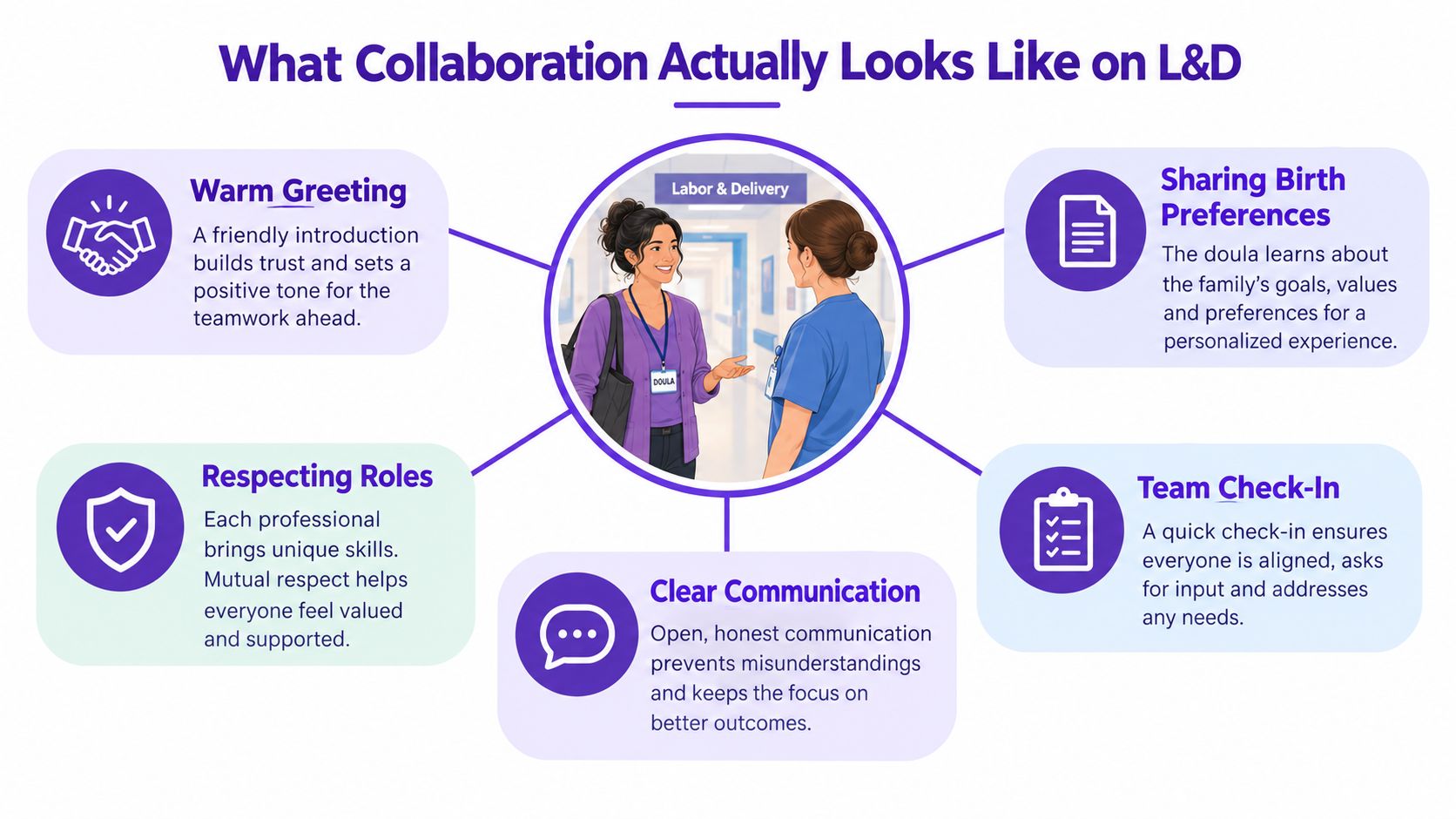
The doula brings continuity: someone who knows the parent's concerns and stays focused on their experience. Nurses, midwives, and physicians carry clinical responsibility within their respective roles. Neither contribution makes the other unnecessary.
Make teamwork visible
The parent shouldn't have to guess whether their support people are coordinating. Useful interactions include:
- Share the priorities: Tell the nurse which preferences matter most, with the parent's permission, rather than delivering a speech about the entire birth plan.
- Check before moving: Ask about clinical restrictions before helping the parent change positions or leave the bedside.
- Close the loop: After a discussion, confirm what the parent understood and which question still needs a clinician's answer.
A 2024 feasibility study reported significant improvements in clinician-reported trust in doulas of 0.23 points, with a 95% confidence interval of 0.12 to 0.34, and communication of 0.25 points, with a 95% confidence interval of 0.12 to 0.38, as described in ACOG's guidance on partnering with doulas.
Those findings concern working relationships, not a guarantee about an individual birth. They support treating coordination as something teams can build deliberately.
Practical rule: Protect the parent's voice without making the parent manage everyone else's working relationship.
A birth preferences sheet works best as a conversation aid. The doula helps keep it relevant while leaving clinicians room to explain what's feasible and what has changed.
Where the Doula Role Ends and Clinical Care Begins
A doula can help you understand the conversation. She shouldn't become the person deciding whether a medical recommendation is right for you.
That distinction gets blurry when a parent trusts their doula completely or feels overwhelmed by hospital language. The safest response isn't to withdraw support. It's to identify which questions need the licensed team and help the parent get those answers.
What Doulas and Clinicians Each Cover
| Doulas | Medical Team |
|---|---|
| Offer emotional support and help the parent stay grounded | Assess clinical concerns and explain findings |
| Provide nonclinical comfort, such as massage and supported positioning | Monitor the parent and baby and determine clinical restrictions |
| Help the parent organize questions and express preferences | Explain treatment options, benefits, risks, and alternatives |
| Support the parent while decisions are discussed | Diagnose, prescribe, and perform medical interventions within professional scope |
| Help recall what was said and request clarification | Provide individualized medical advice and document clinical care |
A doula doesn't check cervical dilation, interpret fetal monitoring strips, prescribe treatment, or make medical recommendations. She also doesn't give consent for the parent or override their decision. If someone works as both a doula and a licensed clinician, the family needs clarity about which role they're serving in that birth.
For families comparing support options, this doula vs midwife comparison can help separate nonclinical support from clinical maternity care.
Support matters without becoming treatment
The 2017 Cochrane review of continuous labor support synthesized 26 trials involving 15,858 women across 17 countries and found support associated with a 15% higher likelihood of spontaneous vaginal birth and, when provided in a doula-like role, a 39% lower likelihood of cesarean birth.
Those results don't establish that a doula can judge whether surgery is necessary. They support continuous care alongside medical care, not in place of it. A doula promising to prevent a cesarean is making a promise the evidence doesn't justify.
A useful boundary sounds like: “I can help you list your questions. Your clinician needs to explain what these findings mean for you and your baby.”
The doula can then help with breathing, offer a cool cloth, or keep the partner grounded while the clinician explains. There's plenty of meaningful work to do without interpreting the monitor.
After a decision, ask yourself: Who explained the medical recommendation, and who helped me process it? The answer should be clear. If your doula's opinion has replaced a clinical explanation, ask the medical team to return.
Prenatal Steps That Make Birth Day Smoother
Don't leave the entire working relationship to the admission desk. Prenatal preparation gives the parent, doula, and practice a chance to discover mismatched expectations before labor makes every conversation harder.
A 2025 hospital-community doula implementation study identified the absence of an established, trusted relationship as the primary barrier, alongside resistance to doula advocacy, knowledge hierarchies, and weak administrative support. A pleasant introduction helps, but it can't fix an unclear hospital process by itself.
Ask about the actual hospital workflow
Ask your OB or midwife whether the practice welcomes doulas and whether two support people, such as a partner and doula, can attend. Confirm the hospital's policy separately, including any restrictions during procedures or transfers. A practice's general enthusiasm isn't the same as a confirmed access plan.
As a preparation target, have the doula send a short introduction two to four weeks before the due date. Include training, nonclinical scope, contact information, and the parent's permission to communicate. Don't send private health details without that permission or assume the message reached the delivering clinician.
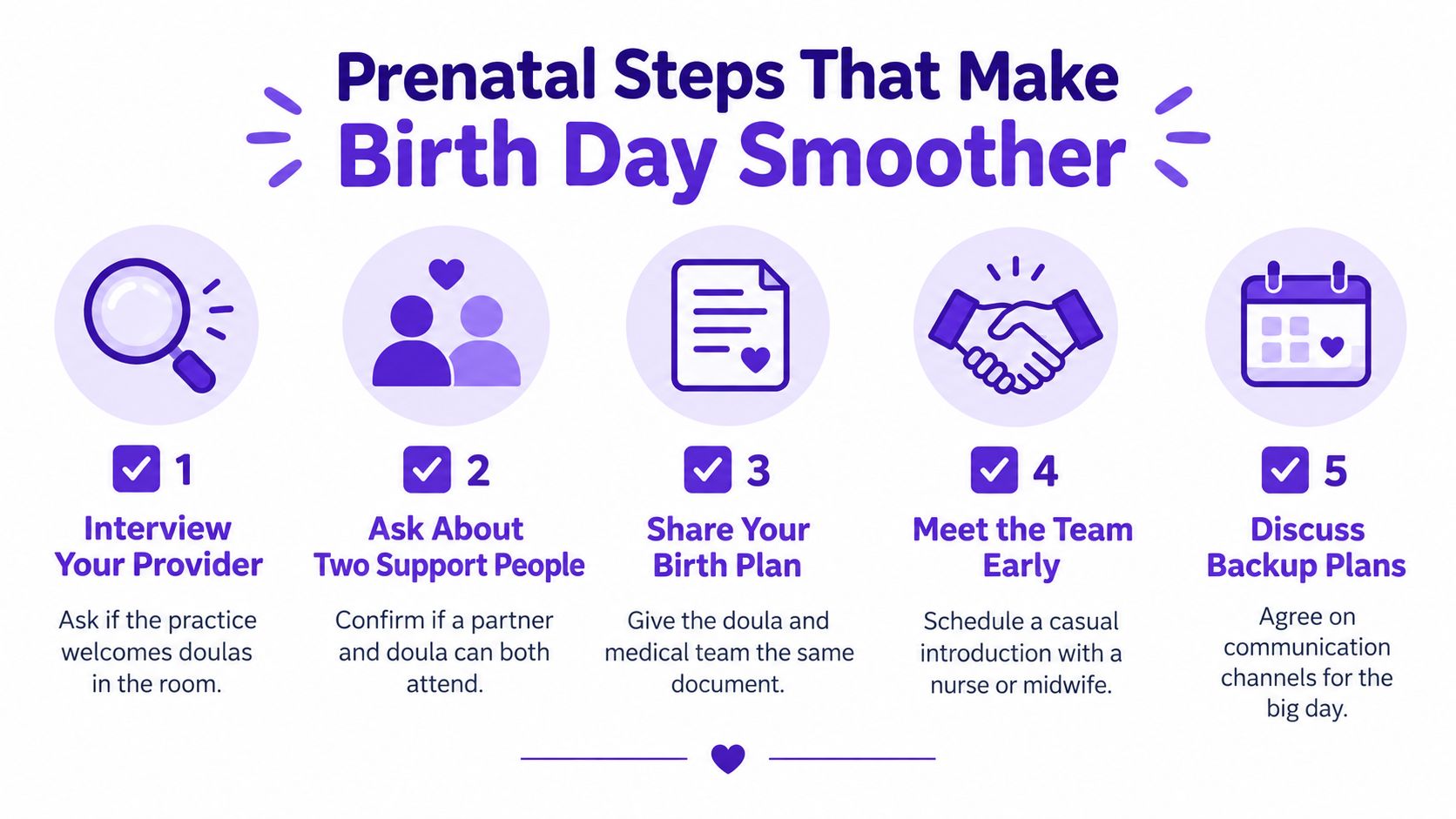
Create a one-page preferences sheet, signed by the parent, with copies for the doula and team. Signing it identifies whose preferences they are; it doesn't replace procedure-specific consent.
Agree that the parent speaks first during consent discussions when able. The doula can prompt a forgotten question, while the partner avoids starting a competing conversation. For shift changes, aim for a brief introduction within five minutes of the new nurse's arrival, provided the nurse isn't handling urgent care.
A checklist for the prenatal visit
Print this list or save it with your preferences sheet:
- Access confirmed: Ask about doula attendance, partner attendance, and procedure-related restrictions.
- Introduction arranged: Share the doula's role and contact details, and request an early team introduction if feasible.
- Preferences aligned: Give everyone the same current document.
- Communication assigned: Decide who asks questions, who takes notes, and how the doula contacts staff.
- Backup plans discussed: Confirm backup doula coverage and what happens if an intervention changes the plan.
To assess a prospective doula, find doula interview questions and ask for concrete answers about unfamiliar hospitals, handoffs, and disagreements. Listen for an actual process, not just “I get along with everyone.”
Communication Scripts for the Hospital Room
You don't need polished language during labor. You need a few sentences you can reach for when you're tired, distracted, or frightened.
The scripts below are templates, not quotations from clinicians or accounts of actual births. Use the words that sound natural to you, and let the medical team answer before adding another question.
Introductions and everyday requests
Meeting the nurse
“Hi, I'm Maya, Jordan's doula. Jordan has asked me to help with comfort and remembering questions. Is there anything you need us to know about the room or care plan?”
That's enough. Credentials can wait unless the nurse asks or the hospital needs documentation.
Asking for time before a procedure
“Is this urgent, or is there time for us to talk privately before deciding? If waiting isn't safe, please explain what needs to happen now.”
The fallback matters. A request for time shouldn't sound like an announcement that care will stop.
Requesting another position
“I'd like to try side-lying. Is there any clinical reason I shouldn't right now, and can you help us protect the lines and monitors?”
Asking about delaying membrane rupture
“Can you explain why you recommend breaking my waters now? If it's safe to wait, what would we watch for, and when would we revisit it?”
Requesting privacy during a cervical check
“Before you start, can you explain the exam and check that I'm ready? I'd like anyone who isn't needed to step out, with my doula staying near my head.”
These questions help you advocate for your birth plan without treating every recommendation as a confrontation.
Urgent changes and room handoffs
When the plan changes quickly, the parent can say:
“Please tell me what's happening, what you recommend, and whether there's time for questions. Keep explaining as you work.”
This doesn't presume that a pause is safe. The doula can stay beside the parent, reduce competing conversation, and help them hear the response.
For a shift change, prepare a 30-second handoff: “I'm Jordan's doula. With Jordan's permission, their priorities are quiet explanations and being asked before touch. They're waiting for an answer about pain relief. Where would you like me during your assessment?”
Don't interpret test results or present an unofficial clinical report. Afterward, ask the parent whether anything important was missed.
For privacy during the shift-change conversation: “Could we discuss personal details with the door closed and visitors outside, if that works for the handoff?”
When a partner wants to step in, the doula can offer a clear exit cue: “You take their hand and talk them through this contraction. I'll step back, and you can signal when you want me.”
Say less, then listen. Repeated questions while a clinician is answering can make the room harder to follow, even when everyone means well.
Two Real-World Scenarios and How the Team Handles Them
These named scenarios are illustrative composites, not reports of actual clients or outcomes. They show how the same working boundaries apply during a slower discussion and a time-sensitive change.

Alex needs help hearing the recommendation
Alex is a first-time parent at 41 weeks in this example. The clinician recommends augmentation, and Alex's partner starts asking anxious questions before the explanation is finished.
The doula helps Alex follow the conversation: “They're discussing helping labor progress. Let's ask them to explain which option they mean and why they recommend it.” She doesn't decide whether labor is progressing adequately.
Alex wants to know what happens if they wait. The doula names that unanswered question, then steps back while the clinician explains. During a cervical exam, she moves out of the clinician's working space and stays where Alex wants her, offering steady contact and reassurance.
Helpful behavior makes the recommendation easier to understand. Unhelpful behavior would be telling Alex that augmentation always leads to surgery or urging refusal before the clinician has explained the situation.
Sam faces a sudden change during pushing
In this example, Sam's team identifies an unexpected category-two tracing, and the OB suggests operative vaginal delivery. The OB, not the doula, explains the tracing, recommendation, alternatives, and urgency.
Sam looks toward the doula for reassurance. The doula asks: “Is it safe to pause 60 seconds so Sam and their partner can speak privately? If not, please explain the urgency while you prepare.”
That is a conditional request, not a countdown the team must honor. If the OB says there isn't time, the doula doesn't block access, argue over the monitor, or lead Sam through a long decision checklist. She stays near Sam's head if permitted and helps them hear the explanation.
What these examples don't prove
A pooled analysis of seven randomized controlled trials found intrapartum doula support associated with cesarean rates of 17.5% versus 23.6% under standard care, with a pooled relative risk of 0.71 and a 95% confidence interval of 0.53 to 0.95. That finding doesn't determine the right delivery method for either illustrative parent.
In both scenarios, the doula's contribution is information support plus presence. In the slower conversation, she helps uncover unanswered questions; during the urgent change, she supports communication without demanding an unsafe delay. Neither situation calls for the doula to become the decision-maker.
When Collaboration Gets Hard Without Burning the Bridge
Quiet compliance isn't the same as good collaboration. A doula may need to point out that the parent hasn't heard an explanation, that a preference was overlooked, or that someone needs an interpreter.
The difference is between raising a concern and taking over. Community knowledge and relationship-based advocacy shouldn't disappear just because the birth happens in a hospital. But neither gives a doula authority to direct clinical care.
Start with the smallest useful repair
If a nurse dismisses the doula or an OB walks past the preferences sheet, first identify the specific problem. Is the parent missing information, or is the doula frustrated that staff didn't acknowledge her?
A private check-in can be more useful than a bedside argument: “I think we're talking past each other. The parent's unanswered question is about timing. How can we get that answered?”
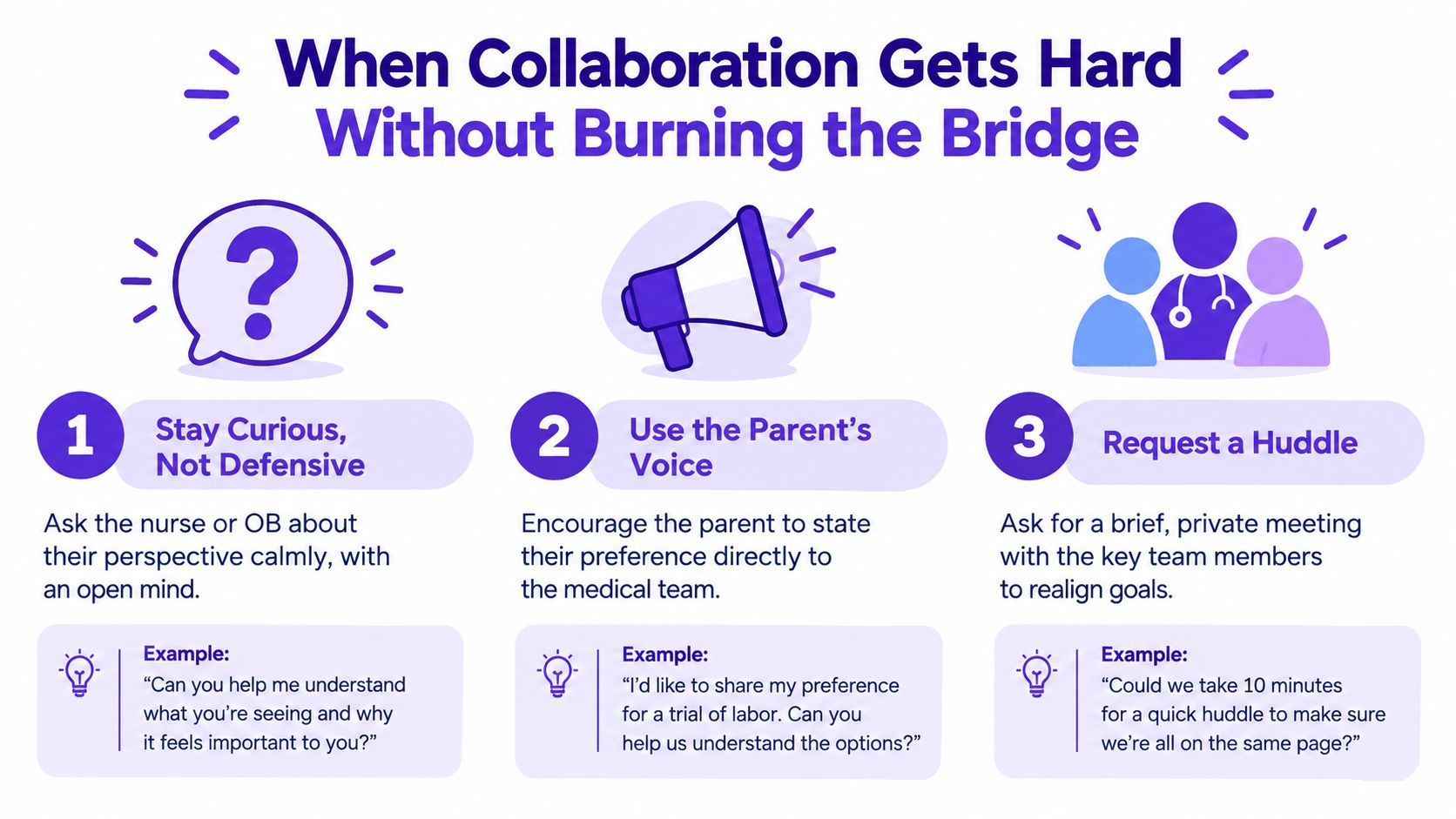
If the concern affects care and remains unresolved, request a brief huddle, then involve the charge nurse or patient advocate as appropriate. Parents can ask for a different nurse, though reassignment may not be available. They can also ask the doula to step out briefly if her presence is making it harder to hear or decide.
A repair should make the parent's care easier, not establish who won the disagreement.
A doula who interrupted, crowded equipment, touched clinical controls, or spoke over the parent should apologize specifically and adjust. Blocking staff access or continuing disruptive behavior after being asked to stop can prompt a request to step out. Staying useful may mean moving back, getting supplies, or waiting.
Don't confuse system problems with bad chemistry
The 2022–2023 Supportive Birth Collaborative used 11 implementation strategies and fully carried out 10, after which clinicians reported improved trust and communication, according to the hospital teamwork feasibility study. Clinicians' understanding of the doula role didn't significantly improve, which shows why communication work and role education need separate attention.
ACOG's partnership guidance discussed earlier also supports respectful teams that include doulas. That guidance is from 2026; the intervention findings it describes are from 2024.
For help deciding how to handle doula physician tension, distinguish ordinary friction from concerns requiring a conversation with the practice:
- Consent concerns: The parent's questions or decisions are repeatedly disregarded.
- Communication access: Interpreter or cultural needs aren't meaningfully addressed.
- Unsafe scope: A doula promises outcomes or advises against treatment without clinical qualification.
- Intimidation: Someone uses threats, humiliation, or retaliation instead of explanation.
Postpartum Handoffs and the First Six Weeks
Before leaving the hospital, the doula can help protect rest, coordinate with lactation if nursing is the plan, and write down questions for follow-up. With the parent's permission, a brief message within 48 hours can thank the delivering clinician and flag unresolved concerns. Urgent symptoms need clinical contact immediately, not a courtesy message.
If the practice schedules two-week and six-week postpartum visits, the doula may join by phone or in person with permission. Families can clarify ongoing support through what a postpartum doula does. For concerns about mood, Vancouver Counselling Clinic's guide to postpartum depression for new parents offers a resource to discuss with a qualified professional.
A reference card to save
- Parent: States preferences and makes informed decisions.
- Clinician: Explains findings, urgency, options, and treatment.
- Doula: Supports comfort, recall, and question-asking.
- Partner: Provides connection and practical help.
Keep these questions accessible: What do you recommend and why? What are the alternatives? Is there time to discuss this?
ACOG's summary of continuous nonmedical support evidence reports relative risks of 0.75 for cesarean birth, with a 95% confidence interval of 0.64 to 0.88, and 0.62 for a low 5-minute Apgar score, with a confidence interval of 0.46 to 0.85, plus labor averaging 0.69 hours shorter. These are group findings, not individual promises.
Doulas are independent professionals. Before hiring, verify training, any applicable credentials or licensure, scope, and fit.
Bornbir connects expecting and new parents with perinatal support providers and lets families compare services, availability, pricing, and reviews. Visit Bornbir to find potential doulas, then ask each candidate how they prepare for hospital introductions, handle disagreements, and arrange postpartum handoffs.