
You laugh at a message from a friend, feel a sudden leak, and shift subtly in your chair. You may have been told at your routine postpartum visit that everything is healing normally, yet your bladder, bowel, pelvic pressure, or sex life still doesn't feel like your own.
That mismatch can make recovery feel confusing. Pelvic floor recovery postpartum is usually a gradual process, shaped by pregnancy, birth, sleep, feeding, tissue healing, nerve recovery, and the demands of caring for a baby. A six-week checkup is an important clinical milestone, but it isn't a finish line.
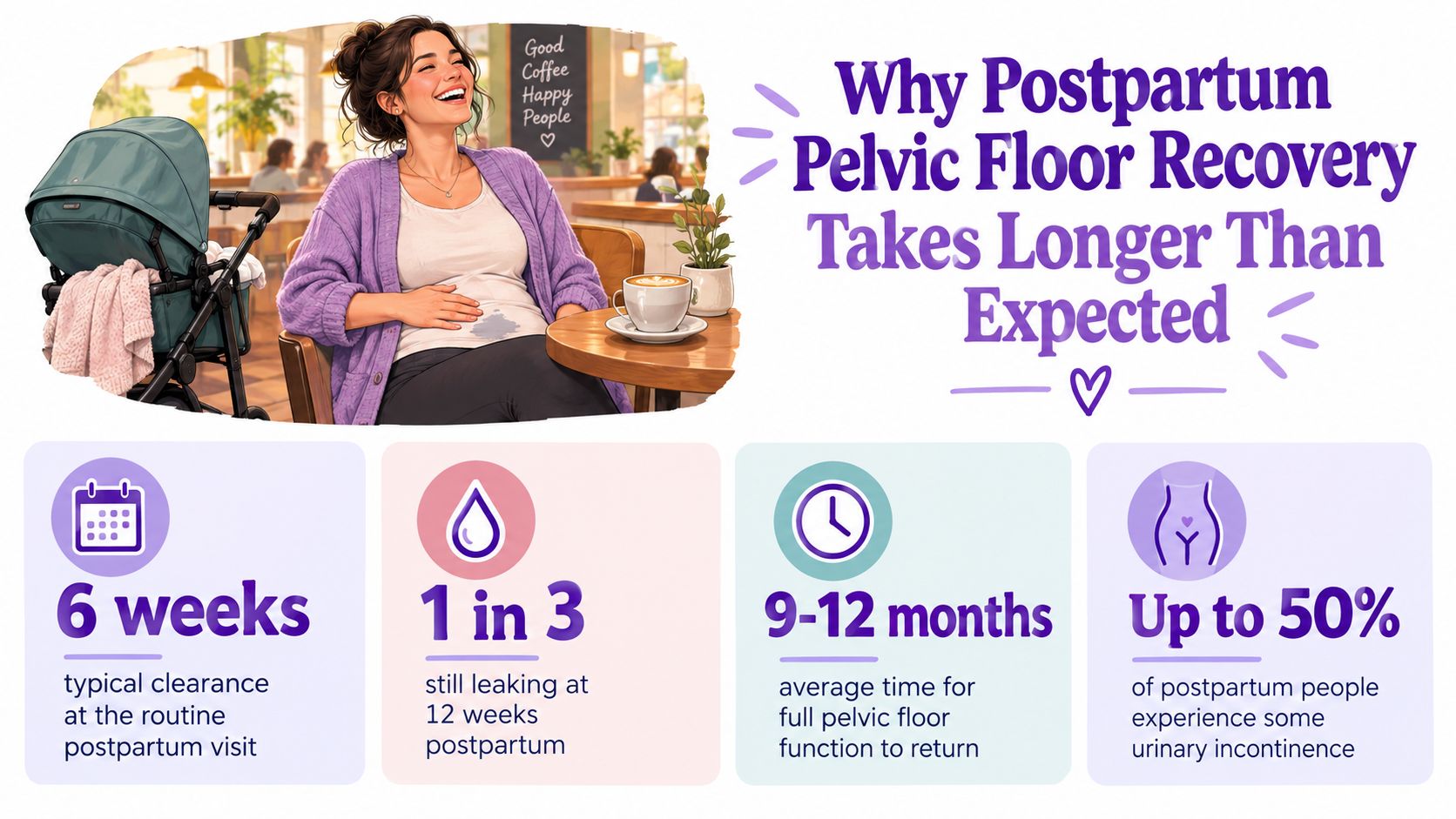
Why Postpartum Pelvic Floor Recovery Takes Longer Than Expected
A parent sits in a coffee shop six weeks after birth, finally out of the house without the baby for a short break. Someone makes them laugh. They cross their legs, press a hand over the lower abdomen, and hope nobody noticed the small leak.
They were cleared at their routine appointment. They don't have significant pain. They can walk, feed the baby, and manage the day. Still, the pelvic floor hasn't necessarily regained its previous strength, endurance, timing, or ability to manage sudden pressure.
Pregnancy stretches the connective tissues that support the pelvic organs and changes how the abdominal wall and diaphragm share pressure. Vaginal birth adds substantial stretching through the pelvic floor, perineum, and surrounding fascia. Nerves may also be temporarily irritated or stretched, and a person can have reduced muscle response without feeling pain.
A 2022 longitudinal study found that after normal vaginal birth, vaginal resting pressure was 21% lower and pelvic floor muscle strength was 15% lower at 6 months postpartum than at mid-pregnancy. At 12 months, resting pressure remained 20% lower and strength remained 7% lower, so recovery had not fully occurred for many participants (longitudinal pelvic floor recovery study). Vaginal birth with assistance was also associated with a 21% decline in resting pressure and a 15% decline in strength at 6 months in the same study.
Practical rule: Feeling comfortable at rest doesn't prove that the pelvic floor is ready for coughing, lifting, running, jumping, or prolonged standing.
Symptoms are common in the early postpartum period and may continue well beyond it. A major review reported that at 6 to 10 weeks, up to 48% of first-time mothers reported urinary incontinence, 60% reported anal incontinence, 29% reported pelvic organ prolapse symptoms, and as many as 66% reported pain with intercourse (review of peripartum pelvic floor disorders). The same review summarized cumulative rates over the first 15 years after childbirth of about 34% for stress urinary incontinence, 22% for overactive urinary incontinence, 31% for anal incontinence, and 30% for pelvic organ prolapse.
These figures don't predict your individual outcome. They do show why leakage, heaviness, bowel changes, and painful sex deserve more than reassurance to “wait and see.” If you want a plain-language explanation of why bladder leakage can happen after birth, this guide to the causes of bladder leakage after childbirth offers useful background.
The right pace depends on birth type, tissue injury, previous conditioning, current symptoms, and how your body handles pressure. The sections below use phases rather than a single deadline, so you can progress when your symptoms and movement quality support it.
Starting With Breath and Gentle Reconnection
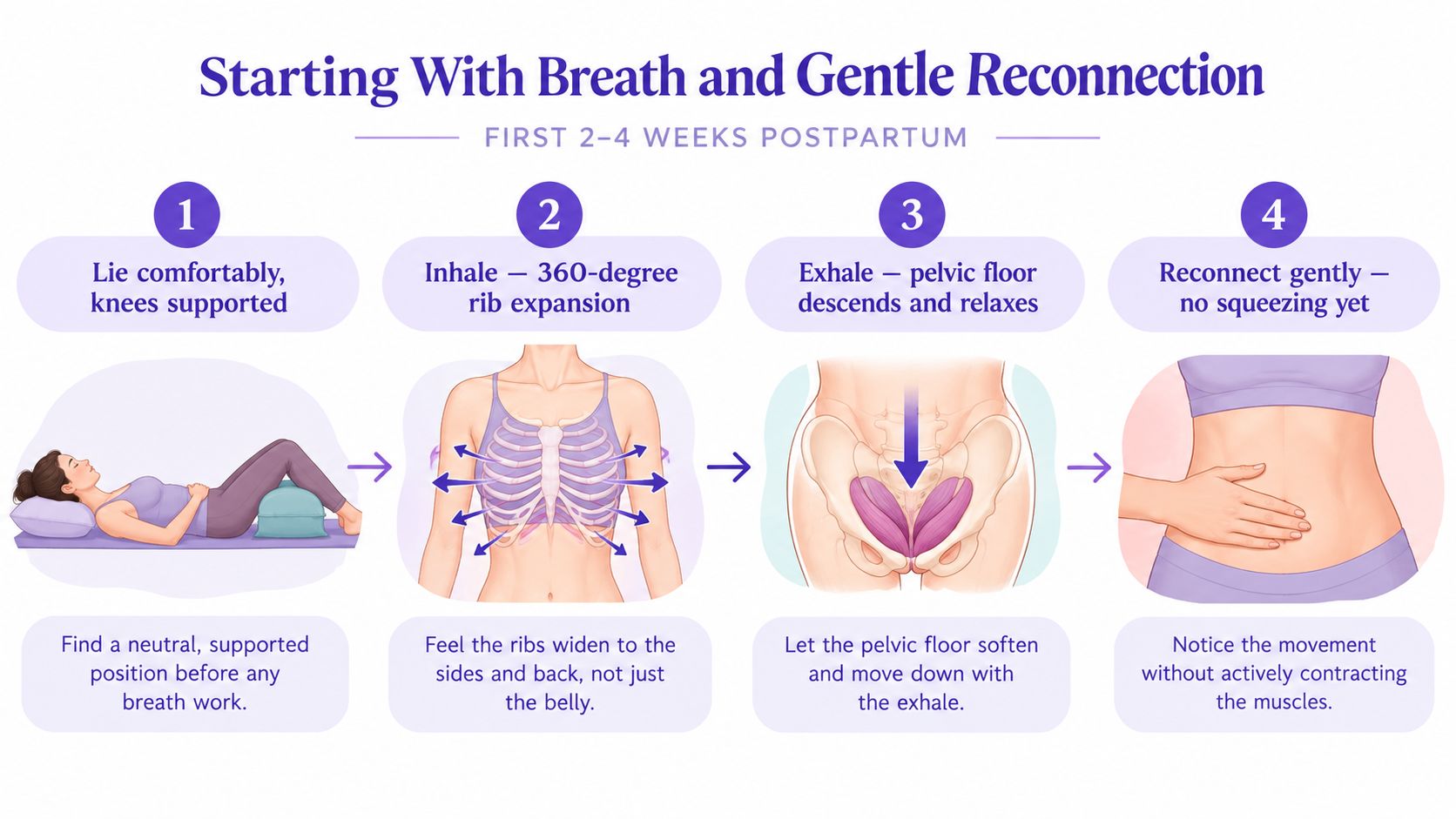
During the first two to four weeks, the priority isn't maximal squeezing. It's restoring a sense of movement and coordination without irritating healing tissue.
Start in a supported position. Lie on your back with your knees supported by a pillow, turn onto your side with a pillow between your knees, or sit upright with your back supported. A side-lying position may feel better after perineal soreness, while a supported seated position can be more practical during feeding. After a cesarean birth, choose the position that doesn't pull on the incision.
Let the breath move in all directions
Place your hands around the lower ribs. Inhale gently and notice the ribs widen to the sides and toward your back, rather than pushing only into the abdomen. As you inhale, allow the pelvic floor to soften and descend. As you exhale, let the pelvic floor respond with a small, comfortable lift.
This is a coordination drill, not a hard strengthening exercise. The goal is to reconnect the diaphragm, abdominal wall, and pelvic floor so they can share pressure without breath holding.
At first, try only a brief contraction on the exhale. Hold it for one or two seconds, then release completely before the next breath. A full release matters. Repeatedly clenching without relaxation can increase tension and make it harder to empty the bladder, tolerate intercourse, or reduce pelvic pain.
Common mistakes include bearing down as though having a bowel movement, tightening the buttocks instead of the pelvic floor, and holding the breath. If your abdomen domes sharply, your perineum bulges downward, or pain increases, reduce the effort.
A reasonable early practice is three short sessions a day, with five to eight breath-linked contractions in each session, provided they remain comfortable. Progress when you can contract and release without pain, pressure, increased leakage, or breath holding. Gentle walking can be added according to comfort and medical guidance.
Manchester University NHS Foundation Trust recommends beginning with short pelvic floor squeezes and progressing toward long and short squeezes three times a day. Its starter example uses a 5-second hold repeated 5 times, followed by 5 quick squeezes, with full relaxation between contractions (NHS-linked pelvic floor guidance).
A Phased Exercise Plan Through the First Postpartum Year
A useful progression changes one demand at a time. You might increase time under tension, move from lying to standing, add load, or introduce faster movement. You don't need to advance every part together.
Four phases for gradual loading
Phase one, weeks zero to four, is about healing, comfortable breathing, gentle reconnection, and walking tolerance. Keep contractions brief and light, with complete release. Stop or reduce the session if bleeding increases, pain appears, pressure develops, or leakage is worse afterward.
Phase two, weeks four to twelve, can add longer contractions, upright positions, supported bridges, and controlled sit-to-stand work when healing allows. Work toward the NHS starter pattern of a 5-second hold, 5 repetitions, and 5 quick contractions, three times daily, but don't force that volume if your muscles fatigue or stay tense.
Phase three, months three to six, adds functional pressure management. Practice exhaling during a sit-to-stand, lifting a light baby carrier close to the body, and balancing on one leg near a stable surface. The aim is not to brace constantly. It's to coordinate the pelvic floor with the task.
Phase four, months six to twelve, can include loaded carries, progressive full-body strength, and preparation for jogging when symptoms remain quiet. National Association for Continence guidance places gentle pelvic floor and abdominal work, walking, and posture focus in the first 6 weeks, then suggests low-impact exercise and light weight training from 6 to 12 weeks, with jogging after a gradual build-up (postpartum exercise guidance).
| Phase | Postpartum Window | Focus | Sample Work | Readiness Cues |
|---|---|---|---|---|
| One | Weeks 0-4 | Healing, breathing, reconnection | Breath-linked contractions, supported positions, short walks | No increase in pain, pressure, bleeding, or leakage |
| Two | Weeks 4-12 | Endurance and upright control | 5-second holds, quick contractions, bridges, sit-to-stand | Can breathe normally and fully release between repetitions |
| Three | Months 3-6 | Functional integration | Controlled lifting, carries close to the body, single-leg balance | Daily tasks don't cause heaviness or symptom flare |
| Four | Months 6-12 | Higher-demand movement | Progressive strength, loaded carries, jogging preparation | Coughing, brisk walking, and impact preparation stay symptom-free |
If back discomfort is limiting your walking, lifting, or feeding positions, use a practical postpartum back pain guide alongside pelvic floor care. A back problem can change how you manage pressure, so treating it as separate from pelvic floor function may slow progress.
For a broader week-by-week activity framework, compare this plan with recovery exercises after childbirth with Bornbir. The date on the calendar is only one part of readiness. Advance when symptoms are stable, movement is controlled, and you recover well after the activity. Hold the phase or deload when leakage, heaviness, pain, or abdominal pressure increases during the session or later that day.
Adjusting the Plan for Different Birth Outcomes
The delivery route changes which tissues need attention first, but it doesn't create a simple “easy” and “hard” recovery category. An uncomplicated vaginal birth may allow earlier upright loading than an operative birth, while a cesarean birth can still involve pelvic floor symptoms because pregnancy and abdominal pressure changes affect the whole system.
Vaginal birth without instruments
After an uncomplicated vaginal birth without significant tearing, gentle breath work and walking can begin according to comfort and clinical advice. If perineal soreness is settling and contractions don't cause pressure or pain, some people can move into the second phase earlier within the stated window.
Defer running, jumping, heavy lifting, and high-effort bracing while leakage or heaviness is present. A sudden increase in bleeding, perineal pain, or vaginal pressure means the current load is too high.
Instrumental vaginal birth
Vacuum or forceps birth can involve greater strain through the perineum and pelvic floor. It also raises the need to consider nerve irritation, scar sensitivity, and possible injury to the deeper support muscles, including the levator ani.
Stay with breath work, walking, and low-effort activation until healing and symptoms are clearly settling. Defer impact work and aggressive strengthening if there is a bulge, persistent heaviness, significant scar pain, reduced sensation, or difficulty generating and releasing a contraction. A pelvic floor physical therapist can assess these factors before you add speed or load.
Cesarean birth
A cesarean birth requires attention to the abdominal wall, incision healing, scar mobility, and tolerance for core loading. Pelvic floor reconnection can still start gently, but avoid exercises that pull on the incision or provoke guarding. Progress from breathing and supported positions toward upright work only when standing, rolling, coughing, and lifting the baby feel manageable.
| Birth Outcome | Earliest Starting Phase | Exercises to Defer Initially | Typical Escalation Window |
|---|---|---|---|
| Unmedicated vaginal birth | Phase one, then phase two as symptoms allow | Impact, heavy lifting, intense bracing if leakage or pressure persists | Earlier within weeks 4-12 when healing and control are good |
| Instrumental vaginal birth | Phase one with a lower threshold for assessment | Running, jumping, forceful squeezing, aggressive scar loading | Gradual progression after perineal and nerve-related symptoms settle |
| Cesarean birth | Phase one with incision-sensitive positioning | High-load abdominal work, painful bridging, heavy lifting | Progress after incision comfort and core loading tolerance improve |
If you're preparing for a planned cesarean, the Bornbir cesarean preparation guide can help you think through support and recovery needs before birth. Whichever track fits you, treat worsening symptoms as feedback, not as a test of willpower.
When Kegels Are Not Enough and a Pelvic Floor PT Helps
Kegels are a tool, not a complete diagnosis. A randomized controlled trial in first-time mothers who started supervised pelvic floor muscle training at 6 weeks after vaginal delivery used weekly supervised classes and daily home exercises for 16 weeks. At 6 months, urinary incontinence was reported by 34.5% of the training group and 38.6% of the control group, showing that structured exercise alone didn't resolve symptoms for everyone (randomized controlled trial).
A 2025 systematic review found postpartum pelvic floor muscle training reduced urinary incontinence by 37% and pelvic organ prolapse by 56%, but evidence for anal incontinence, sexual function, and long-term outcomes remained limited. The review also identified adherence as an important driver of results (2025 systematic review). The practical conclusion isn't that exercise fails. It's that the right exercise, timing, supervision, and consistency matter.
Weakness and overactivity can look similar
Leakage with coughing may reflect reduced strength or timing. But a pelvic floor that stays overactive can also create urgency, difficulty emptying, pelvic pain, or pain with intercourse. In that situation, adding more squeezing may reinforce the problem.
A clinician may need to assess breathing mechanics, abdominal pressure, scar mobility, prolapse symptoms, muscle relaxation, and coordination. Diastasis recti, urinary retention, bowel symptoms, and painful intercourse all change the plan. They aren't solved by automatically increasing contraction volume.
Book an assessment if self-managed work has plateaued by 6 to 8 weeks, if heaviness keeps returning, or if the symptom doesn't clearly match a strength deficit. A pelvic floor PT can use movement testing, external assessment, and, when appropriate and consented to, internal assessment or biofeedback to identify what needs strengthening and what needs down-training.
For general habits that support bladder comfort, you can also review these urinary tract health tips. They won't replace assessment when you have retention, recurrent infection, or persistent leakage. If you're unsure what specialist care involves, this explanation of what is pelvic floor therapy gives a clear starting point.
Warning Signs That Need a Sooner Check-In
Most postpartum symptoms deserve attention without creating panic. The useful question is whether a symptom is improving, stable, or worsening, and whether it interferes with normal activities.
The early postpartum review literature shows that urinary, bowel, prolapse, and sexual symptoms can all occur during the first weeks after birth. A newer review also highlights limited knowledge about postpartum anorectal and pelvic floor disorders, including the lack of evidence-based recommendations for preventing or slowing pelvic organ prolapse progression (review of postpartum anorectal and pelvic floor disorders).
Arrange a pelvic floor or provider review
- Urinary symptoms: Leakage that continues beyond 12 weeks, difficulty emptying the bladder, painful urination, or repeated urinary tract infections deserves a clinical review.
- Bowel symptoms: Loss of gas or stool control, severe urgency, obstructed emptying, or pain with bowel movements shouldn't be dismissed as an inevitable birth effect.
- Prolapse sensations: Persistent vaginal heaviness, a bulge, or pressure that worsens with standing, walking, or lifting is a reason to arrange an assessment.
- Pain: Pain with intercourse, ongoing perineal or scar pain, or pelvic girdle pain that limits walking, lifting, or caring for your baby calls for individualized guidance.
- Core and nerve changes: A visible abdominal midline gap or ridge, persistent numbness, tingling, or a clear decline in function warrants evaluation rather than more repetitions.
- Worsening recovery: Symptoms that trend downward after the first weeks, rather than gradually settling, should prompt an earlier check-in.
Fever, heavy bleeding, severe or escalating pain, or calf pain needs prompt medical attention. Don't wait for a routine pelvic floor appointment when systemic symptoms suggest an urgent postpartum complication. For help deciding when to seek urgent care for new mothers, use a medical provider or urgent care service that can assess your full symptoms.
Your Ongoing Pelvic Floor Recovery Roadmap
Recovery works better as a feedback loop than as a checklist. Each month, ask four questions: Are leaks becoming less frequent? Is heaviness absent or easier to control? Is pain settling? Can you manage more core pressure without breath holding, bulging, or a symptom flare?
Use those answers to decide whether to stay with self-managed care, adjust the load, or book supervised support. A person at 10 weeks with improving symptoms may be ready for more upright and functional work. Someone at 6 months with recurring heaviness or pain may need an assessment even if they have followed every exercise consistently.
A simple decision rule
Advance when the current activity feels controlled, breathing stays natural, symptoms don't appear during the task, and you feel recovered afterward. Increase one demand at a time, such as duration, resistance, speed, or impact.
Hold when symptoms are unchanged but manageable. Keep the same phase, reduce volume, improve technique, and allow more recovery between sessions. Track practical tasks such as carrying the baby, climbing stairs, walking briskly, returning to intercourse, and lifting from the floor.
Book an evaluation when leakage, bowel changes, heaviness, pain, numbness, retention, or abdominal pressure stalls or worsens. Birth type should guide what the clinician checks, but symptoms determine how quickly you need help.
Your birth-type track stays relevant throughout the year. After vaginal birth, monitor perineal healing, scar sensitivity, bowel control, and pressure symptoms. After cesarean birth, monitor incision comfort, abdominal wall movement, scar sensitivity, and tolerance for core loading. Both tracks can progress, pause, or move into supervised rehabilitation as the body gives new information.
For practical home routines and wider postpartum support, explore this collection of evidence-based postpartum guidance. The aim isn't to wait passively for recovery or to push through every symptom. It's to match the next challenge to your current capacity and get expert input when the pattern doesn't improve.
Bornbir connects new parents with vetted perinatal providers, including pelvic floor and postpartum support professionals, so you can compare care options that fit your needs, location, and schedule. Visit Bornbir to explore postpartum resources and find support for the next stage of your recovery.