
Your one-year-old used to fall asleep pretty easily. Then the bedtime protests started, naps got weird, and now you're walking out of the room only to hear crying, standing in the crib, or a sudden burst of energy right when sleep should happen. A lot of parents hit this wall around the first birthday and wonder if they missed their chance, or if sleep training one year old is somehow harder than it “should” be.
It often is harder than the earlier baby stage. Not because you failed, but because a 12-month-old is more alert, more mobile, more opinionated, and usually going through a big shift in daytime sleep. That means generic infant advice doesn't always fit anymore.
The good news is that this age can still respond well to structured sleep changes. The approach just has to match a toddler who can pull to stand, protest separation, fight a nap, and still need a safe, boring, very predictable sleep setup.
Why One Year Old Sleep Training Is Different
At 12 months, many parents hit a confusing stage. Their child looks exhausted by dinner, then spends 20 minutes standing in the crib, crying when a parent leaves, and treating bedtime like a second wind instead of the end of the day. That pattern is common at this age because the problem is rarely just bedtime behavior.
A one-year-old is in a different sleep stage than a younger baby. Mobility is higher. Separation protest is louder. The daily schedule is often less stable because wake windows are shifting and naps no longer fall as neatly as they did a few months earlier. Sleep training one year old usually works best when the plan matches those changes instead of copying advice written for a younger infant.
What changes around the first birthday
Around the first birthday, many children still need two naps but start showing signs that the old schedule is getting tight. Some resist the second nap. Some take two short naps and still seem overtired by bedtime. Some look ready for one nap, then melt down because the longer wake windows are still too hard. This in-between phase is one reason sleep training at 12 months can feel inconsistent from one day to the next.
Wake time matters more now. A child who is undertired may protest bedtime hard. A child who is overtired may also protest bedtime hard, wake more overnight, or fall asleep quickly and then pop back up later. Parents often assume the method is failing when the larger issue is that the schedule no longer fits the child.
That is why I usually assess timing before I adjust bedtime response. If bedtime has become chaotic, fix the schedule before you blame the method.
Why younger-baby habits stop holding up
Sleep associations that felt manageable at six or eight months can become harder to sustain at 12 months. Rocking a bigger child for long stretches is more physically draining. Feeding back to sleep can turn into a repeated expectation at every waking. Going in quickly for every protest can backfire with a toddler who gets more upset each time the parent appears and leaves again.
This age also brings a real balance problem. Parents want to build independent sleep, but they also have to account for safety. A one-year-old may sit, kneel, pull to stand, or bump around the crib while upset. That means the goal is not to leave and hope for the best. The goal is to choose a response pattern that is consistent, safe, and realistic for a more active child.
If you are still sorting out start sleep training timing, the first birthday is not a cutoff. It is usually a reset point where the schedule, the method, and your expectations all need to become more toddler-specific.
Why this age can still respond well
This stage is harder in some ways, but it is also very workable. A one-year-old can learn patterns fast. When the wake windows fit, the bedtime routine is predictable, and the parent response stops changing night to night, many toddlers settle faster than parents expect.
Research supports behavioral sleep approaches in late infancy. A 2016 randomized trial by Gradisar and colleagues found improvements in infant sleep with behavioral interventions and did not find later differences in attachment, cortisol, or parent-child relationship measures at follow-up, as summarized in this study overview.
The trade-off is straightforward. Change usually brings a few hard nights up front, especially with a child old enough to protest clearly and persistently. For many families, that short-term difficulty is worth it if the current pattern involves multiple night wakings, long settling times, and a parent doing all the work to get sleep started.
Building a Consistent Bedtime Routine
A one-year-old does better when bedtime stops being a nightly debate. The routine should feel repetitive enough that your child knows exactly what comes next, and simple enough that you can do it even when you're exhausted.
For most families, bedtime is typically between 7 and 9 p.m., and the average one-year-old gets 7 to 10 hours of night sleep plus 2 to 4 hours of naps each day, with wake-up often between 6 and 7 a.m., based on guidance for one-year-old sleep patterns. Use that as a general frame, then adjust for your child's real schedule.
A bedtime routine that holds up
Start the routine about 30 to 45 minutes before the sleep time you're aiming for. Keep the order the same every night.
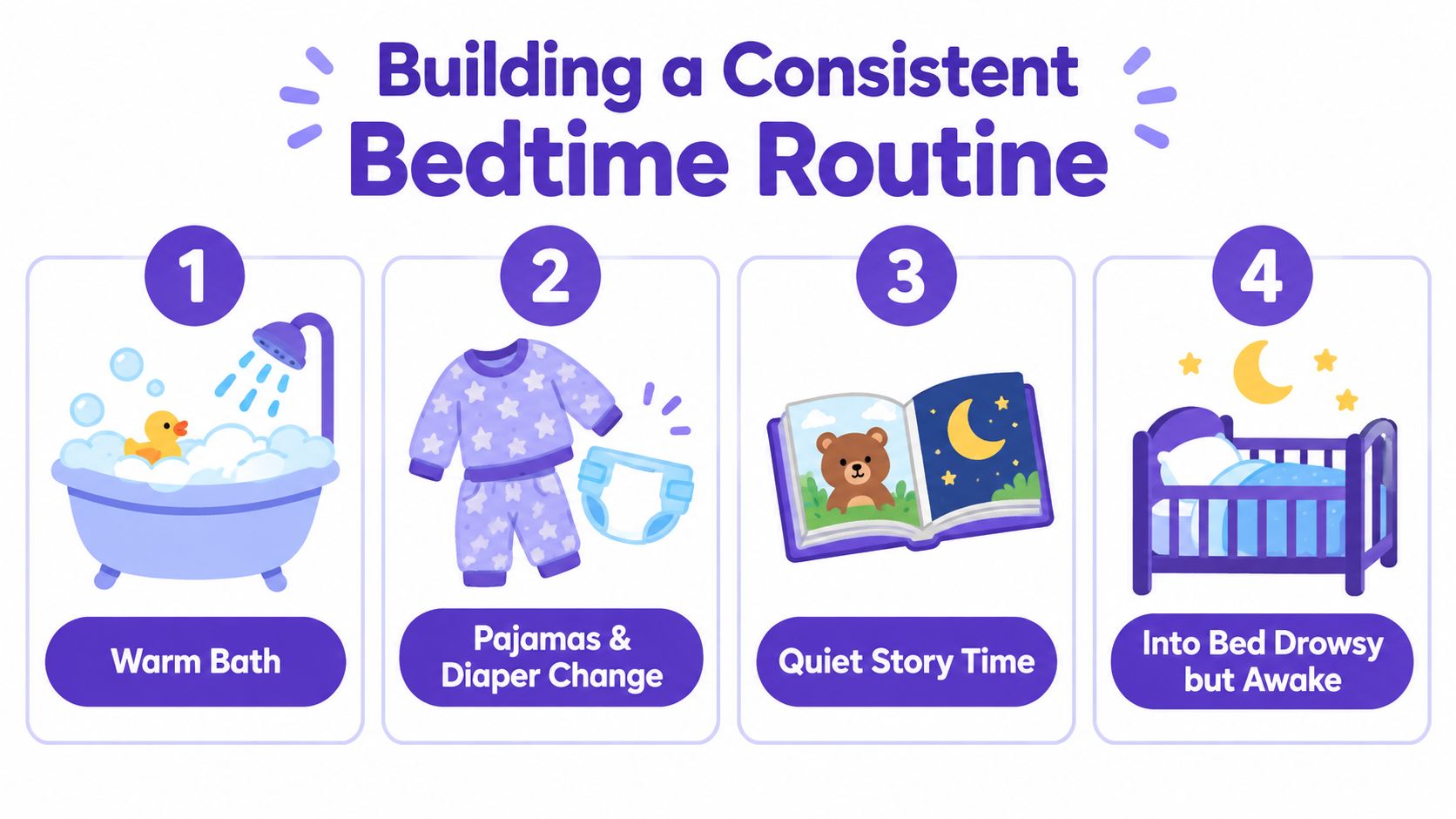
A reliable checklist looks like this:
Bath or quick wash-up. Not every child needs a full bath nightly, but the cue matters. Warm water can help shift the mood from play to wind-down.
Fresh diaper and pajamas. Keep the room calm and boring. Low light helps.
Short feeding if needed, then books. If your child still has milk before bed, avoid making the feed the final step before sleep. Put a little space between feeding and crib when you can.
Into bed drowsy but awake. This is the part many parents skip because it feels harder in the moment. It matters because it teaches your child where sleep begins.
What to remove from the evening
If bedtime has turned into a second play window, strip it down. Loud toys, screens, roughhousing, and last-minute snacks can all make settling worse. Some families find it helpful to review sleep preparation advice from Vinson because the reminders are practical and easy to apply in a real home, not just in an ideal one.
You can also use sound strategically. A steady fan or white noise machine can make the room feel consistent from bedtime through night wakings. If you want setup ideas, the Bornbir white noise guide is a useful reference.
Bedtime routines work because they reduce decision fatigue for both of you. Your child stops wondering what happens next, and you stop improvising when you're already tired.
What a good routine is not
It's not long. It's not stimulating. And it's not a string of extra “just one more” delays.
If your current routine includes rocking, another bottle, another song, another lap around the room, and another rescue after crib transfer, that's usually a sign the routine has become a sleep crutch chain. At one year old, simpler is better.
Comparing Sleep Training Methods for Toddlers
Parents usually don't need more method names. They need help choosing the one they can follow at 2 a.m.
Behavioral sleep interventions for infants and toddlers are often delivered in just a few sessions and work by reducing parental involvement at sleep onset so the child learns to fall asleep and resettle independently. An umbrella review of 24 studies found these interventions increased sleep for both infants and parents, with positive bedtime routines and parent sleep knowledge as core components, according to this PubMed review summary.
That broad finding is useful, but one-year-olds still vary a lot. Some get more upset when a parent stays in the room. Others escalate if a parent leaves.
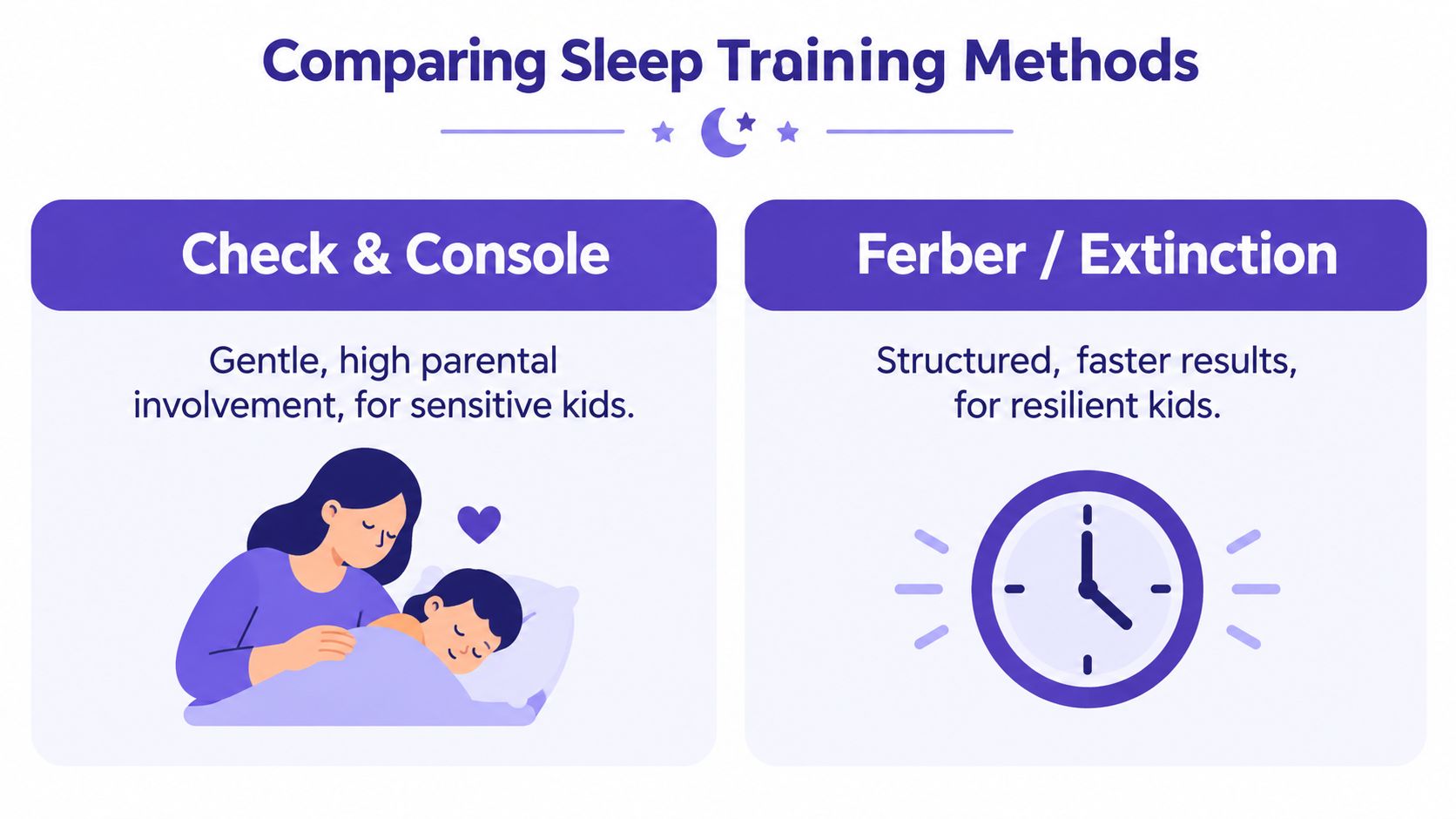
Side by side comparison
| Method | How it works | Best fit | Common problem |
|---|---|---|---|
| Graduated extinction | You put your child down awake and do brief checks at increasing intervals | Parents who want structure but not constant presence | Checks can overstimulate some toddlers |
| Camping out | You stay in the room and reduce your presence gradually over time | Parents who want a gentler-feeling option | Some children cry harder because they can see you |
| Bedtime fading | You temporarily move bedtime later so your child falls asleep faster, then shift earlier | Children who lie awake too long at bedtime | It fails if the daytime schedule is off |
What usually works best at 12 months
If your child is tired but not frantic, graduated extinction often gives the clearest routine. You do the same thing at bedtime and night wakings. Brief check-ins should stay brief. They are there to reassure, not restart the whole bedtime process.
If your child gets furious when you leave but calms somewhat with your presence, camping out may feel more manageable. Just be honest with yourself. If sitting beside the crib turns into hour-long negotiations, it's not gentle anymore. It's just prolonged.
If your child is partying in the crib and not even close to sleep, bedtime fading can be smart. Trial-based guidance commonly uses it when a child is too alert at the usual bedtime. In that case, the first fix is often schedule timing, not more soothing.
A decision filter parents can use
- Choose graduated extinction if your child gets more worked up by being picked up repeatedly.
- Choose camping out if leaving the room causes instant panic and you can stay calm and consistent.
- Choose bedtime fading if bedtime resistance looks more like alertness than distress.
What matters most: Pick one method you can repeat without changing the rules every night.
If your child is also trying to climb out or you're weighing a room change, sleep training can get tangled up with furniture decisions. Families often benefit from reading tips for switching to a toddler bed before making that move too early. If you want a broader look at approach options, this overview of gentle baby sleep training can help you compare philosophy as well as technique.
Managing Night Wakings and Wake Windows
Night wakings feel personal when you're living through them. Usually, they're not. They're often the result of timing, habit, or a child needing the same help returning to sleep that they needed at bedtime.
Wake windows matter more than many parents expect
For one-year-olds, bedtime often improves when wake time before bed is appropriate. Older babies and toddlers often need 5 to 6 hours of awake time before bed if they are on one nap, while babies still taking two naps usually need 3 to 4 hours awake before bed, based on wake window guidance for older babies.
That's one of the biggest reasons sleep training one year old can feel confusing. A child on two naps may resist bedtime because the last wake window is too short. A child pushed too fast to one nap may melt down by dinner, then wake often overnight from overtiredness.
Read the waking before you respond
Not every wake needs the same response. Look at the pattern.
- A wake soon after bedtime often points to overtiredness, under-tiredness, or a child who fell asleep with a lot of help and wants that help again.
- A wake at a predictable time every night often becomes habitual.
- A sudden messy night after a good stretch may point to teething, illness, or a schedule disruption.
Pause for a moment before going in. Some toddlers resettle if given space. If you do respond, use the same method you chose at bedtime. Night consistency matters.
What helps and what usually backfires
A simple troubleshooting list:
- Help first with timing. If naps run too late or bedtime floats all over the place, method changes won't stick.
- Keep responses boring. Dim lights, few words, no new play.
- Repeat the bedtime plan overnight. If bedtime is independent but every night wake gets rocking, your child learns two different rules.
- Avoid random rescue patterns. Doing checks one night, full rocking the next, and bringing your child into your bed at dawn creates a powerful mixed signal.
A one-year-old can protest a limit and still be safe, loved, and capable of learning a new sleep pattern.
If feeds are still part of the night, handle that thoughtfully. Some one-year-olds still wake from habit more than hunger, but if you're unsure about nutrition or growth, check with your pediatric clinician before cutting night feeds abruptly.
Safety and Developmental Considerations
You finally choose a plan, then your one-year-old starts pulling to stand in the crib, crying harder at separation, and testing every limit at bedtime. That is often the point where parents wonder whether sleep training is still appropriate or whether the setup itself needs to change.
At 12 months, safety questions are less about newborn rules and more about mobility, climbing, and containment. A child who can stand and cruise changes the practical side of sleep training. Check the mattress height, remove anything that can be used as a step, and make sure the crib still matches current safety standards. If your child is close to climbing out, that becomes a setup problem first, not a behavior problem.
When to pause and when to proceed
Pause formal training if your child is sick, in clear pain, or going through a major disruption that has thrown sleep badly off course. A fever, ear infection, vomiting, or obvious teething pain calls for comfort first.
If your child is healthy but practicing new skills in the crib, training can usually continue. Expect some rougher nights when standing, babbling, or early walking take over at bedtime. In practice, I usually advise parents to keep the bedtime response consistent while giving the child a little time to settle after those bursts of activity.
Crib, room, and separation questions
Many parents consider a toddler bed right when sleep gets hard. In most cases, that move makes training harder at 12 months, not easier. A crib gives clearer boundaries, and clear boundaries matter when separation anxiety rises and impulse control is still immature.
Move to a toddler bed when the crib is no longer safe, especially if climbing out is becoming realistic, or when your pediatric clinician has given a specific reason to switch. If those issues are not present, keeping the crib is usually the simpler choice.
A safer setup at this age usually means:
- Lower the mattress as your child grows and becomes more mobile.
- Remove climb aids such as large stuffed animals, pillows, or stacked blankets.
- Keep the room simple so the sleep space does not turn into a play zone.
- Check monitor cords and furniture placement if your toddler can now reach farther than before.
If you want a practical refresher, Bornbir safe sleep tips gives a useful checklist.
The emotional side matters too
Separation anxiety is common at this age, and it changes the feel of sleep training. A younger baby may fuss from overtiredness or habit. A one-year-old often protests because they understand that you are leaving and want you back.
That does not mean the plan is unsafe or unkind. It means the limit feels harder.
The job is to tell the difference between protest and a genuine problem. Crying because bedtime changed calls for a calm, predictable response. Crying with illness, pain, or an unsafe sleep setup calls for something different.
Setting Realistic Expectations for Success
At 12 months, progress rarely looks neat. You may get three better bedtimes, then a rough night after a late nap, a daycare schedule shift, or a fresh wave of separation protest. That does not mean the plan stopped working. It usually means your child is in a stage where sleep skills, schedule needs, and developmental changes are all moving at once.

What success usually means at this age
For a one-year-old, success is a more predictable bedtime, less help needed to fall back asleep, and a schedule that starts making sense again.
It does not require a child who sleeps perfectly every night. In practice, many families see bedtime improve first. Night wakings often get shorter before they disappear. Naps can lag behind, especially if your toddler is stretching wake windows or starting to wobble between one and two naps.
That last piece matters more at 12 months than many parents expect. Some children still need two solid naps. Others are starting to resist one of them, but are not ready for a full one-nap schedule every day. If the schedule is off, sleep training can look like it is failing when the bigger issue is timing.
What the evidence supports
Research on behavioral sleep interventions supports short-term improvement in sleep and parent well-being, not a guarantee of perfect long-term sleep. Earlier in the article, I noted the review evidence showing benefits for some families without signs of later harm to attachment or child emotional outcomes.
That lines up with what I see in real homes. Sleep training is usually not about changing your child's temperament. It is about reducing the amount of chaos around sleep so the whole household can function better now.
A practical expectation helps here. You are aiming for better patterns, not a flawless sleeper.
What progress often looks like in real life
Look for small changes that hold over several days:
- Bedtime gets shorter and less dramatic
- Your child needs less intervention between sleep cycles
- Naps land at more predictable times
- Evenings feel calmer because you are no longer improvising every night
Some pushback is normal, especially early on. If sleep suddenly gets harder after a few decent nights, check the schedule before you scrap the method. At this age, a wake window that is too short or too long can create the same kind of protest parents often blame on the approach itself. It is also common to hit a temporary spike in crying or protest. This guide on a sleep training extinction burst can help you tell the difference between a normal bump and a plan that needs adjusting.
The standard that helps families most
Consistency beats perfection.
Use a method you can follow at 2 a.m. Keep the bedtime routine steady. Adjust wake windows as your toddler's naps shift. Expect a few setbacks during illness, travel, teething, or developmental leaps.
If you stay steady through those bumps, most families get enough improvement to make daily life easier. That is a meaningful result.
If you want more support than a blog post can give, Bornbir helps parents find sleep coaches, postpartum professionals, and other perinatal support based on their actual needs. If your one-year-old's sleep has turned into a schedule puzzle, a bedtime battle, or a family burnout issue, it's a practical place to look for one-on-one help.