
You've got enough on your plate already. The baby finally sleeps, the bottle is rinsed, and then your tooth starts throbbing, or a crown pops loose right before a pediatrician visit. In NYC, that kind of problem turns into a logistics mess fast, especially when you're juggling a newborn, a stroller, insurance paperwork, and zero patience for a waiting room across town. Urgent dental care NYC only works when you know where to go before you're in pain.
Dental emergencies in this city are not rare, and they're not always nighttime problems. People end up in emergency departments during normal business hours too, which shows the core issue is access, not just timing. If you're newly postpartum, pregnant, or caring for a baby, the biggest mistake is trying to “wait it out” without a plan.
Understanding Urgent Dental Care in NYC
A parent can go from fine to miserable in one breakfast. The tooth that felt a little sensitive yesterday can turn into a sharp, constant ache while you're bouncing a baby, and suddenly you're trying to find care while one hand holds a diaper bag and the other is on the phone. That's how urgent dental care NYC really shows up, not as a neat appointment, but as a crisis squeezed between feeding schedules and transit delays.

Why planning beats panic
In a city this dense, “I'll find someone later” often means you won't. Same-day dental access is uneven, insurance networks are confusing, and a parent dealing with sleep deprivation doesn't have the energy to call ten offices while the baby cries in the background. A basic plan, one clinic to call, one backup option, and one person who can watch the baby, saves you time and pain.
Practical rule: If you're newly parenting in NYC, keep one urgent dental contact saved before you need it.
The best local setup is simple. You want a dentist or clinic that can assess pain, swelling, broken teeth, or a lost restoration quickly, then tell you whether you need a procedure now or a follow-up later. If your support system is thin, postpartum help matters too, and postpartum doula support in NY can make it easier to get out the door for care without turning the whole day upside down.
Urgent dental care is not the same as routine dentistry. Routine cleanings can wait. Severe pain, trauma, swelling, or a damaged tooth can't. That's the line you should use when deciding whether to start calling right away.
When Is a Dental Problem an Emergency
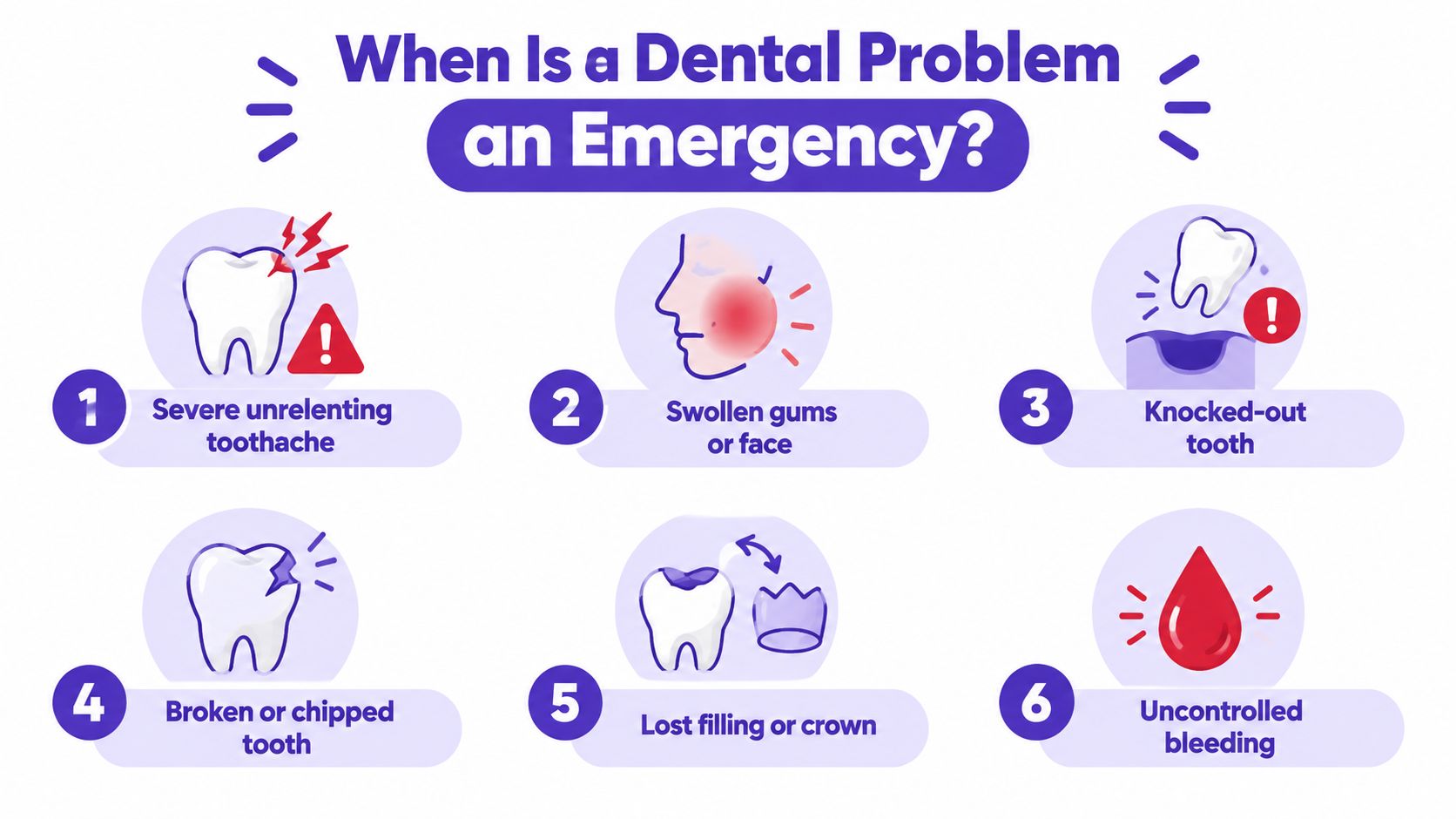
Some tooth problems are annoying. Others are urgent, and parents need to stop guessing. If the pain is severe, the tooth is knocked out, the face is swelling, or bleeding won't stop, treat it as time-sensitive and get help quickly.
The symptoms that mean stop waiting
A severe, unrelenting toothache usually means something deeper is wrong, not just a little irritation. Swollen gums or a swollen face can point to infection, and facial swelling is the kind of symptom you don't try to manage with patience alone. A knocked-out tooth is time-sensitive because the chances of saving it depend on acting quickly.
Don't downgrade obvious damage
A broken or chipped tooth becomes more serious when there's pain, sharp edges, or a visible crack. A lost filling or crown isn't always a disaster, but if it exposes sensitive tooth structure or causes pain, it needs fast attention. Uncontrolled bleeding after an injury is another hard stop. Keep pressure on it and get evaluated.
If swelling is moving into the face, or you're having trouble swallowing, don't treat that like a normal dental issue.
Use your child's pediatric guidance as a model for your own decision-making too. Parents already know to use a clear threshold for care, and a pediatrician call checklist is a good reminder that the right move is usually the one you make early, not late. That same mindset applies to your mouth.
If you're unsure, don't sit on it. A clinic can sort out whether it's urgent or just uncomfortable. Waiting only makes the visit harder, costlier, and more disruptive.
ER vs Emergency Dentist - Which Path to Take
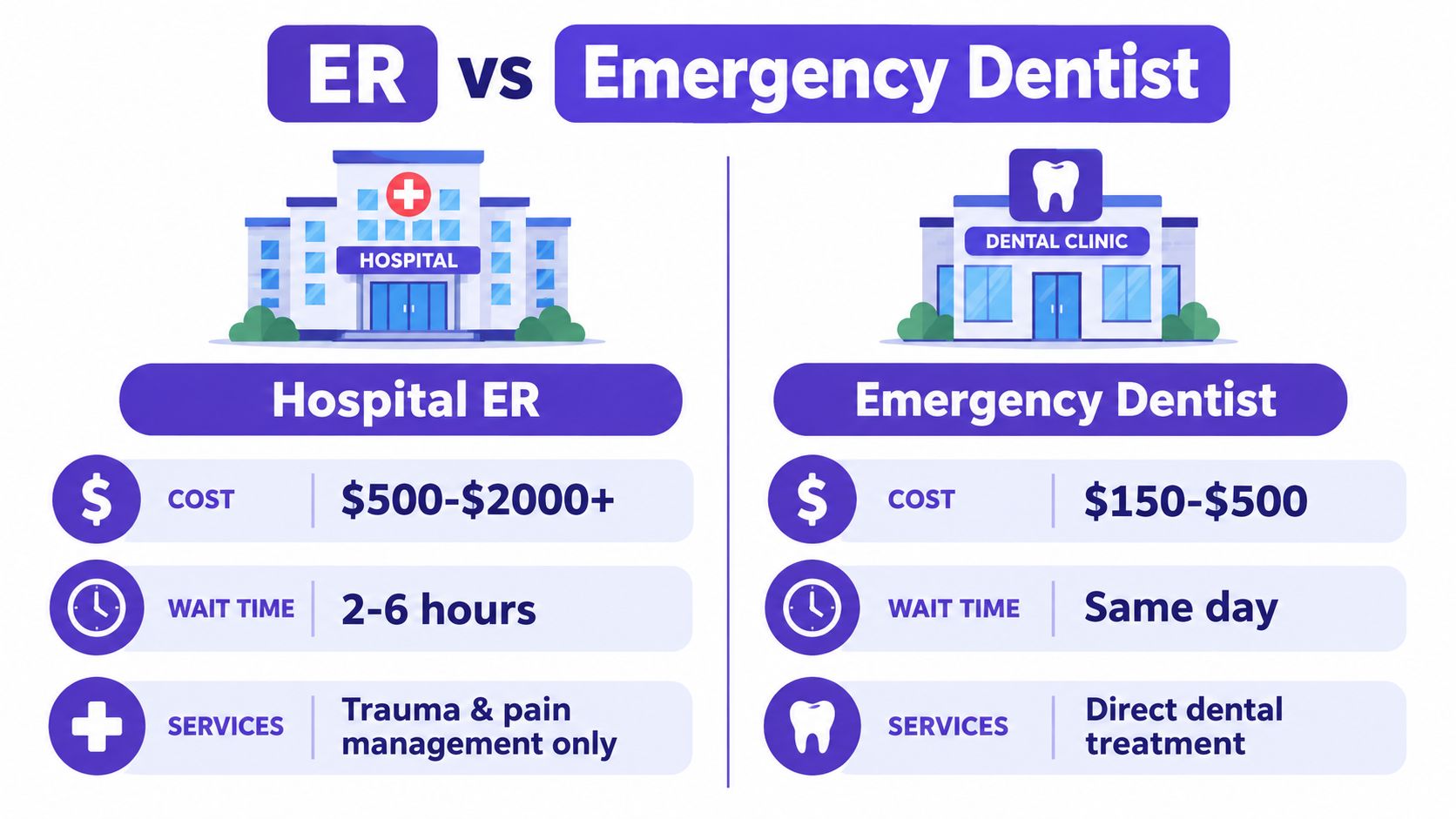
A lot of NYC parents waste time going to the wrong place first. The emergency room is the right move for serious medical danger, but it usually isn't where you get definitive dental work done. An emergency dentist is usually the better first stop for tooth pain, a broken tooth, a lost crown, swelling that still feels localized, or a dental abscess that needs direct treatment.
Why the ER gets overused
NYC has a long history of avoidable dental emergency-department use. The city documented more than 180,000 preventable oral-health emergency-department visits among adults from 2009 through 2014, about 1% of all adult emergency-department visits, equal to 874 preventable oral-health visits per 100,000 residents. People ages 21 to 30 accounted for 33% of those visits, and 60% of weekday visits happened between 8 a.m. and 6 p.m. according to the city's report on preventable oral-health visits. Those numbers point to access problems, not just bad timing. NYC DOH data brief
What each path is good for
An ER can stabilize serious swelling, trauma, or symptoms that look medically dangerous. It's the safer choice if there's trouble breathing, trouble swallowing, or a bigger injury involving the jaw or face. But if the underlying problem is a tooth that needs treatment, the ER often becomes a detour.
An emergency dentist is built for the actual dental problem. That means diagnosis, drainage, temporary relief, or treatment planning without bouncing you back and forth. If you want a practical comparison, the bornbir guide to family house calls is a useful reminder that the best care is the care that reaches the problem directly, not the care that sends you into another waiting pattern.
For new parents, this choice matters because every extra stop means more time arranging childcare, parking, and transit. If the issue is clearly dental, start with dental care.
Finding Same-Day and Walk-In Dental Clinics
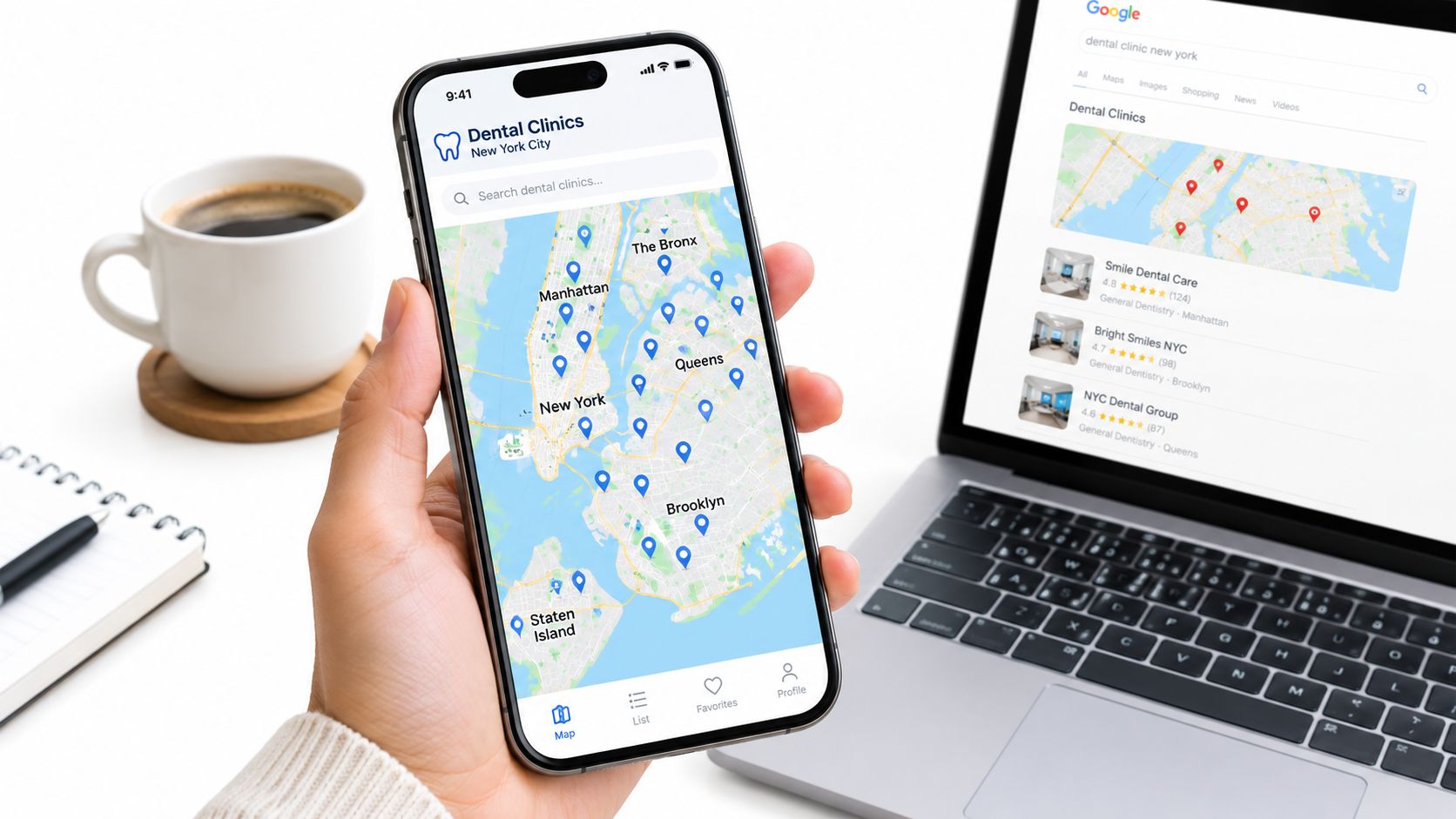
The fastest way to find care is to stop searching broadly and start searching locally and specifically. Look for clinics that say same-day, walk-in, urgent, or emergency on their own sites, then call before you leave home. If you're using teledentistry or a phone triage, use it to confirm that the clinic can treat the problem that day.
Search smart, not wide
Start with your borough, then widen only if needed. In NYC, travel time can kill same-day access, especially with a baby in tow, so a clinic in Queens or the Bronx that can see you today may be more useful than a closer office with no opening. Call early, ask whether they handle pain, swelling, broken teeth, or a lost restoration, and ask whether they accept your insurance before you get on the train.
Use state and city resources too. New York State keeps a dental directory that includes Medicaid-accepting clinics, and the state's Medicaid dental page notes that members can sometimes use teledentistry when appropriate and can call 311 for help finding a dentist. Medicaid transportation through NYC Human Resources Administration can also arrange no-cost scheduled rides to medical appointments, including dentist visits. For a true medical emergency, the city says to call 911. NY State Medicaid dental guidance
What to ask before you go
Ask whether they handle same-day extractions, drainage, temporary repairs, or just evaluation. Ask whether they want you to bring insurance cards, X-rays, or medication lists. Ask whether they can see a baby carrier, stroller, or a partner waiting with you, because logistical flexibility matters when you're a new parent.
Good question to ask: “Can you treat this today, or are you only doing an exam and referral?”
That one sentence saves time. It tells you whether you're heading to real treatment or just another stop.
How Paul L. Gregory, DDS Can Help
When you need a place that can handle both urgent pain and the bigger picture, Paul L. Gregory, DDS is worth knowing about. It's a Midtown Manhattan practice at 57 W 57th St, which is a practical location if you live or work near Central Park South, Columbus Circle, or Midtown West. For parents trying to fit care into a packed day, location alone can make or break whether you get seen.
What it solves for urgent-care patients
This kind of office matters when the problem is not just pain, but uncertainty. A parent may need quick assessment for a fracture, infection, or broken restoration, then a straight answer on whether the issue can be stabilized now or needs deeper treatment later. That's the gap many emergency settings leave open.
The practice combines family, cosmetic, restorative, and emergency dentistry, which is useful when one issue leads into another. A broken tooth may need temporary relief today and a crown later. A painful infection may need short-notice care now and a more complete fix after the swelling settles.
Why the setup helps busy families
A single office that can handle prevention, diagnosis, restorative work, endodontics, oral surgery, pediatric dentistry, and urgent visits reduces the referral shuffle. Parents don't need to explain the same history to three different offices if one practice can manage more of the case. The clinic also uses digital X-rays, intraoral cameras, and impression-free scanning, which helps make the visit smoother and faster.
The strongest practical point is continuity. For new parents, that means less time lost to repeating the same story and fewer gaps between diagnosis and treatment. If you want a deeper read before choosing care, their resource on urgent dental care in NYC is a useful place to compare how urgent visits are handled.
This is the right choice when you want a Midtown option that can move from urgent evaluation to real treatment without sending you all over the city. It's especially useful if your schedule is tight and your tolerance for back-and-forth is basically zero.
Navigating Insurance and Costs for Urgent Care
The worst time to decode dental coverage is when a baby is crying in the background and your tooth is flaring up. Parents in NYC get hit with a mess of terms like urgent, emergency, sliding scale, and low-cost, but none of that tells you the actual bill or whether the office can fix the problem. Call ahead and get a straight answer before you leave the house.
What to clarify before treatment
Ask how the visit will be billed, as an exam, a procedure, or both. Ask whether X-rays, drainage, extraction, fillings, or a temporary repair are separate charges. Ask whether the office takes your plan directly or files a claim after the visit. Those details matter more than the language on a clinic page.
For uninsured or underinsured patients, the numbers can still be murky. A recent NYC-focused compilation reported notable uninsured shares at some health-center systems, including 25.9% at Family Health Centers at NYU Langone and 23.3% at NYC Health + Hospitals health-center sites, while also noting an $85 urgent-care examination fee at NYU with pain-relief procedures billed separately. NYC clinic cost overview
Don't assume antibiotics solve it
For common pulpal or periapical problems, antibiotics are usually not the answer. The core issue is infected or inflamed tissue, and the fix is local care such as pulpotomy, pulpectomy, nonsurgical root-canal treatment, or incision and drainage. Antibiotics make sense when there is systemic involvement like fever or malaise, or when definitive treatment is not available right away and symptoms are getting worse. ADA antibiotic stewardship guidance
Practical rule: If a clinic only offers pills and no plan for the tooth itself, keep looking.
Parents also need to ask whether Medicaid transportation, teledentistry, or a different site can lower the burden. If you are pregnant, caring for a newborn, or recovering postpartum, cost is only half the issue. The other half is whether you can realistically get there and be treated. If you're dealing with pregnancy, newborn care, or postpartum recovery, understanding how coverage works matters, and our guide on are doulas covered by insurance in 2026 breaks down a related insurance question many parents face. That's why clarity beats guessing every time.
Immediate First Aid for Dental Emergencies
When the pain hits at home, keep the first steps simple. You're not trying to solve the whole dental problem in the bathroom. You're trying to protect the tooth, reduce damage, and get to care without making things worse.
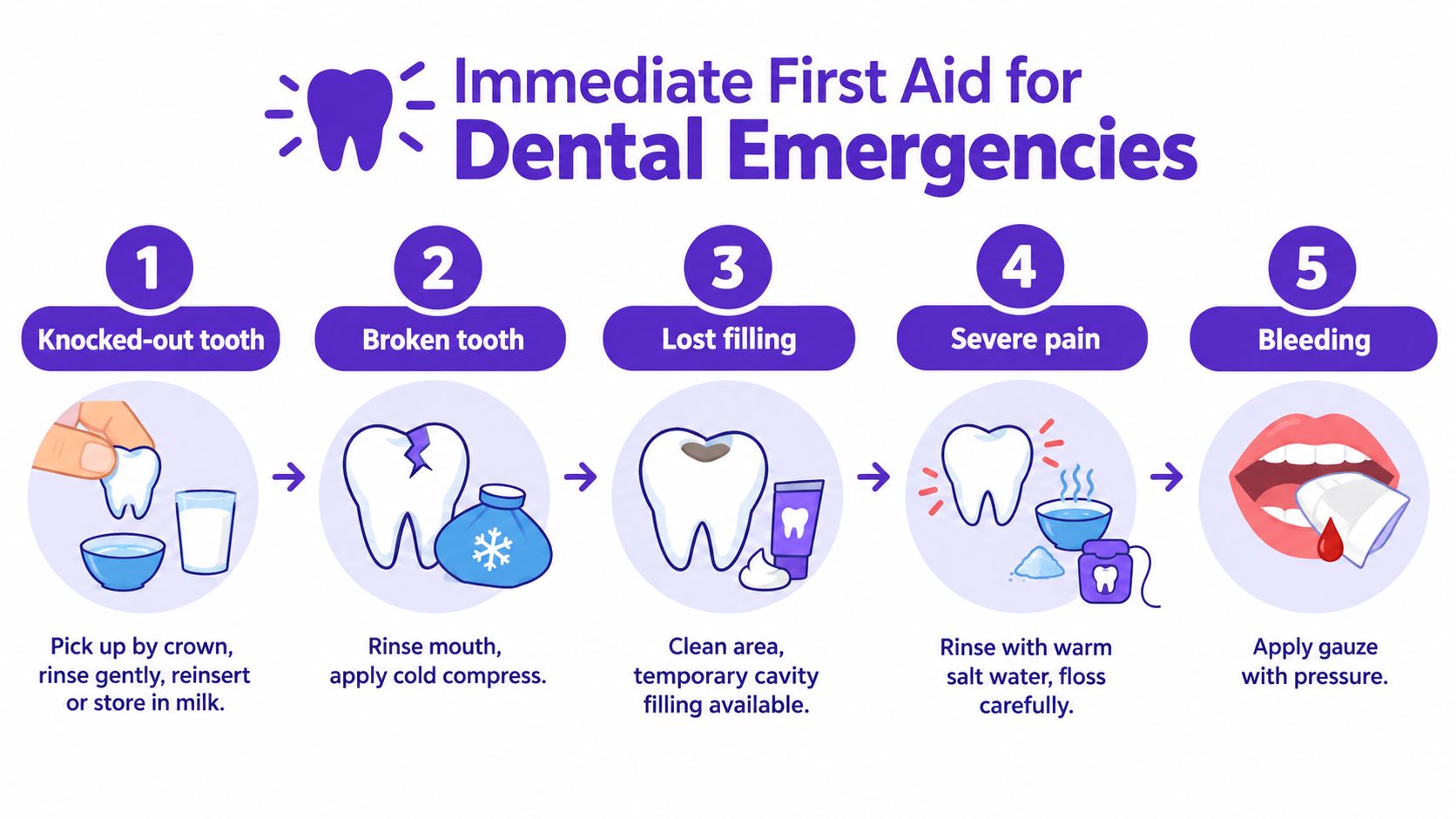
What to do right away
If a tooth is knocked out, pick it up by the crown, rinse it gently if needed, and try to place it back in the socket. If that's not possible, keep it moist in milk while you head out. If a tooth is broken, rinse your mouth and use a cold compress on the outside of the face. If bleeding won't stop, apply gauze with pressure and keep checking it.
For a lost filling, clean the area carefully and avoid chewing on that side. For severe pain, rinse with warm salt water and floss gently in case something is trapped between teeth. Don't jam aspirin directly on the gums. Don't use heat on swelling. Don't try to pry anything loose with kitchen tools.
What parents should prioritize
If you're pregnant or caring for a newborn, safety and timing matter more than heroics. Keep the injured side quiet, avoid hard foods, and arrange help before pain gets worse. If you have a partner, neighbor, or relative who can watch the baby for an hour, use them. If not, call the clinic and explain the situation clearly so they can tell you whether they can move fast.
The guide to infant CPR classes is a reminder that parents prepare for emergencies at home all the time. Dental emergencies deserve the same mindset. A few calm steps buy you time, and time matters when a tooth can still be saved.
Special Considerations for Pregnant Women and New Parents
Pregnancy changes the mouth. Hormonal shifts can make gums more reactive, and that means a small problem can feel bigger, faster. New parents also have a different problem, not just the pain itself, but the fact that every appointment competes with feeding, sleep, and baby logistics.
The safest move is to keep routine dental care going during pregnancy and to treat urgent problems early instead of waiting for a better week. If you're expecting, tell the office you're pregnant when you book. If you're postpartum, say so too, because timing, positioning, and medication questions matter more than usual.
For new parents, the hurdle is not usually fear, it's coordination. Who watches the baby, how do you get there, and what happens if the appointment runs long? That's why flexible scheduling, teleconsults, and a close-in location aren't luxuries, they're what makes care possible.
A parent who ignores tooth pain to “get through the week” often ends up needing more time later, not less.
Keep your own checklist short. Save one dentist's number, know who can help with childcare, and keep your insurance card within reach. If swelling, fever, or worsening pain shows up, don't negotiate with it. Get seen.
Preparing for Your Emergency Dental Visit
Bring the basics and skip the clutter. You want photo ID, insurance cards, a medication list, and any loose crown, filling, retainer, or broken piece that came off. If you're pregnant, bring that up right away. If you're breastfeeding, mention it too.
Call ahead if you can, and say exactly what's happening. “Severe tooth pain and facial swelling” gets faster triage than “I think I need to see someone.” Ask whether you should eat first, whether you need a ride, and whether the office can treat the problem that day or only evaluate it.
If you're going with a baby in tow, plan like the visit may take longer than you want. Bring diapers, a bottle, and one extra layer of patience. The smoother your setup, the faster the office can focus on the tooth instead of your logistics.
If you're trying to handle urgent dental care NYC while also caring for a newborn, don't try to improvise every time pain hits. Save one reliable clinic, keep your insurance details handy, and line up childcare support before you need it. If you want a faster way to coordinate family support around appointments, Bornbir can help you compare postpartum help and related services so you're not doing everything alone.