
You've got a baby at home, or maybe you're recovering from a hospital stay and the idea of loading everyone into the car feels like too much. A clinician walking through your front door can sound old-fashioned, but for the right family, primary care house calls still make a lot of sense. They can turn a stressful day of parking, waiting rooms, and paperwork into a calmer visit where the doctor or nurse practitioner sees how life is going at home.
A home visit is not the same thing as urgent care in your living room, and it's not just fancy concierge medicine with a higher price tag. It's scheduled primary care delivered where you live, often by a physician, nurse practitioner, or physician assistant who follows you over time. That matters when the question isn't only, “What's the diagnosis?” but also, “Can this family safely manage medications, feeding, sleep, mobility, and follow-up right now?”
What Primary Care House Calls Look Like Today
A home visit starts differently from a clinic appointment. A clinician can weigh a newborn on a portable scale in a sunlit nursery, look at the layout of a hallway, check where medications are stored, and ask questions while a parent is holding the baby instead of juggling a stroller in a waiting room. That's the basic idea behind primary care house calls, a form of ongoing medical care brought to the home by a clinician who can diagnose, prescribe, and coordinate follow-up.
That model is broader than a one-time sick visit. It can cover chronic disease care, postpartum checks, medication review, and follow-up after discharge, but it also has limits. It's not the same as home health nursing, which usually focuses on tasks like wound care or therapy services, and it isn't a substitute for every office visit or emergency evaluation.
For a new parent, the appeal is easy to understand. A baby who is feeding poorly, a parent who is sore after birth, and a house full of sleep deprivation can make a routine appointment feel enormous. For a homebound older adult, the same visit can remove the barrier of transportation completely.
Practical rule: If the main problem is getting the person safely to care, a house call may help. If the main problem is needing imaging, emergency treatment, or a procedure, the clinic or hospital is still the better fit.
The rest of the decision usually comes down to four questions, who provides the visit, what problems it can solve, who qualifies, and what it costs. For families in the postpartum period, practical postpartum recovery tips can help you decide which concerns are normal home-care questions and which ones need a clinician at the door.
From Living Room to Exam Room and Back Again
A century ago, getting care at home was normal. A historical review reports that about 40% of physician-patient encounters happened at home in 1930 in the United States, then that share fell to 0.5% by 1996 as office-based medicine became the default. By 1980, house calls were already under 1% of primary care activity in the country.
The decline was even sharper in the middle of the century. A CDC historical report described a 77% drop in physician house calls between 1959 and 1971, with the share of visits that were house calls falling from 9.2% in 1958-59 to 1.7% in 1971. The clinic became the usual setting, while the home moved to the margins of care.
For families in the perinatal period, that history helps explain why a home visit feels unusual today even though it once fit everyday life. It also connects naturally to the role of an expecting parents home birth midwife, where care begins in the home and follows the family through a very personal stage of life.
Why the model came back
The return of house calls was not a nostalgia project. It grew as clinicians identified higher-need patients more clearly, and as payment systems began to support home-based care again. An AAFP review notes that the number of house calls from 1996 to 2016 doubled, and Medicare Part B billing reached nearly 2.6 million paid house calls in 2015.
The same AAFP review says older Medicare-related data showed only 0.88% of Medicare patients received physician home visits, while the Health Care Financing Administration recorded charges for 1.6 million home visits in 1996. A 2019 review also reported annual house calls rose 43% from 1.4 million in 1998 to 2.1 million in 2004, describing it as the first increase in a century.
Today, the model is narrower than it used to be. It is mainly reserved for people with higher needs, including mobility limits, caregiver strain, or complex chronic illness. Portable equipment helps, but the main change is in who benefits most. House calls are now a targeted tool for patients whose care improves when the clinician comes into their environment.
For new parents, that history matters because it shows both sides of the model. A home visit can be the right fit when a parent is recovering, a baby is hard to transport, or leaving the house feels like too much. It also helps set expectations. House calls today are not a broad replacement for office care, but a focused option for families who need care to come to them.
Who Actually Shows Up at Your Door
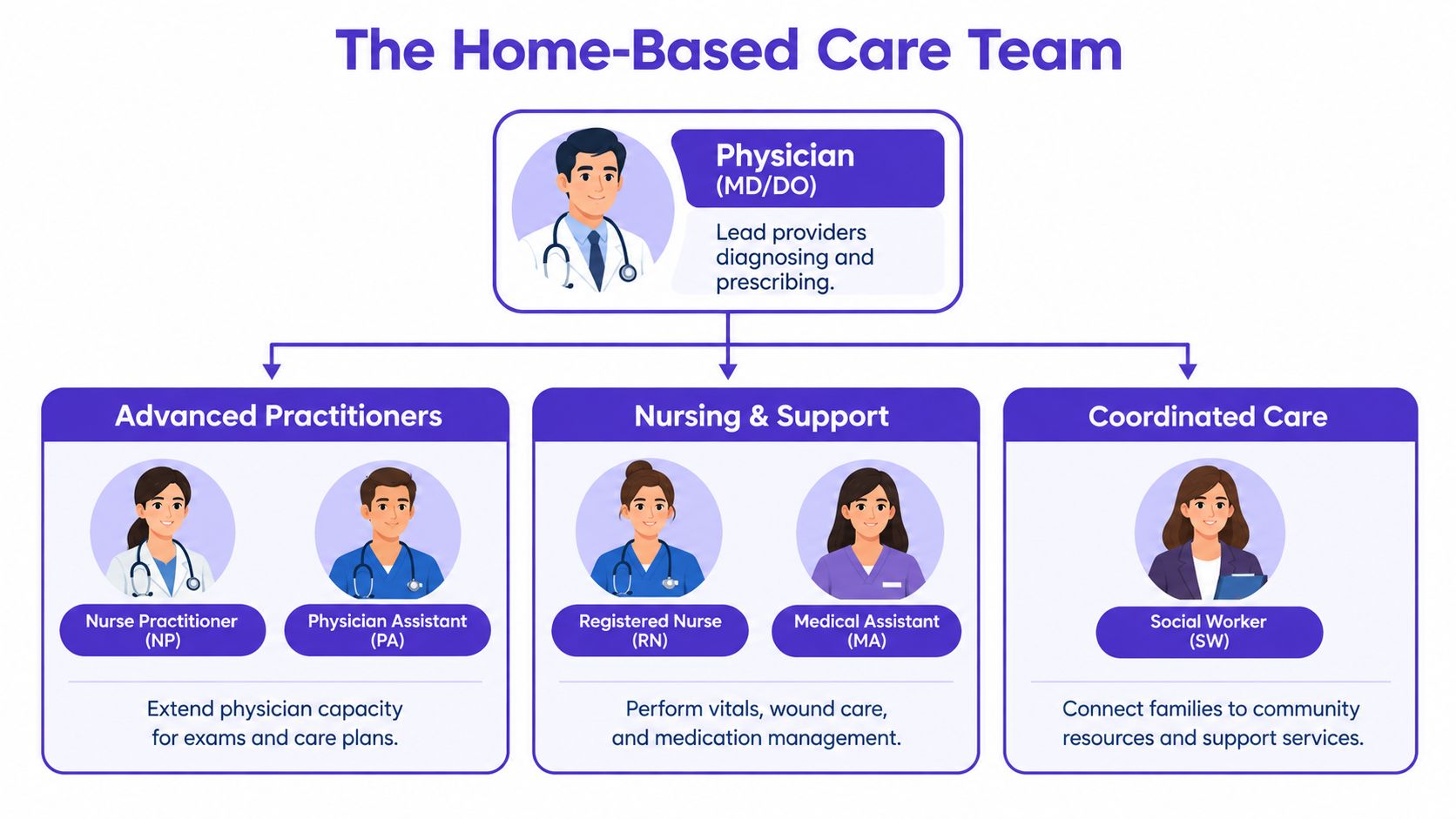
A house-call visit can be done by a physician, nurse practitioner, or physician assistant, and many programs add registered nurses, medical assistants, social workers, or community paramedics to the mix. In a small independent practice, one clinician may handle most of the visit and coordinate the rest by phone. In a larger home-based primary care program, the visit often feels more like a team effort, with different people handling vitals, medication reconciliation, care planning, or social needs.
What each person can usually do
A physician or advanced practice clinician can take the history, do the physical exam, review medications, make a diagnosis, and prescribe treatment. Nurses and medical assistants often handle vital signs, blood draws, wound care, vaccine prep, and medication lists. Social workers can help with caregiver burden, transportation planning, equipment, and community resources.
That team approach matters because a home is not a clinic room. The clinician can see fall risks, unopened pill bottles, how the baby is being fed, or whether a caregiver is stretched too thin. Those are medical clues, not background noise.
How the practice structure changes the experience
Some practices are independent solo services. Others are part of a health system, a mobile primary care group, or a hospice-linked team. The rules also vary by state, especially for nurse practitioners, whose independent practice or collaborative agreement requirements depend on local law. Cross-state telehealth can make consultation easier, but the person who walks in your door still has to be licensed where the patient is located.
Good question to ask: Who is supervising the clinician, what can they do on-site, and what happens if they need help from another clinician after the visit?
If you're looking for a family-centered resource that also includes perinatal support services, a guide to lactation consultant services can help you separate feeding support from general medical follow-up, which are related but not identical needs.
Benefits and Honest Trade-Offs of Home-Based Care
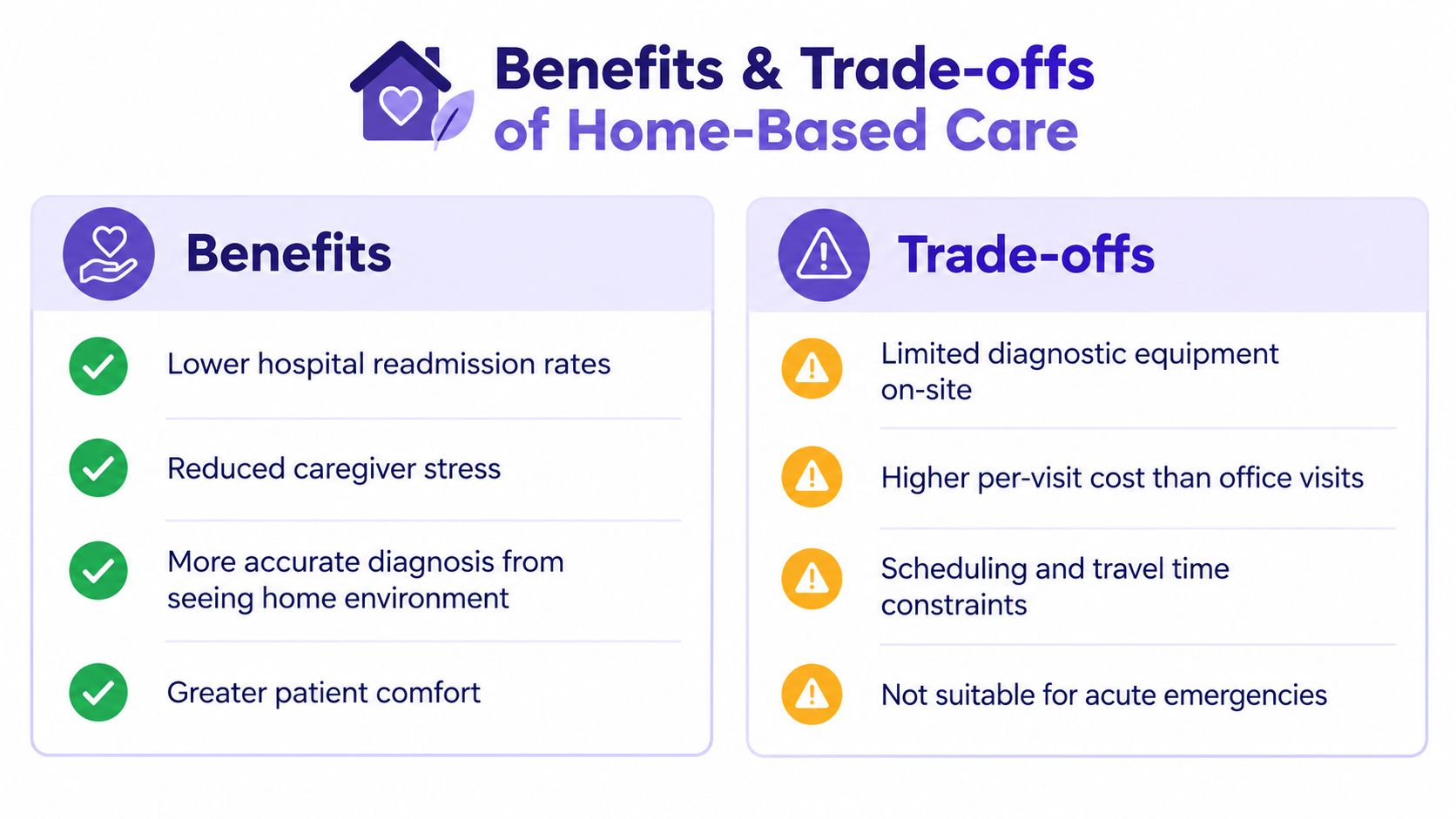
The clearest benefit of a home visit is that the clinician sees the patient in real life, not in a stripped-down exam room. That can change the medical picture fast. Medication bottles are easy to spot, mobility problems are obvious, and the actual setup of the home can explain why a plan is or isn't working.
The evidence base leans in that direction too. AHRQ's review found home-based primary care reduces hospitalizations and hospital days, with some evidence of fewer emergency and specialty visits, but no significant differences in function or mortality (AHRQ review). That's a useful reminder that the main measurable win is often utilization, not a dramatic short-term survival change.
Why families notice the difference
For new parents, the biggest upside is often practical. A newborn weight check at home can mean less packing, less exposure to crowded waiting rooms, and less stress when the parent is still recovering. If a baby is premature, medically fragile, or immunocompromised, avoiding a waiting room can feel like a real benefit even when the clinical need is simple.
House calls also help when the home environment itself is part of the assessment. The clinician can look at stairs, bathroom setup, sleeping arrangements, and the way caregivers are dividing tasks. That makes the visit feel more grounded, because the plan fits the household instead of assuming an ideal setup.
Where the limits show up
The trade-offs are real. A house call can't replace imaging, complex procedures, or the full diagnostic setup of a clinic. It can also take more time for the clinician, which usually means a smaller patient panel and less flexibility for spontaneous scheduling. Geography matters too, because many services only cover a defined area.
The cost picture is more complicated than the marketing. The strongest use case is still the patient who struggles to leave home, not the person who wants an easier appointment. That distinction matters for families deciding whether convenience alone is enough to justify the model.
Seeing the house often helps more than seeing the chart. It's not a luxury add-on, it's part of the exam.
How Life Primary Care Can Help
Life Primary Care is a house call primary care practice serving patients across northern and central New Jersey. Clinicians travel to the home for full-scope primary care, chronic disease management, wellness visits, urgent care, and diagnostics, while the coordination office in East Hanover handles scheduling, insurance verification, and follow-up. Care happens at home, not in a clinic, which is the whole point of the model.
The service is built for people who need care where they live. That includes people with trouble traveling, parents trying to manage recovery and newborn care, and families balancing multiple medications or specialist plans. It also includes older adults who do better when a clinician can see the home setting before making decisions.
Life Primary Care lists in-home services such as history and physical exams, chronic disease management, Medicare Annual Wellness Visits, post-hospital transitional care, geriatric and dementia care, palliative care, urgent same-day visits, in-home labs, medication review, and telehealth follow-up. The practical value is in the workflow. Results and care plans are communicated by phone, referrals are arranged before the clinician leaves, and the patient doesn't have to make the same trip twice.
If you're trying to understand how a visit works, the primary care house calls page lays out the service in plain terms. It's a useful fit when the problem is less about needing a hospital and more about needing a careful, in-person evaluation without leaving home.
For new parents, the most relevant use cases are the ones that blend medical follow-up with family logistics. A home visit can support early recovery, medication review after discharge, and a calmer first look at feeding, sleep, and parent well-being. It's not the answer to every newborn question, but it can be the right answer when leaving the house is the biggest barrier.
Who Qualifies and When Families Use Them
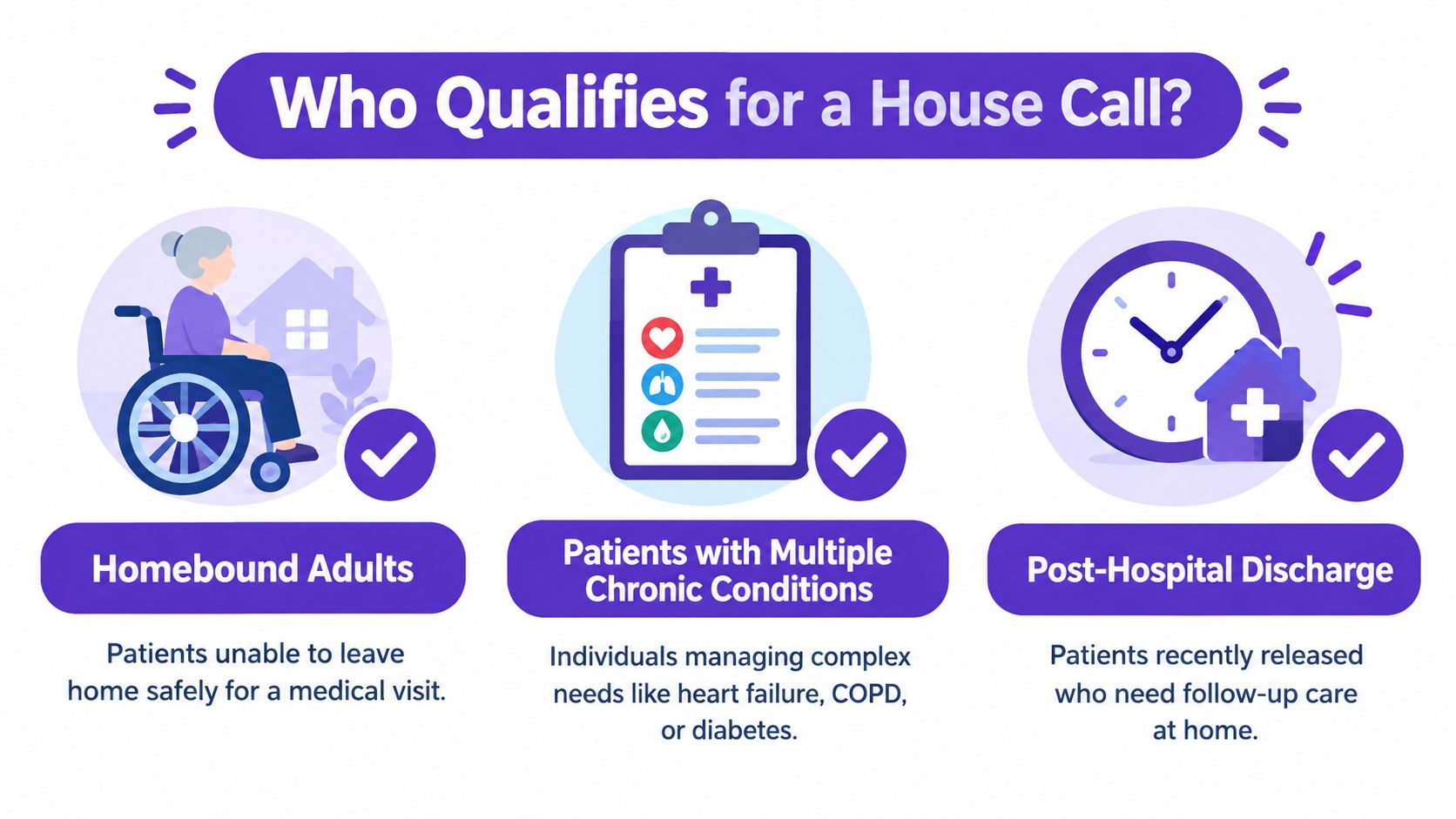
Most house-call programs start with a simple rule. The people who gain the most are usually the ones who have a hard time getting to a clinic safely or consistently. That includes homebound adults, patients managing multiple chronic conditions, people recently discharged from the hospital or skilled nursing, and people recovering from surgery.
For families in the postpartum period, the fit can be different but just as real. A parent might not be homebound in the classic sense, but they may still need an in-home check because moving around hurts, the baby feeds best in the home setting, or the family is dealing with a second child, a car seat, and no spare hands. In those situations, the house call is less about luxury and more about logistics.
Where the perinatal use cases fit
Postpartum home visits can include feeding support, weight checks for the baby, jaundice checks when clinically indicated, and screening for postpartum mood symptoms during the fourth trimester. Those visits often overlap with lactation help, newborn monitoring, and parent recovery, which makes the home a practical setting for care. A 2-week latch assessment or a 72-hour medication review after discharge are both easy examples of when a house call can make sense.
Eligibility varies a lot. Some practices accept any patient who can pay out of pocket. Others want documented homebound status or a referral from another clinician. Publicly supported postpartum home visit programs may be available through Medicaid, local health departments, or nurse-family partnerships, but the details depend on where you live.
If you're comparing options for a newborn or postpartum parent, how matches families can help you understand how some parent-facing services connect families with the right kind of support. The main point is simple. A house call works best when care needs to happen in the context of the home, not just in spite of the home.
Cost, Insurance, and What You Might Pay
Insurance is the first thing to check because house calls can be covered in one setting and not in another. Medicare Part B reimburses home visits when the clinician certifies that the patient is confined to the home and the visit is medically necessary. Some Medicare Advantage plans have expanded in-home primary care benefits through in-home risk adjustment programs, but the details still depend on the plan.
Medicaid coverage varies by state, and postpartum or home-health-eligible visits may be covered in some programs. Commercial insurance is less predictable, especially when the service is concierge or membership-based. If the practice is outside your network, you may be asked to pay first and seek reimbursement later with a superbill.
A practical cost snapshot
| Visit Type | Typical Coverage | Estimated Out-of-Pocket Range | Key Caveat |
|---|---|---|---|
| Medicare-covered home visit | Medicare Part B when medically necessary and homebound rules are met | Often tied to standard Medicare cost-sharing | Homebound certification has to fit the rules |
| Medicare Advantage in-home care | Varies by plan | Varies widely | Benefits depend on network and prior authorization |
| Medicaid postpartum or home-health visit | Varies by state and program | Often low or none when covered | Eligibility can be narrow |
| Commercial house call | Varies by insurer | Varies by provider and region | Network status matters |
| Concierge or membership model | Often limited or no coverage | Retainer fees can be substantial | Separate fees may apply for labs or equipment |
The best comparison is not just house-call price versus office copay. It's house-call price versus the actual cost of taking time off, arranging transport, missing work, and potentially landing in urgent care or the hospital. For some families, the saved stress is the core value. For others, the price only makes sense when the visit prevents something bigger.
If you're also comparing postpartum support services, the guide to doula insurance by Bornbir is useful for seeing how non-physician home support is often billed differently from medical care. That distinction matters because a doula, a nurse, and a house-call clinician don't play the same billing or clinical role.
Before booking, ask whether labs, durable equipment, and follow-up calls are billed separately, and whether the practice provides paperwork for out-of-network claims. Those details are where surprise bills tend to show up.
How to Find and Schedule a Trusted House Call
Start with the places that already know your care history. Your insurance portal, OB office, pediatrician, hospital discharge planner, and home-health agency are often the fastest routes to a real option. If you're postpartum, ask whether the clinician can coordinate with both the parent's doctor and the baby's pediatrician so the visit doesn't live in a silo.
Then check credentials. Confirm the clinician's state license on the medical board website, look up the NPI registration, ask about malpractice coverage, and review any sanctions or disciplinary history. That sounds formal, but it's the same due diligence you'd do for a clinic visit, just with less visibility if you skip it.
Questions worth asking before the visit
- Who is coming to the home? A physician, nurse practitioner, physician assistant, or another team member.
- What can they do on-site? Physical exam, vaccines, wound care, blood draw, EKG, or medication review.
- How are prescriptions handled? Ask how they send orders and which pharmacy they use.
- What happens if the visit turns into a bigger problem? You want a clear plan for referral or escalation.
- Do they coordinate with your usual clinicians? That matters if you already have an OB, pediatrician, or specialist.
Scheduling also has practical details. Ask how long the visit usually takes, whether a family member should be present, and how the practice handles pets, smoking, or cancellation fees. If a service refuses to share credentials, wants cash-only payment without explanation, or tells you to skip your regular pediatrician, treat that as a warning sign.
House calls fit best when the clinical question is about the person in context, not just the lab result. If you can safely get to a clinic, that may still be the simplest option. If getting out the door is the problem, a house call can be the more realistic one.
House Calls, Telehealth, and Clinic Care Compared
Telehealth is great when the question can be answered by talking and looking. A house call is better when touch, movement, the room, the meds, or the baby's feeding setup matter. A clinic visit still wins when you need broader diagnostic equipment, rapid in-office testing, or same-day escalation that's easier to arrange in a facility.
| Feature | House Call | Telehealth Visit | Clinic Visit |
|---|---|---|---|
| Physical exam | Direct exam at home | Limited by camera and history | Direct exam in office |
| Home environment review | Yes | No | No |
| Labs and imaging | Limited on-site, often coordinated later | Not on-site | Usually available or easier to arrange |
| Best fit | Mobility limits, postpartum checks, homebound patients, complex home assessments | Follow-up questions, medication discussion, minor issues | Broader workups, procedures, routine office care |
| Time and travel burden | Low for the patient, higher for the clinician | Lowest for the patient | Highest for the patient |
| Emergency use | Not for emergencies | Not for emergencies | Not for emergencies |
A few common questions
Can house calls replace a pediatrician? No, not usually. They can complement pediatric care, especially for newborn follow-up or specific concerns, but they should coordinate with the child's usual doctor.
Do they work in rural areas? Sometimes, but geography can make availability thin. The same is true for specialty coordination.
What happens if the problem is urgent? If the baby or parent is in distress, the home visit isn't the right level of care. Emergency services or the hospital are the better choice.
How do they fit with specialists? The good programs communicate the plan, send notes, and make the referral chain clearer.
The cleanest way to choose is to match the setting to the question. Use telehealth for simple follow-up, the clinic for deeper diagnostics, and a house call when the patient's home situation is part of the problem or part of the solution.
If you're trying to decide whether a home visit makes sense for a newborn, a postpartum parent, or an older adult in the family, start by checking insurance coverage, then ask a local clinician whether the visit would be medically useful. A house call is most useful when the home itself changes the care plan, and that's the standard worth using before you book.