
You've got an appointment coming up, a previous cesarean on your mind, and a growing list of questions about this birth. You might want a vaginal birth but worry about needing surgery again, especially if your last delivery changed quickly or left you feeling unheard.
The most useful VBAC preparation tips aren't about making yourself have a particular kind of birth. They're about knowing your options, checking the hospital's capabilities, and deciding how you'd like the team to handle changes. VBAC means vaginal birth after cesarean. TOLAC, or trial of labor after cesarean, is the attempt, which can end in either vaginal birth or another cesarean.
Check Your VBAC Eligibility and Odds
Start with your records, not a calculator result. Work through these factors with your clinician before treating any percentage as a personal forecast.
Factors that shift planned VBAC success
The Royal College of Obstetricians and Gynaecologists guideline reports planned VBAC success of about 72–75% overall, rising to about 85–90% with a previous vaginal birth, especially a previous VBAC. Those estimates inform the table below, but the overall figure isn't a separate estimate specifically for people without a prior vaginal birth.
| Factor | Effect on Success | What to Ask Your Provider |
|---|---|---|
| Previous vaginal birth, especially a previous VBAC | Raises success to the higher range described above | Does my history count as a prior vaginal birth in my record? |
| No prior vaginal birth (overall population reference) | The overall success estimate above includes people with different birth histories | What is my estimate based on my own history? |
| Cesarean for a nonrecurring reason, such as breech | Generally higher likelihood than a recurring indication | Is the original reason likely to happen again? |
| Maternal hypertension or obesity | Associated with lower success | How would these change my plan and monitoring? |
| Maternal age over 35 | Associated with lower success | Does my age change my estimate at this practice? |
| Pregnancy beyond 40 weeks | Associated with lower success | What is the plan if I reach 40 weeks? |
| Classical or contractile upper-uterus incision | Generally a contraindication to planned labor because of higher rupture risk | Which incision type do I have, and where is it documented? |
A clinical overview in StatPearls identifies age over 35, hypertension, obesity, and pregnancy beyond 40 weeks as factors associated with lower success, while a nonrecurring reason such as breech is favorable. These factors guide counseling. They don't all carry the same weight or automatically rule out labor.
Separate eligibility from probability
Eligibility asks whether attempting labor is medically appropriate. Probability asks how likely vaginal birth may be if you attempt it. Confirm the uterine incision in the operative report first, rather than guessing from your skin scar.
Then discuss cervical readiness, how labor might begin, and the reason for your earlier surgery. Learning how TOLAC scores work can help you ask what an estimate includes and what it leaves out.
Leave with a short written summary: your clinician's estimated range, the factors supporting it, and what might change it. If they can't give a meaningful range yet, record that uncertainty rather than filling in a number yourself.
Verify Questions and Birth Setting Readiness
A supportive conversation is a good start, but it isn't the same as an emergency-ready birth setting. Bring your operative report and keep the answers to these questions together so you can compare what the clinician and hospital tell you.
Ask the care team in order
- Confirm the uterine incision and any extensions. Ask your clinician to explain the location and wording in the operative report so your eligibility assessment rests on documented surgical details.
- Compare the clinician's policy with the hospital's policy. A clinician may support TOLAC while working within hospital restrictions that affect who can attempt it.
- Clarify triage after contractions or membrane rupture. You need to know whom to call, where to enter, and whether the team wants you assessed promptly.
- Request the hospital's induction protocol. Knowing the actual medications and procedures prevents a vague assurance from becoming a surprise during admission.
- Ask how counseling covers an intrapartum cesarean. The discussion should include your preferences, future pregnancy plans, and what happens if labor doesn't remain the safest option.
The ACOG-focused VBAC counseling presentation emphasizes emergency resources, including round-the-clock anesthesia, blood-bank access, intensive-care capability, and neonatal support. Ask whether those services are on site and immediately accessible, rather than available only through transfer.
Birth setting readiness checks for a VBAC labor
| Resource or Standard | Why It Matters in VBAC Labor | Question to Ask |
|---|---|---|
| Continuous electronic fetal monitoring | Heart-rate changes can signal trouble involving the previous uterine scar | Is monitoring continuous from the start of regular contractions? |
| Rapid emergency cesarean | Delay matters if rupture occurs | How quickly can an operating room be ready? |
| Round-the-clock anesthesia | Needed for emergency surgery | Is anesthesia staffed at all hours? |
| Blood bank access | Supports management of severe bleeding | Is blood group testing done on admission, and when is crossmatching needed? |
| Neonatal intensive care | Supports the baby if complications arise | Is neonatal intensive care on site? |
| Intravenous access and one-to-one labor support | Part of planned VBAC labor care | Is one-to-one support offered throughout labor? |
Check what routine care looks like
RCOG's patient guidance recommends continuous electronic fetal monitoring from regular contractions, along with intravenous access, blood testing, one-to-one support, and progress assessments at least every four hours once labor is established. Ask how staff combine those checks with movement, comfort measures, and privacy.
Try a concrete scenario: if the monitor pattern changes overnight, who assesses you, who performs surgery, and who calls anesthesia? An answer describing the actual staffing process is more useful than reassurance alone.
Practical rule: If the clinician and hospital give different answers, resolve the difference before labor, not at the admission desk.
A hospital with emergency surgical capability is the appropriate setting for this plan. A home or freestanding birth setting can't provide emergency surgery, and neither a doula nor an independent midwife replaces that capability. As you find providers supportive of VBAC, look for clear explanations as well as encouragement.
Plan for Induction and Changes in Labor
Spontaneous labor isn't the only acceptable goal. You can prefer labor that starts on its own and still prepare thoughtfully for induction, ruptured membranes, high blood pressure, low fluid, or labor that stops progressing.
Induction doesn't automatically remove VBAC eligibility. It does change the conversation about methods, monitoring, and whether continuing labor remains appropriate.
The AAFP summary of guidance and cohort evidence reports uterine rupture rates of approximately 0.52% with spontaneous labor, 0.77% with induction without prostaglandins, and 2.4% with prostaglandin-assisted induction in one large cohort. These are reported group outcomes, not predictions for your hospital or your individual pregnancy.
Uterine rupture risk by labor start method
| Labor Start | Reported Rupture Risk | What It Means for Your Plan |
|---|---|---|
| Spontaneous labor | About 0.52% | Preferred when it begins on its own and waiting remains appropriate |
| Induction without prostaglandins | About 0.77% | Review the agents and monitoring with your team |
| Prostaglandin-assisted induction | About 2.4% | Clarify before labor whether this is planned or a fallback |
Don't read the prostaglandin category as permission to use any medication within it. Misoprostol should not be used for term cervical ripening or induction after a prior cesarean. Ask for medication names, not just the general word induction.
This visual can help you organize the conversation around changes rather than a single expected path.
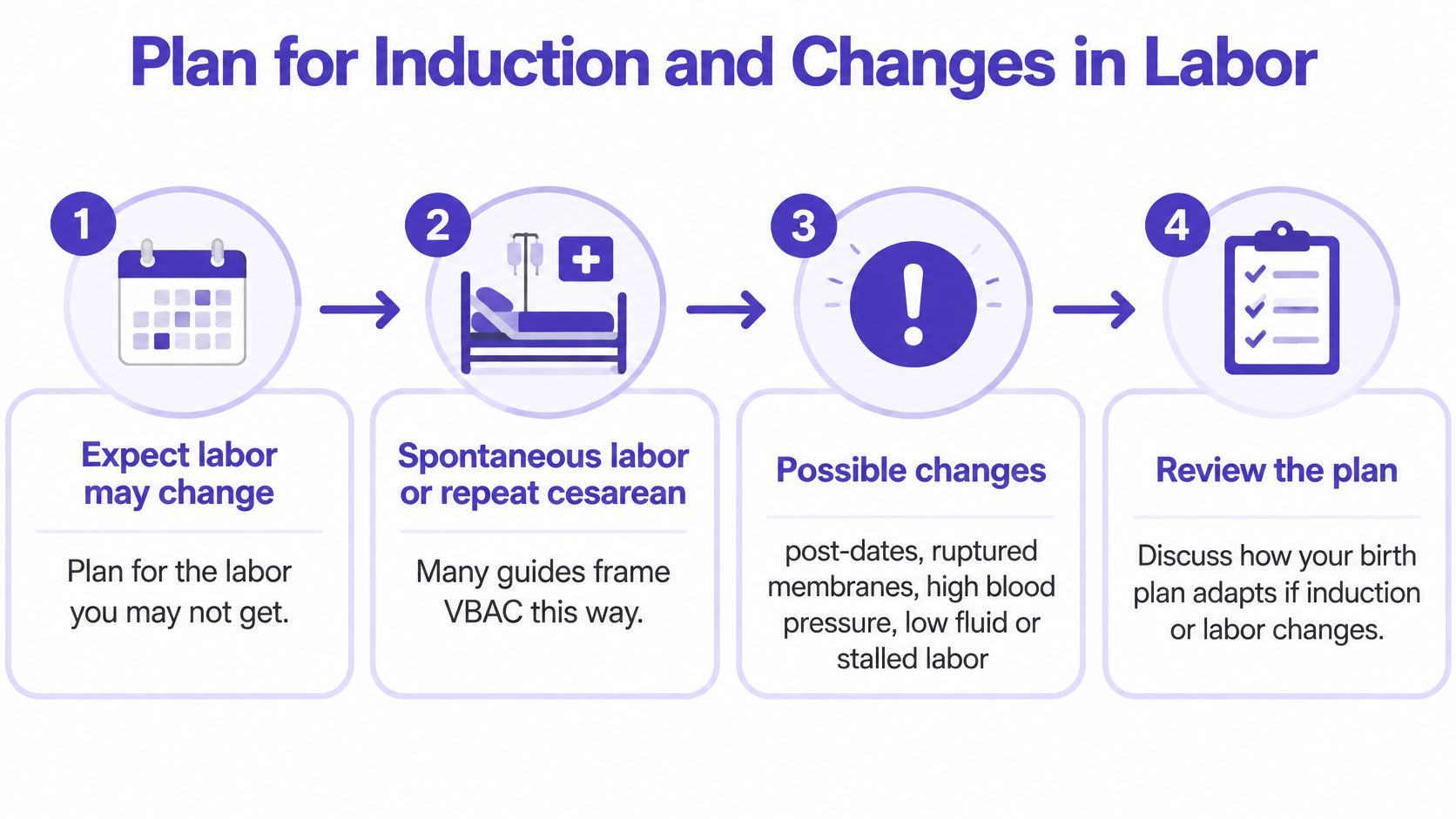
Map the decisions before you need them
If your water breaks without contractions, ask when to call and come in, how the team assesses you and the baby, and what would make waiting inappropriate. Don't create your own waiting deadline from someone else's birth story.
If the cervix needs ripening, ask which options the team considers appropriate with your uterine scar. Have them explain whether a mechanical option, such as a cervical balloon, fits your circumstances and what would rule it out.
If oxytocin is offered, ask whether the purpose is starting contractions or strengthening existing labor. Request an explanation of how the dose is adjusted, how contractions are assessed, and what findings would prompt stopping or reviewing treatment.
If you want an epidural, discuss it as pain relief rather than a test of commitment to VBAC. Ask the anesthesia team about assessment, timing, mobility, and any changes to your care or monitoring.
If progress slows or fetal concerns appear, ask what the team will reassess before recommending surgery. The answer should distinguish a situation with time for discussion from an emergency that needs immediate action.
While exploring induction options with Bornbir, make a list of terms you want your clinician to translate into plain language. General explanations help you prepare questions, but they can't select the safest method for your pregnancy.
Practice a changed-plan conversation
Say you arrive expecting to wait for spontaneous labor, but your clinician recommends delivery because of a new concern. Ask what has changed, what options remain, what the risks of waiting are, and when the team will reassess.
Your partner can write down the answers while you listen. If the situation isn't urgent, ask for time to discuss the choices privately. If it is urgent, ask the team to explain what they're doing as care proceeds.
Preparing for induction isn't giving up on vaginal birth. It's making room for the decisions your pregnancy may require.
Write a Birth Plan That Allows a Switch to Cesarean
For someone with one prior low-transverse cesarean, the clinical review on birth after cesarean describes the commonly cited uterine-rupture risk during TOLAC as about 0.5%, or 1 in 200. It also summarizes RCOG counseling figures of about 10 additional serious neonatal outcomes per 10,000 planned VBAC births compared with planned repeat cesarean, with neonatal death around 4 in 10,000 planned VBAC births.
These outcomes aren't interchangeable, and none is a personal forecast. Ask your clinician what the terms mean and how your history changes the comparison with planned repeat surgery.
Use the birth-plan discussion to make your priorities clear while there's time to talk.

Put the decision language in writing
Start with your preferred mode of birth, then add a clear statement about changing course:
My preference is a vaginal birth after cesarean. I authorize a rapid transition to cesarean if maternal or fetal safety requires it, with an explanation and consent discussion whenever circumstances allow.
A birth plan doesn't replace the hospital's informed-consent process. Review this wording with your clinician so everyone understands your preferences and how urgent decisions will be communicated.
Keep the remaining points short:
- Labor preferences: Include comfort measures, pain relief, movement, and the induction choices you've discussed.
- Communication: Name your support person and ask staff to explain recommendations directly to you whenever possible.
- Urgent concerns: Note that sudden severe abdominal pain, abnormal fetal heart-rate patterns, vaginal bleeding, loss of fetal station, or maternal instability require immediate clinical assessment.
- Cesarean preferences: Record whether you'd like your support person present and early contact with your baby when medically possible.
- Recovery needs: Identify who can help with meals, transport, older children, and getting comfortable at home.
Loss of fetal station means the baby moves back upward in the birth canal. Maternal instability means concerning changes in your condition, such as circulation or blood pressure. These are clinical findings, not signs you're expected to diagnose yourself.
Keep a copy with your hospital documents and give another to your support person. Including planning your C-section recovery doesn't predict surgery. It means practical help won't depend on which way your baby is born.
Prepare Your Body and Mind for a Trial of Labor
Consider a parent whose earlier birth ended in an emergency cesarean after a long induction. At her next prenatal appointment, she asks about exercise, but what she really wants to know is whether she'll feel trapped in the same experience again.
She starts by separating what she can practice from what she can't control. Walking, comfortable movement, rest, and communication are things she can work on. The final mode of birth isn't something she can earn through effort.
A gentle routine can be part of preparation without becoming another performance target.

Practice comfort rather than chase a result
With your clinician's approval, stay active through walking and comfortable pregnancy-appropriate movement. Practice supported upright positions, relaxed breathing, and pelvic floor coordination rather than assuming that more strengthening is always better.
For movement ideas to discuss with your clinician or pelvic health therapist, Lake City Physical Therapy's labor stretches offers a starting point. Skip movements that hurt, and get individualized advice if you have pelvic pain or activity restrictions.
- Make rest practical: Arrange help with evening tasks or childcare so sleep isn't always the first thing you sacrifice.
- Keep basics steady: Drink regularly, eat consistently, and discuss healthy pregnancy weight gain without turning preparation into restrictive dieting.
- Rehearse breathing: Use Bornbir's guide to labor breathing to practice with your partner before contractions make learning harder.
Give the earlier birth room in the conversation
In this example, the parent writes down what felt out of her control: unexplained medication changes, staff speaking over her, and not knowing why surgery became necessary. A birth debrief with the previous team or a counselor can help her turn those memories into specific requests.
She and her partner practice asking what a recommendation is for, how urgent it is, and whether there are alternatives. They agree on a cue for needing a pause when it's safe, and discuss who should communicate her preferences if she can't speak for herself.
If anxiety, low mood, or memories of the earlier birth are affecting daily life, tell your clinician early. You don't have to wait until labor to deserve support, and feeling afraid doesn't mean you're unprepared.
Build a VBAC Timeline Before Labor
Put preparation tasks on your calendar, but don't mistake a planning schedule for a medical rule. The timing below is an example you can adapt with your clinician, especially if you're already later in pregnancy.
Keep the operative report, appointment notes, hospital contacts, and birth preferences in one folder. Mark unresolved questions clearly so you don't leave an appointment remembering only the reassuring parts.
This overview gives the preparation a simple order.
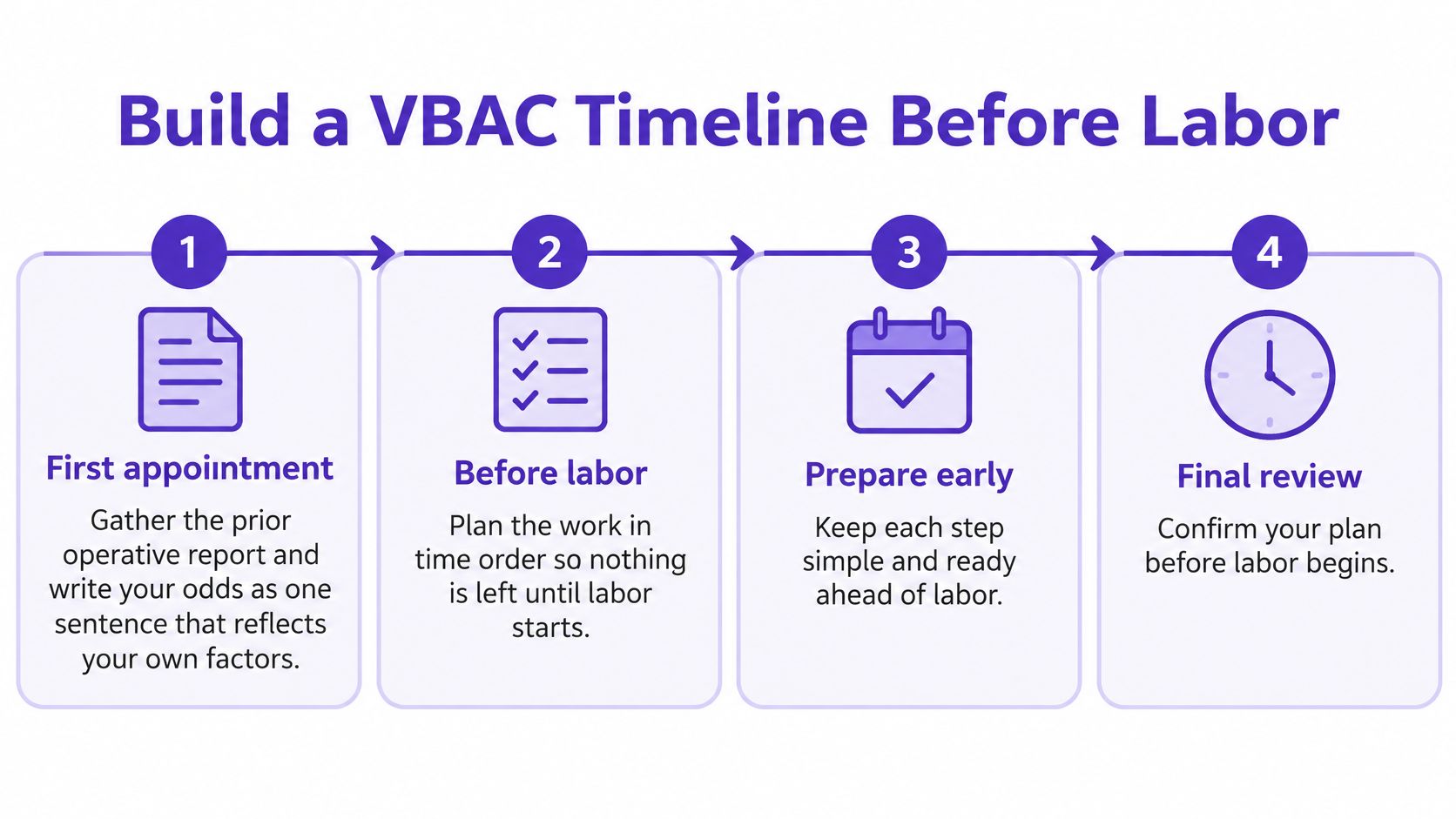
Give each task a place on the calendar
| Suggested Planning Point | Task | What You Should Have Afterwards |
|---|---|---|
| First appointment | Request the operative report and discuss eligibility | A documented incision type, or a named person responsible for obtaining it |
| By about 20 weeks | Complete clinician questions and the facility-readiness check | Written answers and a list of unresolved differences |
| Between 28 and 32 weeks | Discuss induction decisions and draft birth preferences | A short plan covering vaginal birth and a possible cesarean |
| Around 36 weeks | Review the plan with your clinician and support person | Confirmed care arrangements and accessible copies |
| Around 38 weeks | Check triage instructions and after-hours contacts | A clear route for contacting the team and arriving at hospital |
These are suggested organizational milestones, not deadlines that establish eligibility or determine delivery timing. If you're starting later, prioritize missing medical records, the birth setting, and the conversations that could change your choices.
Arrange support with the same care
We recommend interviewing two or three doulas, because personality fit matters as much as training. Talk through a changed-plan scenario: how would the doula support you if induction were recommended or you needed surgery?
Our doula interview checklist recommends asking about prenatal visits, the on-call window, continuous labor support, a postpartum follow-up, and text or phone support between visits. We also offer a free Doula Interview Questions tool to organize those conversations. This is general hiring guidance, not medical advice.
Give each unresolved task an owner. You might request records while your partner calls labor and delivery about the entrance used overnight. If your health or delivery recommendation changes, ask your clinician to update the clinical assessment rather than relying on an earlier estimate.
Make this month specific
Choose actual calendar dates for these actions:
- Your next available weekday: Request any missing surgical records and confirm where they'll be sent.
- Your next prenatal visit: Bring the unanswered eligibility, induction, and emergency-readiness questions.
- A quiet evening with your support person: Rehearse a changed-plan conversation and assign practical tasks.
- Before the month ends: File the updated notes, confirm outstanding answers, and schedule the next review.
You don't need certainty about how labor will end. You need a team that can explain the options, respond when circumstances change, and keep you involved in your care.
Bornbir connects expecting parents with perinatal support providers and offers a free Doula Interview Questions tool. Use it to prepare interviews, compare support styles, and find someone who can help you plan for both your preferred birth and a change of course.