
If you're asking are midwives covered by insurance, the short answer is yes, sometimes, but the result depends on credential, payer, and place of birth. In the U.S., CNM services are a mandatory Medicaid benefit, yet coverage is much less consistent for other midwife credentials, and even covered care can still produce surprise bills when the setting changes.
You might be on the phone with an insurer right now, getting one answer from a representative and a different answer from another. That happens because midwife coverage is not one yes-or-no question, it's three questions at once.
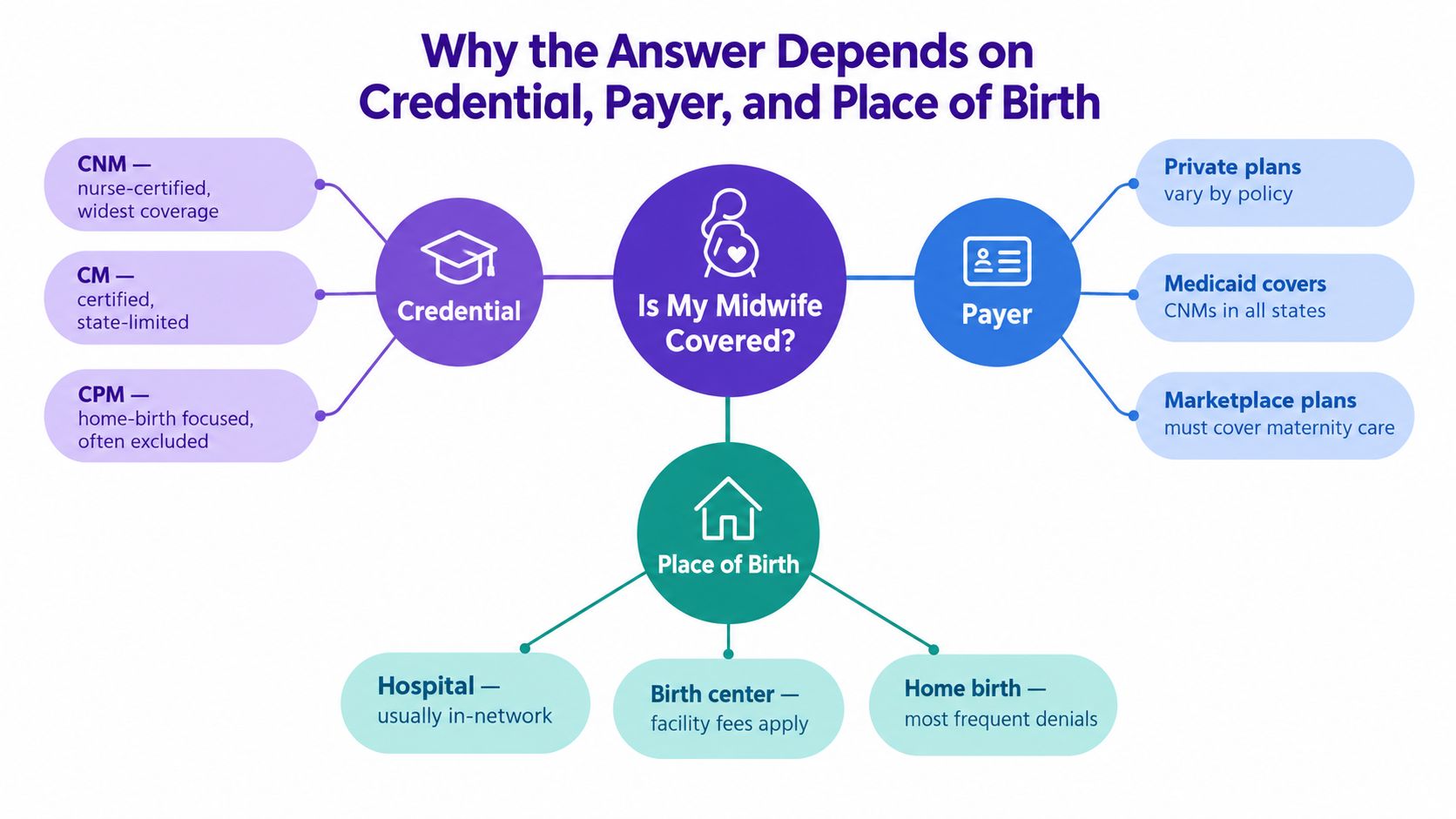
Why the Answer Depends on Credential, Payer, and Place of Birth
Maya is eight weeks pregnant and calling her insurer before she books a midwife. One representative says midwives are covered, another says the plan needs review, and a third asks where the birth will happen. That mix of answers makes sense, because midwife is only the starting point. Coverage changes with three separate questions.
Start with the credential
A credential is the kind of midwife. In the U.S., families usually hear about Certified Nurse-Midwives (CNMs), Certified Midwives (CMs), and Certified Professional Midwives (CPMs). Insurers often treat these differently because the training path and billing setup are not the same.
A CNM usually fits more easily into standard medical billing. A CM or CPM may need extra review, and a CPM is often the one most likely to be treated as out of network or not recognized in the same way. That is why “a midwife is covered” can still turn into a denied claim if the credential does not match what the plan pays for.
Then look at the payer
The payer is the insurance program paying the claim. That may be a private employer plan, a marketplace plan, Medicaid, or Medicare. The payer matters because the same midwife service can be handled differently depending on whose rules apply.
Medicaid is the clearest example. Federal policy supports maternity coverage, but state rules still shape how midwife care is paid, especially outside the CNM category. Private plans follow their own network and benefit rules, so a midwife can be covered under one payer and rejected under another.
Then check the setting
Place of birth means where the care happens. A hospital, birth center, and home birth can all trigger different billing decisions, even with the same midwife. A CNM may be covered in a hospital but questioned for a home birth. That is the kind of surprise that leads to bills parents did not expect.
Practical rule: ask three questions, which credential, which payer, and which birth setting.
That frame gives a much clearer answer than the word midwife alone.
The Three U.S. Midwife Credentials and How Plans Treat Each One
The credential is usually the biggest clue to whether a claim will pay. A CNM looks very different to an insurer than a CM or a CPM, even when all three support pregnancy and birth.
| How U.S. Insurers Typically Treat Each Midwife Credential | Credential | Education & Exam | Private Insurance Recognition | Medicaid Recognition | Typical Practice Settings |
|---|---|---|---|---|---|
| CNM | Certified Nurse-Midwife | Registered nurse plus graduate midwifery training | Widely recognized | Covered in all states under federal Medicaid rules | Hospitals, birth centers, clinics, some home births |
| CM | Certified Midwife | Midwifery education without the nursing prerequisite | Uneven, state dependent | Limited and state dependent | Hospitals and some birth centers |
| CPM | Certified Professional Midwife | Separate certification focused on out-of-hospital birth | Often excluded or out of network | Much less consistent, varies by state | Homes and birth centers |
CNMs are the easiest credential for insurers to recognize because they sit closest to the standard medical billing system. That's why many families hear that a CNM is “covered” and assume the same will be true for every midwife. It usually isn't.
CMs and CPMs are where surprises start. The consumer advice problem is simple, people often ask whether a midwife is covered at all, when the question is whether this credential is covered in this state under this plan. A useful plain-language breakdown of those credential differences is also available in the CNM vs CPM vs CM guide.
Bottom line: before you book, ask the practice exactly which certification your midwife holds, not just whether they call themselves a midwife.
A CNM-led hospital practice can bill very differently from a CPM-led home-birth practice, even if both feel similar to a parent looking for respectful care. One may move through the insurer's maternity system smoothly. The other may need special review, a superbill, or an appeal.
Private Insurance and Marketplace Plans
A family can hear “covered” and still face a bill, because private insurance looks at three separate pieces, the credential, the payer, and the place of birth. A midwife may be covered in one setting and treated very differently in another, even when the care feels similar from the parent's side.
Private plans often handle CNMs more predictably because those claims fit the usual maternity billing system. A plan may cover the midwife visit but still separate the hospital, birth center, or anesthesia charges. That split matters more than the label on the front of the insurance card.
Network status changes the bill
The cleanest claim path is usually a CNM billed through an in-network hospital or clinic. The insurer may bundle prenatal visits, delivery, and postpartum care into a maternity global fee, then apply the plan's deductible, copay, or coinsurance. Parents still owe something, but the bill usually follows a familiar pattern.
An out-of-network birth center changes the picture. The midwife can be allowed in principle while the facility fee is handled on a separate claim, or denied altogether. A family might see one line for the professional service and another for the birth center, with different coverage rules on each line. That is one reason a bill can look partial even when the care itself was approved.
Employer plans and marketplace plans use different rules
Employer-sponsored coverage often comes in two forms. Self-funded plans usually follow federal plan language, while fully insured plans and marketplace plans are shaped more directly by state insurance law. The difference can affect whether a birth center counts as covered, and whether the plan treats a non-CNM midwife as reimbursable at all.
A sample explanation of benefits may help. One line can show a maternity global fee for the midwife, then a separate facility fee for the birth center, plus another charge if newborn care or anesthesia is billed apart from the delivery claim. None of that means the insurer made an error. It usually means birth care is split across several billing codes and several providers.
If you are comparing plans and already know the state, it can help to check midwife insurance Texas as a practical example of how state rules affect coverage decisions.
Useful test: if the plan says the midwife is in network, ask whether the birth center and any supervising physician are also in network. One yes does not guarantee the others.
Private coverage often starts with the midwife, then runs into the rest of the bill. The midwife charge, the facility charge, and the network status each pull in their own direction, so the final amount depends on all three.
Medicaid Coverage for Midwives by State
Medicaid is the biggest public payer for births, so its rules matter a lot. Federal Medicaid policy requires CNM services to be covered, but it does not create the same universal protection for every other midwife type (MACPAC review). That leaves states with room to shape the rest.
CNMs are the baseline, the rest vary
A practical way to think about Medicaid is this. CNMs are the most secure category because the benefit is mandatory. CMs and CPMs depend much more on state recognition, local billing rules, and whether the state lets those providers enroll.
The payment issue matters too. A recent review found that 31 states reimburse midwifery services at the same rate as physician services, while 29 states pay less, usually 75% to 97% of physician rates for the same services (PMC review). That gap affects whether midwives can stay in networks and whether patients can utilize the coverage they technically have.
Billing details can be just as important as the benefit itself
State Medicaid programs often use the same CPT-style billing logic that obstetricians use, but some states require a written collaborative agreement with a physician before payment is allowed. Other states don't. Scope-of-practice law, provider enrollment rules, and claims processing all shape the final outcome.
A person in New York may find a broader Medicaid path for midwife care than someone in a state that recognizes fewer credential types. A family in a non-recognizing state can still be told that maternity coverage exists, while the claim gets denied on the back end because the provider type isn't enrolled.
If you're comparing state resources, the Pennsylvania midwives bornbir page is a useful example of how local coverage questions come up in practice. For families who are also thinking about asset rules, this guide to life insurance rules for Medicaid applicants can help explain why eligibility conversations can get complicated fast.
| Medicaid Midwife Coverage by Credential and State Type | Credential | Federal Mandate | Typical State Coverage | Common Billing Requirement |
|---|---|---|---|---|
| CNM | Certified Nurse-Midwife | Yes, mandatory benefit | Covered in all states | State Medicaid enrollment and proper maternity billing |
| CM | Certified Midwife | No universal mandate | Recognized in some states | State recognition and provider enrollment |
| CPM | Certified Professional Midwife | No universal mandate | Limited and state specific | State licensure, enrollment, or special program rules |
The simplest rule is this. Medicaid coverage is strongest for CNMs, more uneven for CMs, and much more limited for CPMs. Always check both the state rule and the billing rule before assuming a birth will be paid.
How Birth Setting Changes Coverage Decisions
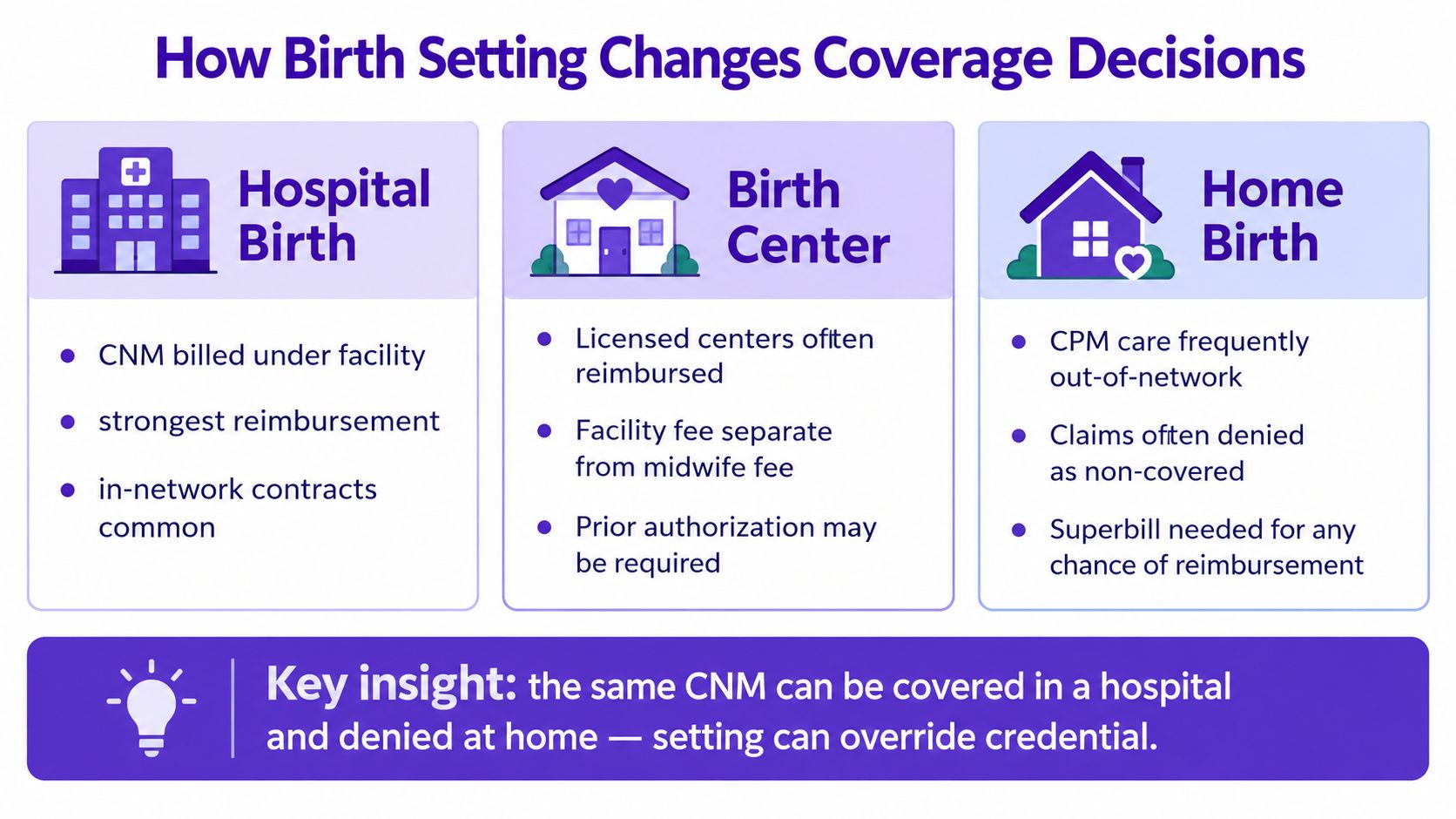
The same midwife can be covered in one setting and denied in another. That sounds odd until you look at how insurers separate the provider from the facility.
Hospital births are usually easiest to process
A CNM attending a hospital birth is usually the cleanest claim for a plan to process. The hospital is already in the insurer's system, the maternity fee structure is familiar, and the provider network is easier to verify. That's why many families discover that “covered” really means “covered at the hospital.”
Birth centers can trigger separate fees
Birth centers sit in the middle. Some insurers treat them as outpatient facilities, while others treat them as non-covered birthing centers. That's where a separate facility fee can appear, even when the midwife herself is eligible for reimbursement.
A home birth is often the hardest setting to get paid. A plan may recognize the midwife in principle, then deny the claim because the site of care is outside the network rules or outside the plan's birth setting policy. The same CNM who is paid in a hospital can be denied at home if the plan doesn't cover that setting.
A claim can be built correctly and still be denied if the setting doesn't match the plan's rules.
That's why setting can override credential in real life. The birth site changes who bills, which codes are used, and whether the insurer sees the claim as standard maternity care or as an out-of-network event.
If you're looking for a home-birth provider, the find home birth midwives page can help you think about the care setting before you ever get to billing.
What to Ask Your Insurer and Your Midwife Before You Sign
The two phone calls that matter most are the insurer call and the midwife billing-office call. You want both sides to say the same thing in writing, because verbal answers disappear fast once a claim hits the system.
Questions for the insurer
Ask whether the midwife is in network for maternity benefits, not just for general care. Then ask what CPT codes will be billed, whether there's a global maternity fee, and whether the plan treats the birth center or home birth as a separate facility charge. Also ask about your deductible, out-of-pocket maximum, and whether prior authorization is required.
Questions for the midwife's office
Ask for the midwife's NPI type and taxonomy, the billing entity name, and whether they submit claims directly or only give superbills. Find out their network status with your main payer, what insured patients usually owe out of pocket, and whether they offer payment plans when something is denied.
Practical move: get every answer through the member portal or email, not just over the phone. Written answers are much easier to use when a bill goes sideways.
This is also a smart moment to check Bornbir's guide to midwife questions, since it helps you think through the care side and the billing side together. If you're also comparing other benefits, a page like checking pelvic floor therapy benefits shows the same basic principle, the service may be covered, but the billing details still matter.
A lot of parents stop at “Is this midwife covered?” and miss the rest. The better question is, “How will this specific practice bill this specific plan for this specific birth setting?” That one sentence prevents a lot of expensive confusion.
Alternatives and Next Steps When Coverage Is Limited
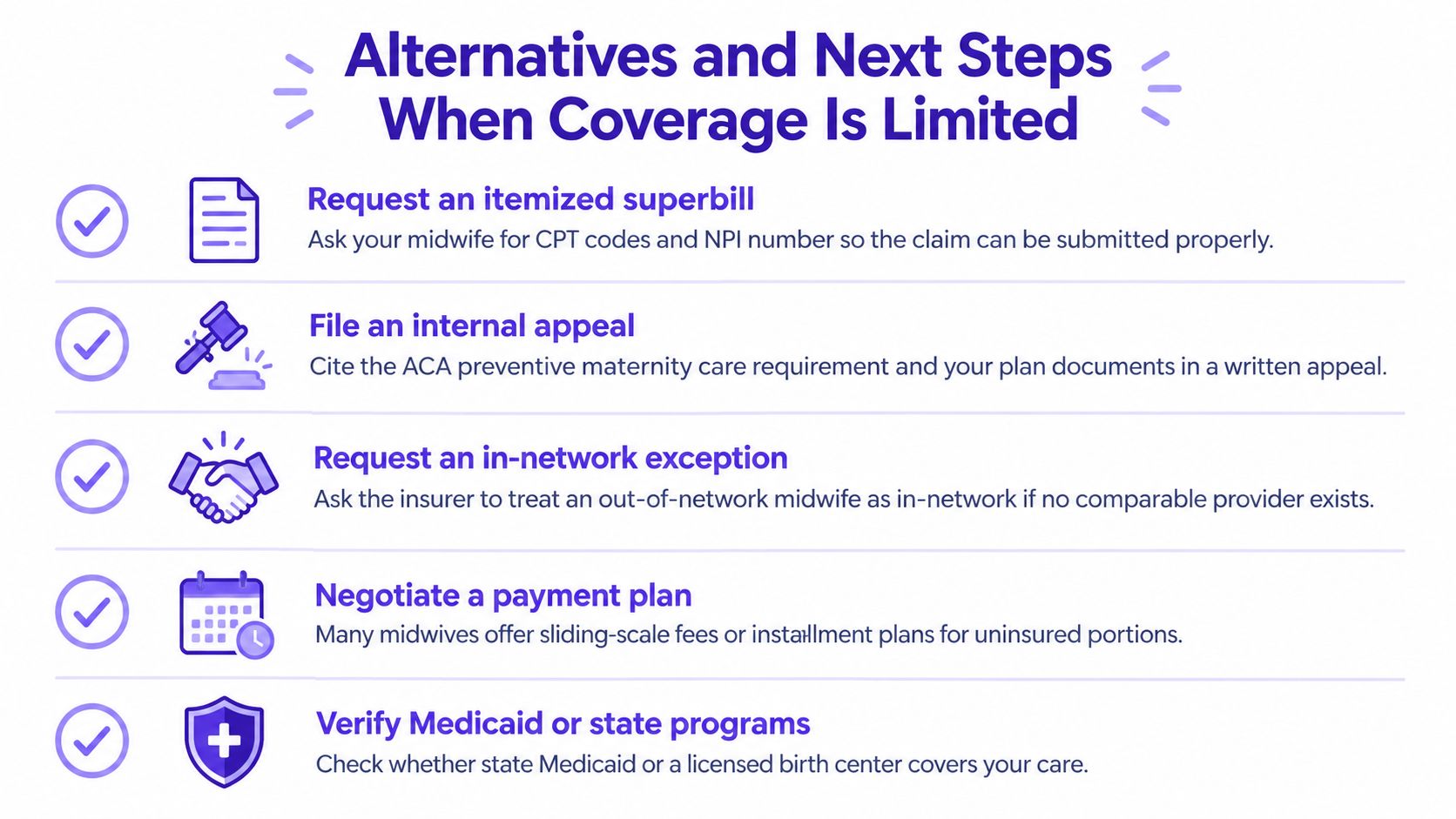
A denial doesn't always mean the plan won't pay anything. It often means the claim needs to be corrected, appealed, or routed differently.
Start with the paperwork
Ask the midwife's office for an itemized superbill with the CPT codes and NPI number. If the claim was coded wrong, ask them to rebill it. If the insurer denied a covered service, file an internal appeal and quote the exact plan language that supports your case.
Ask for an exception when the network is thin
If there isn't a comparable in-network midwife within a reasonable distance, ask for a gap exception or in-network exception. Some families get partial reimbursement this way, especially when the insurer can't point to a usable alternative.
Reduce the amount you owe directly
If the service is still only partly covered, ask about self-pay pricing, payment plans, or sliding-scale fees. Many practices will lower the billed amount for patients who are paying out of pocket. HSA and FSA funds can also help with eligible prenatal and postpartum costs.
Escalate when the denial is wrong
If the insurer keeps refusing a service that should be covered, contact the state insurance commissioner. If the denial seems tied to scope-of-practice confusion, a complaint to the state midwifery board can help. Families in Canada may need to look at provincial out-of-hospital birth programs or Indigenous health benefits when public coverage falls short.
Bornbir is one place families can use to compare providers, pricing, and reviews across pregnancy, birth, and postpartum care, which can make it easier to find a midwife who fits both the care plan and the insurance situation. Visit Bornbir to compare options and start a clearer conversation with providers before you book.