
Can breastfeeding after surrogacy count as a success if your baby still needs formula or donor milk? That question gets lost when feeding advice focuses only on whether an intended parent can produce milk. A more useful starting point is deciding what you want from nursing, then making sure your baby gets enough nutrition regardless of your supply.
You don't have to choose between trying to breastfeed and having a dependable feeding plan. You can prepare for both, with medical guidance, practical support, and room to change your mind.
What Realistic Feeding Outcomes Look Like
Breastfeeding after surrogacy is medically possible through induced lactation, even without a previous pregnancy. Most outcomes described in the small published case literature involve partial milk production rather than a full supply.
Reported feeding outcomes in surrogacy case studies
The older report and single intended-mother case below are described in a surrogacy-induced lactation case report and discussion; the additional surrogate-pregnancy cases are summarized in LactMed's review of domperidone.
| Study or case | Participants | Reported result |
|---|---|---|
| Older report of surrogate mothers | 10 surrogate mothers | Two breastfed completely and three partially; all five babies with established feeding grew satisfactorily |
| Single surrogacy case | 1 intended mother | Scant secretion and no meaningful prolactin change; daily breastfeeding for 4 weeks with formula supplementation |
| Surrogate-pregnancy case reports | 2 women | Partial breastfeeding for about 3 months each |
| Separate surrogate-pregnancy case | 1 parent | Partial breastfeeding for one month after estrogen was stopped at delivery |
These reports show what's possible, not what any individual parent should expect. They don't establish a dependable chance of producing enough milk, and the term successful breastfeeding doesn't necessarily mean exclusive breastfeeding.
The single intended-mother case is especially helpful for understanding that distinction. Medication and pumping produced little secretion, but nursing still became part of daily care while formula supplied the needed nutrition.
What the outcomes mean for your family
Results depend on the person, preparation, and the infant's willingness to nurse. Previous lactation experience and infant age were associated with feeding outcomes in an older questionnaire study of adoptive mothers, a relevant comparison group, though not a prediction tool for surrogacy families.
A small pump yield also can't tell you whether a baby has taken an adequate feed at the breast. You'll need a plan to track wet diapers and feeding patterns, alongside clinical weight checks.
A useful definition of success: Nursing can be meaningful without being the baby's only source of nutrition.
Choose goals that don't require your body to meet a specific volume:
- Direct nursing for bonding: Offer the breast for closeness and comfort when it works for you and your baby.
- Partial milk provision: Treat the milk you produce as a contribution, not a test you have to pass.
- A complete feeding plan: Arrange enough milk or formula independently of how induction progresses.
How Induced Lactation Works Without Pregnancy
Pregnancy normally prepares breast tissue through hormonal changes over months. Induced lactation starts without most of that preparation and uses repeated nipple stimulation and milk removal to encourage production.
Think of the breast as a supply line that responds to demand. Pumping or nursing sends the signal, while removing milk helps keep that signal active. Prolactin supports milk production, and oxytocin helps milk move out of the breast.
The Academy of Breastfeeding Medicine's guidance for nongestational parents explains these pathways and emphasizes that full production usually isn't achievable. That's why combination feeding belongs in the starting plan, not just an emergency backup.
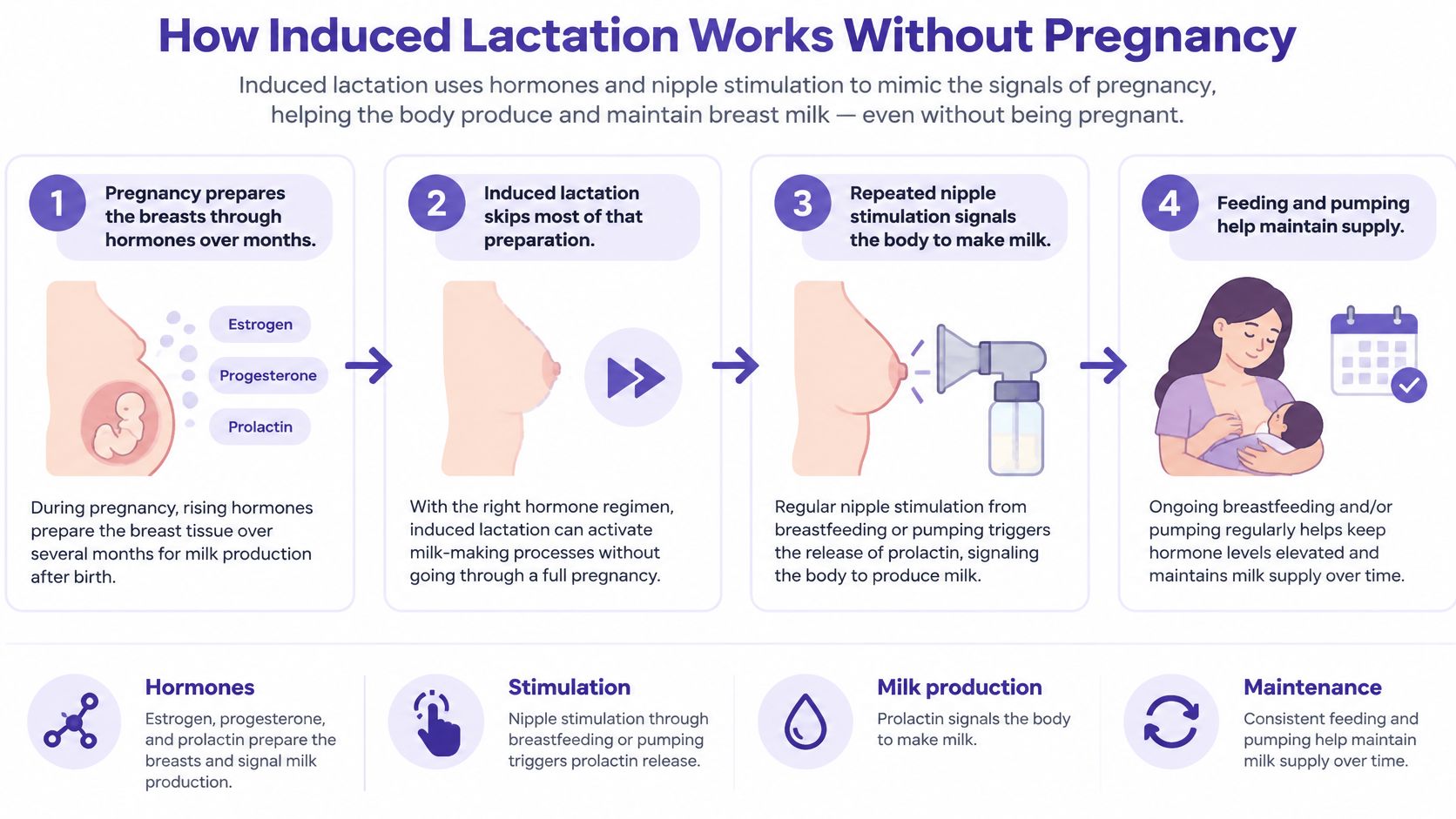
Follow the process in order
- Begin stimulation. A lactation consultant can help you start with a breast pump, hand expression, or nursing when your baby is available. Pumping should create a comfortable pulling sensation, not pain.
- Remove milk regularly. Once secretion appears, continue effective removal rather than judging progress from a single session. An appropriate flange fit and workable schedule matter more than turning the suction higher.
- Watch for first milk without setting a deadline. You may begin with drops, and a response can take weeks. No visible milk at the start doesn't tell you exactly what your eventual supply will be.
- Continue after birth. Your care team can help combine nursing, pumping, and supplemental feeds without leaving the baby hungry or making every feed unmanageable.
Medication may support this process, but it never replaces stimulation and milk removal. Some parents use medication under supervision; others need a different approach because of their health history or preferences.
Know what needs attention
An International Board Certified Lactation Consultant, or IBCLC, can assess pump technique, latch, and whether the baby transfers milk effectively. If you've lactated before, restarting milk production after a break may involve different expectations from starting for the first time.
Ask for help if pumping causes persistent pain, nipple damage, or breast swelling that doesn't improve. A baby who seems unable to feed effectively also needs assessment, not a longer nursing session.
Expect adjustments at each stage. The aim is a comfortable, repeatable routine that supports your feeding goal without putting nutrition on hold.
Medication Safety Before You Start
Medication supports stimulation and never replaces it. There isn't a standard drug protocol that reliably produces milk for every intended parent, so an online schedule isn't a prescription for your situation.
The Academy of Breastfeeding Medicine's galactagogue protocol doesn't endorse a specific medicine as a standard solution. It calls for screening for contraindications, allergies, and interactions before using drugs or supplements.
Domperidone and metoclopramide are prescription medicines with jurisdiction-specific restrictions. Don't self-source them or borrow someone else's prescription. Domperidone has recognized cardiac-safety concerns and dosing limits in some markets, so local availability doesn't establish whether it's suitable for you.
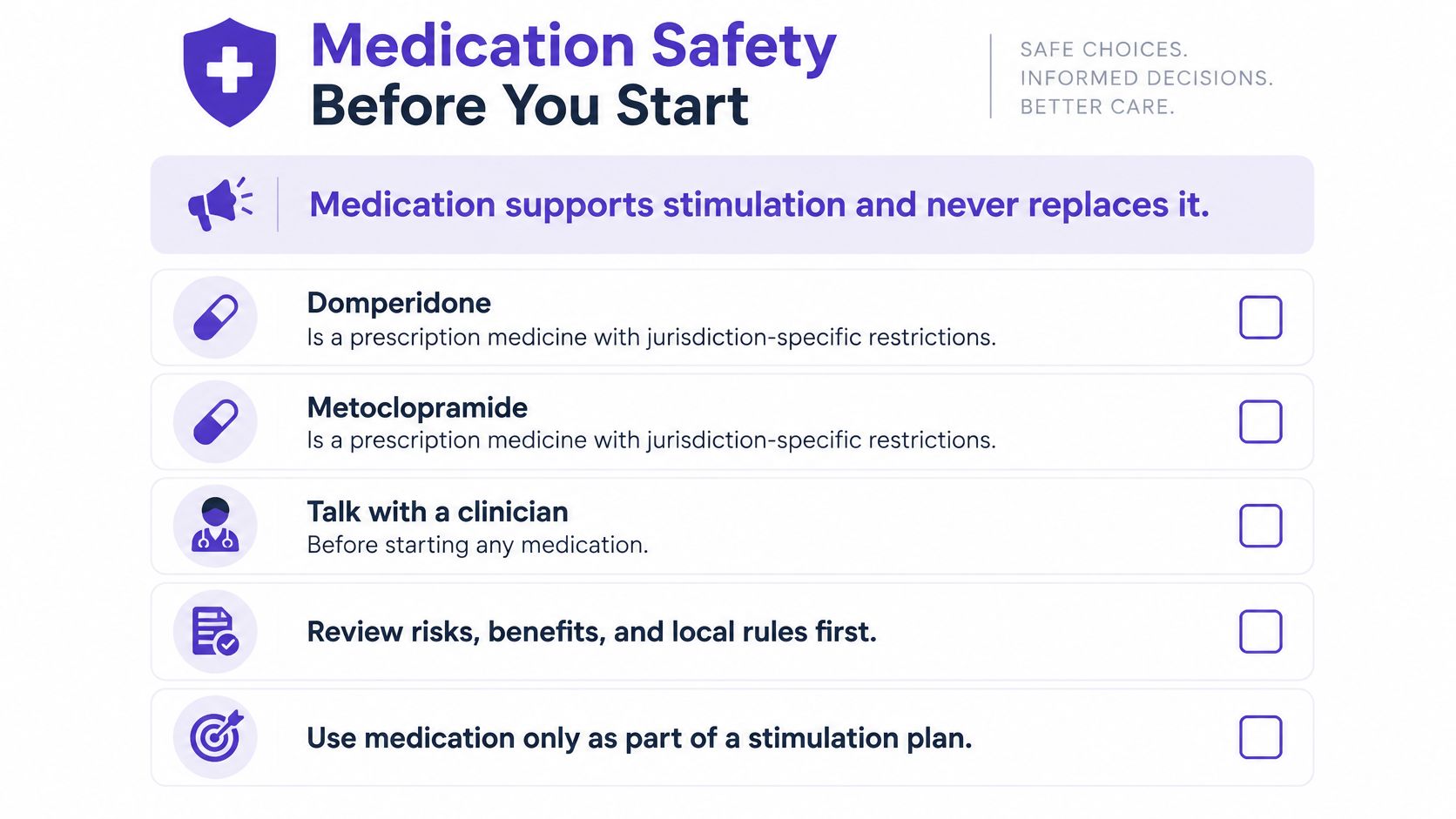
Bring a complete picture to the appointment
Give the prescribing clinician information they can use to make a decision:
- Medical history: Include heart conditions, fainting, previous medication reactions, and mental-health history.
- Current medicines and supplements: Bring names and doses, including nonprescription products and herbs.
- Known allergies: Describe the reaction, not just the substance.
- Pregnancy and feeding history: Explain any previous pregnancy, breastfeeding, pumping, or supply difficulties.
- Your goal and timeline: Say whether you're hoping for direct nursing, partial milk, or a larger supply, and share the expected birth date.
- Infant monitoring arrangements: Identify who will oversee weight checks and review diaper output after birth.
Hormonal regimens need the same individualized review. Herbal galactagogues, products intended to increase milk, also need screening. Natural doesn't mean free of adverse effects or interactions.
Leave with a decision, not just a prescription
LactMed advises correcting modifiable feeding factors before relying on galactagogues. That means checking effective latch, frequent removal, pump technique, and breast drainage rather than assuming a different medicine will solve the problem.
Ask the clinician to explain the likely benefit, the uncertainties, and what would make them recommend against treatment. Discuss how you'll report mood changes, possible side effects, or new medicines prescribed elsewhere.
Before starting: Get a written decision, a monitoring plan, and the name of the person to contact with concerns.
That written decision may be to use medication, defer it, or avoid it. Each can be a reasonable outcome when it reflects your health and feeding priorities.
Supplementation Options and Measuring Growth
A 2025 study of 117 nongestational mothers who became parents through surrogacy or adoption found that 17 breastfed for at least 180 days, while 100 stopped earlier. Exclusive breastfeeding through 120 days was associated with longer duration, with an adjusted odds ratio of 5.72.
That association doesn't mean avoiding supplements will make induction succeed. The study also found that sustained feeding depended more on early, frequent breastfeeding than medication duration, and its findings can't predict an individual family's outcome.
Supplementation options after surrogacy
| Option | Best when | Watch for |
|---|---|---|
| Expressed milk by bottle | Milk from the surrogate or a donor is available and consent is agreed | Milk handling, storage, and transition terms |
| Donor human milk | Parent's own milk supply is low | Screening and availability vary by region |
| Commercial formula | Supply is minimal or the infant needs more volume | Adds to feed volume, so discuss amounts with a clinician |
| Supplemental nursing system | The parent wants to keep nursing while the infant receives supplemental feeds | Tubing, cleaning routine, and a learning curve |
| Paced bottle feeding | The infant takes bottles and the parent wants to protect breastfeeding | Responsive pacing to avoid overfeeding |
The first options concern what the baby receives. A supplemental nursing system and paced bottle feeding concern how the baby receives it. You can combine a feeding source with a method that suits your family.

Match the method to the baby
With paced bottle feeding, hold the baby supported and relatively upright, keep the bottle more horizontal, and allow pauses. Respond to the baby's cues instead of encouraging them to finish a set amount.
A supplemental nursing system delivers additional milk through thin tubing near the nipple while the baby nurses. Ask an IBCLC to demonstrate placement and cleaning, then watch you use it. It's an option, not a requirement for successful combination feeding.
Bornbir's guide to combination feeding can help you think through how breast and bottle feeds fit into daily care.
Measure intake, not effort
Track weight with the infant's clinician, record wet and dirty diapers, and watch hydration and feeding behavior. Success means the baby grows appropriately, your chosen goal remains workable, and supplemental amounts change when the baby needs them.
- Intake concerns: Contact the infant's clinician promptly for slower-than-expected weight gain, fewer wet diapers than expected for age, dehydration signs, or feeding distress that doesn't settle.
- Technique concerns: Call the lactation consultant for latch, pump, or tubing problems.
- Medication concerns: Contact the prescribing clinician.
Don't wait for the next scheduled visit when you're worried about infant intake. Marked sleepiness, difficulty waking, or an inability to feed needs urgent medical assessment.
Emotional Side of Feeding After Surrogacy
Say you've prepared carefully, learned to pump, and pictured nursing your baby after birth. Then the milk stays at drops. You might feel disappointed even while feeling grateful to be a parent, and those feelings don't cancel each other out.
Clinical discussions can miss the identity, grief, and comparison pressures around breastfeeding after surrogacy. The intended mother in the published case with scant secretion still described substantial emotional benefit from daily nursing while using formula. Her experience illustrates a possibility, not an emotional outcome every parent should expect.

Keep closeness separate from a supply target
You might enjoy nursing even when little milk transfers. You might also find that pumping makes you anxious or takes time away from the contact you wanted. Neither response tells you how devoted you are to your baby.
You don't have to keep a feeding routine that hurts your well-being to prove that you tried hard enough.
Choose a support person who can listen without turning each conversation into advice about increasing supply. Resources on supporting mental health while breastfeeding can help you recognize when encouragement needs to become practical or professional support.
If anxiety, guilt, or grief starts to dominate daily life, counselling is a reasonable next step. For families in that area, Interactive Counselling's Penticton counsellors for anxiety offer a local resource to explore.
Respect separate bodies and separate decisions
The intended parent's induced lactation and the gestational carrier's lactation are separate processes. The carrier decides whether to express milk from her body; intended parents make their baby's feeding decisions with the infant's care team.
If the carrier wants to provide expressed milk, document consent and practical boundaries before birth. Include how communication will work and what happens if she needs or wants to stop.
- Write down the plan: Include alternatives so nobody feels pressured to maintain an arrangement.
- Set a review point: Revisit feeding after the first weeks, once you know more about daily life.
- Name your support person: Decide who can take over practical tasks on difficult days.
- Allow a change: Reducing pumping or stopping induction can be a thoughtful choice.
A sustainable plan is one your family chooses, not one you maintain out of guilt.
Planning Timeline and Care Team Before the Due Date
Planning timeline for induced lactation
These timings come from an Infant Feeding Academy presentation describing published induced-lactation protocols. They're protocol examples, not guarantees or instructions to start medication yourself.
| Phase | Timing | Action |
|---|---|---|
| Long preparation | About 6 months before the due date | Combined oral contraceptive with domperidone, per one published protocol |
| Pumping start | About 6 weeks before delivery | Hospital-grade pump every 3 hours |
| Accelerated preparation | When less time is available | Domperidone for 30 to 60 days, followed by pumping |
| First milk | About 2 to 3 weeks of pumping | Protocol example, not a guarantee |
| After birth | From the first days | Frequent milk removal to improve or maintain supply |
The schedule shows why it helps to talk about feeding before delivery. It doesn't mean you must follow this particular medication pathway, and it doesn't mean you've missed your chance if you're starting later.
Frequent, effective milk removal after birth matters more than reaching a single preparation date. Your team should adapt the schedule to your medical needs, access to care, and the time you have.
Start with lactation and medical appointments
Book an IBCLC consultation now, rather than waiting to see whether milk appears. Describe that you're a nongestational parent planning induced lactation and ask about the consultant's relevant training and experience.
At that appointment, work through flange fit, comfortable pump use, hand expression, and how you'll assess latch once the baby arrives. Make sure the plan includes infant weight monitoring, not just advice for increasing supply.
We list lactation consultants who are IBCLCs, International Board Certified Lactation Consultants. Our breastfeeding support guidance for new parents can help you prepare for that conversation.
Arrange the prescribing-clinician appointment alongside lactation care. Bring your medicine list, health history, and expected birth timeline so the clinician can assess whether hormonal or pharmaceutical support is appropriate.
Before leaving, establish who coordinates the plan if the prescriber and IBCLC recommend changes. You shouldn't have to interpret conflicting advice about medication and pumping on your own.
Finalize consent and feeding arrangements before birth
Ask the surrogacy attorney or agency to help document any agreed milk-provision arrangements. Clinical feeding advice and legal documentation serve different purposes, so keep both teams involved without treating either as a substitute for the other.
Write down the practical details:
- Consent and stopping: Record what the carrier has agreed to and how she can communicate a change.
- Milk handling: Assign responsibility for containers, labeling, storage, transport, and receiving milk.
- Transitions: Decide what you'll use when expressed milk isn't available.
- Communication: Name the person who manages logistics so the carrier isn't fielding repeated requests.
A written feeding plan should identify the available feeding sources, preferred methods, and donor milk or formula backup. Give relevant caregivers the same version so nobody assumes nursing alone supplies a complete feed.
If you're arranging doula support, we recommend asking specifically about feeding help. Our doula interview checklist distinguishes basic latch help and reassurance from persistent pain or weight concerns, which should trigger referral to a lactation consultant.
Get equipment and follow-up ready
Arrange the pump and supplies before you need them. Have the IBCLC check fit and technique before committing to a routine that's uncomfortable or difficult to maintain.
Prepare a clean area for pump parts, milk containers, and any supplemental nursing equipment. Ask for a demonstration of cleaning and handling, rather than relying on memory when you're tired.
Confirm newborn follow-up with the infant's clinician before discharge arrangements are finalized. Record where weight checks will happen, how to reach the practice with intake concerns, and who will review changes to supplemental amounts.
If birth is close, start consultations immediately and prioritize a plan that works from the first feed. Don't rush an unsupervised medication course to catch up with a sample schedule.
Book your first consultation this week, bring your timeline and medicine list, and set a review after the first weeks of feeding. Leave that review open to keeping, simplifying, or changing the plan.
We connect families with independent lactation consultants, including IBCLCs, for in-person and virtual support. Visit Bornbir to share your feeding goals, compare providers, and arrange help with an induced-lactation and supplementation plan that fits your family.