
It's 2 a.m., your newborn is crying to feed, and you're bracing yourself before you even undo your top. The first seconds pinch. Then the pinch doesn't let up, your shoulders tense, and your baby slips off, frustrated, and starts again. You're left wondering if this is just how the first days feel or if something's wrong.
That question has a practical answer. A painful latch in a newborn usually has a pattern you can see and time. Once you know what a working feed looks like, you can fix the simple problems at home, spot the patterns that point elsewhere, and call for help on the right day, not a week too late.
Tell a Normal Latch From a Painful One
Start by watching one whole feed, not by judging how sore you feel afterward. Prop your phone where it can record your baby's mouth and chin, then feed as you normally would. When you play it back, you're looking for a simple mechanical idea. A working latch puts a deeper mouthful of breast tissue in your baby's mouth. A painful latch usually means your baby's taking mainly the nipple, so the nipple gets compressed and rubbed instead of sitting deeper where there's less friction.
Timing helps you sort normal adjustment from a problem. A review in the American Academy of Family Physicians journal notes that an effective latch may produce brief tenderness during the first 30 seconds to 1 minute, while pain that continues throughout the feeding suggests abnormal nipple compression or another problem. The same review found improper positioning or latch contributed in 89% of nipple-pain cases, so position is worth checking first, but it isn't the only possible cause.
What to check during the feed
The CDC newborn breastfeeding basics page lists three signs of a poor latch. Your baby suckles only on the nipple, the lips curl inward, and breastfeeding hurts. That page also notes nipples can feel sore or sensitive during the first few weeks while they adjust, so don't judge everything by day one. Judge the pattern across a feed, and across several feeds.
| Feeding sign | Good latch | Painful or poor latch |
|---|---|---|
| Mouth and lips | Wide open, lips flanged outward | Lips curled inward or pressed tight |
| Chin and nose | Chin touches the breast, nose has room | Nose pressed into the breast, chin not touching |
| Areola visible | More areola visible below the lower lip than above the top lip | More areola visible above the top lip than below |
| Sucking pattern | Slow, deep and rhythmic with pauses | Quick, shallow or with a clicking sound |
| Pain during the feed | Tenderness that fades within 30 to 60 seconds | Pain that continues through the whole feed |
| Nipple after the feed | Round shape, no cracks or flattening | Cracked, blistered, flattened or bleeding |
| Baby after the feed | Calm, content and swallowing audibly | Still hungry, unsettled or slipping off the breast |
On your recording, check the easy things first. Does the chin touch the breast? Do the lips flare outward like a fish, rather than tucking in? Can you hear swallowing after the first quick sucks settle into a slower rhythm?
Plain rule: If most of the right-hand column shows up in one feed, don't push through the next feed the same way. Break the latch and use the steps that follow.
One feed doesn't tell the whole story, especially if your baby's sleepy, frantic, or still learning. Patterns that repeat, sore skin that isn't healing, and a baby who never seems settled are more useful signals. If feeds are hard in several ways at once, it helps to understand why newborns struggle with feeding, because latch pain and low milk transfer often travel together.
How to Fix a Painful Latch Step by Step
Position comes first because it's the most common fixable cause. NHS guidance on common breastfeeding problems says nipples usually become sore when the baby is not positioned and attached well at the breast. A shallow latch leaves the nipple under concentrated pressure from the gums and tongue. A deeper latch brings more breast tissue into the mouth and generally reduces friction, which is why small changes in angle can change pain within one feed.
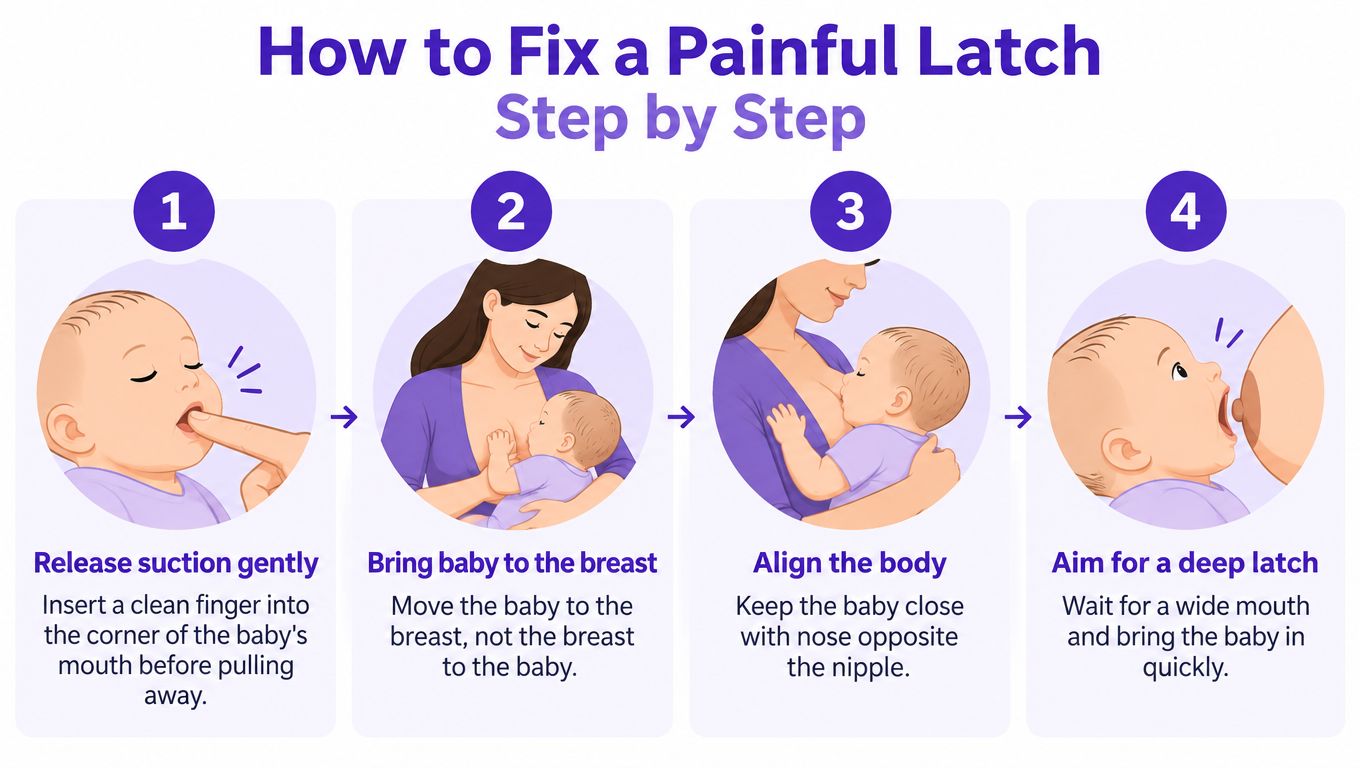
Break the latch and reset
- Release suction before you move your baby. Slip a clean fingertip into the corner of your baby's mouth until you feel the seal give, then ease your baby off. Pulling a latched baby straight off drags on already sore skin and can tear it.
- Bring your baby to the breast, not the breast to your baby. Line your baby's nose up level with your nipple. If you're hunching or lifting the breast to meet a low mouth, your baby will usually end up nipple feeding.
- Hold your baby close, tummy to tummy. Keep the head free to tilt slightly back, with no hand pushing on the back of the head. A slight head tilt helps the chin lead and the mouth open wider.
Starting while your baby's frantic and crying hard is a common slip. A crying baby's tongue sits high and the mouth doesn't gape well. If you can, calm your baby skin to skin for a minute, watch for rooting and lip licking, and start before crying peaks.
Aim for depth, then check
- Wait for a wide gape, then bring your baby in quickly. Brush the nipple from nose to chin to trigger the mouth opening wide, like a yawn. Aim the nipple toward the roof of the mouth, with the bottom lip landing well below the nipple, not on it.
- Check three things in the first minute. The lips should flange outward, the chin should touch the breast, and you should see more areola below the lower lip than above the top lip. If you see curled lips or feel pinching that isn't fading, break suction and try again rather than waiting it out.
- Change position if pain stays high. A laid-back hold, where you recline and your baby lies tummy down on you, lets gravity keep your baby close and often produces a deeper latch with less effort. A football hold, with your baby tucked under your arm on the feeding side, gives you a clear view of the mouth. Rotating between comfortable breastfeeding positions for newborns also changes where pressure falls on sore skin.
Skipping the wide gape is the slip that causes the most repeat pain. It feels urgent to latch as soon as the mouth opens a little, especially when your baby's hungry and loud. A small mouth almost always means a shallow latch, so one extra second of waiting usually saves you a painful twenty minutes.
- Watch the whole feed, not just the first minute. Babies often drift down onto the nipple as they get sleepy, and then clamp to stay on. If sucking turns quick and shallow, or pain creeps back, support your baby closer or re-latch. Switch sides when sucking and swallowing slow right down.
- Check your nipple as soon as your baby comes off. It should look round, much as it did before the feed. A flattened, creased, or lipstick shape tells you the nipple was compressed, even if pain seemed bearable. If skin's sore, spread a few drops of expressed milk over it and let it air dry, or use a lanolin product made for breastfeeding.
A feed that's working usually ends with a baby who comes off relaxed, hands open, and a nipple that looks round and intact.
Give changes two days of consistent practice, checking depth at every feed, then reassess. Pain that's clearly dropping feed by feed is progress. Pain that's the same or worse after two days of better positioning isn't a technique problem you should keep solving alone, especially if the nipple's cracked or bleeding, or your baby seems unsatisfied after most feeds.
Pain Patterns and What Each One Usually Means
Here's where parents often get stuck. The latch looks right in the mirror, the chin's in, the lips are flanged, and it still hurts. That's possible, because latch pain has more than one cause. A protocol from the Academy of Breastfeeding Medicine on persistent pain lists concurrent or sequential causes including nipple damage, infection, dermatoses, vasospasm, functional pain, and infant oral or neurologic factors. So the useful question isn't just does it hurt. It's when does it hurt, where, and what does the skin look like.
Match the pattern to the next step
| Pain pattern | Possible cause | Next step |
|---|---|---|
| Pain from the first latch that lasts the whole feed | Shallow latch or nipple compression | Re-latch and check depth and chin position at the next feed |
| Pain after comfortable feeds, nipples white or blue | Vasospasm | Ask a clinician to assess, keep nipples warm and dry |
| Burning pain with shiny or reddened skin | Dermatitis or infection | Same-day clinician review |
| Hard, hot, red area in one breast with fever | Mastitis or blocked milk duct | Contact a clinician promptly |
| Pain with clicking, slipping off and poor weight gain | Restricted tongue movement | Infant feeding assessment by a specialist |
| Pain that eases within 1 to 2 weeks with a good latch | Normal adjustment of sensitive nipples | Continue and monitor each feed |
The first row is the most common pattern and the one home fixes address. Pain from the very first latch, plus a flattened nipple afterward, points to compression. Work on depth, and expect change within a few feeds.
The next two rows are the ones parents misread as their own failure. Nipples that turn white, red, or blue after feeds, sometimes with throbbing or burning as color returns, can point to vasospasm, where blood vessels in the nipple narrow. Keeping nipples warm and dry after feeds, and avoiding cold air on wet skin, can help while you wait to be seen, but the pattern itself needs a clinician's assessment. Burning pain with shiny or reddened skin points toward dermatitis or infection rather than position, and creams you've been using, including lanolin or pad materials, can themselves irritate skin. Note everything that's touching the skin and tell the clinician.
A hard, hot, red area in one breast, especially with fever or flu-like aching, isn't a latch technique issue in that moment. Keep milk moving with feeding or expressing if you can, and contact a clinician promptly the same day.
Two quieter causes are easy to miss. Pump trauma from a flange that's the wrong size or suction set too high can damage nipples even when your baby latches well, so pain that's worse on pumping days is a clue. Oversupply or a fast flow can make a baby clamp down to slow the milk, which hurts and can look like a latch fault when it's really a flow problem. Mention spraying, coughing, or gulping at letdown when you describe the problem, and check your baby's milk intake so you can separate flow problems from transfer problems.
Before any visit, write down three things for two or three feeds. Note when pain starts and stops, what the nipple looks like right after, and what color it turns in the minutes after. That short record saves time and often changes the answer you get.
When Tongue-Tie Could Be Part of the Problem
A clicking sound mid-feed is often the first thing a parent notices. Clicking usually means suction is breaking. Air gets in, the seal goes, your baby has to re-grip, and that repeated gripping is hard on nipple skin. Restricted tongue movement is one reason suction breaks, but positioning can break it too, so clicking alone doesn't prove tongue-tie.
Tongue-tie, also called ankyloglossia, is when the tissue under the tongue is unusually short or tight and limits how the tongue moves. NHS information on tongue-tie says this may prevent a baby from opening the mouth wide enough or staying attached for a full feed, which can lead to nipple feeding, sore or cracked nipples, and reduced milk transfer.

Signs worth reporting
- Frequent or very long feeds where your baby still doesn't seem satisfied afterward
- Difficulty staying attached, with repeated slipping off and re-latching
- Poor weight gain, confirmed at weight checks rather than guessed at home
- Clicking from broken suction, especially alongside pain through the whole feed
An assessor also looks inside the mouth. A heart-shaped tongue tip when your baby tries to lift it, and difficulty lifting, extending, or moving the tongue side to side, are part of that picture. You can look during a yawn or cry, but don't try to judge tightness by pressing under the tongue yourself. How the tongue works during a feed matters more than how it looks at rest.
Say you've fixed position for two days and pain hasn't shifted. Film one feed from the side, including the clicking and the slipping off. A lactation consultant can watch that video with you, observe a live feed, and judge whether tongue movement is limiting transfer. That's the right order. Assessment first, decision second.
Tongue-tie isn't the cause of every painful latch, and not every tight-looking frenulum needs treatment. A trained infant-feeding specialist should assess how any restriction affects feeding before treatment is considered, so don't book a procedure based on an online photo comparison. If a release is discussed after a full assessment, it helps to read about what infant laser frenectomy involves so you can ask informed questions about the procedure and aftercare. You can also review when to seek tongue tie help before your appointment, so you arrive knowing which questions matter.
When to Call a Lactation Consultant or Doctor
Some signs shouldn't wait for the two-day reassessment. Call the same day if nipple skin is cracked, damaged, or bleeding, if one breast has a hard red area with fever, if you see signs of infection such as spreading redness or pus, or if your baby has clearly fewer wet diapers or seems unusually sleepy and hard to wake for feeds. Poor weight gain at a check also belongs in that same-day group, because pain for you and low intake for your baby can have the same root cause.
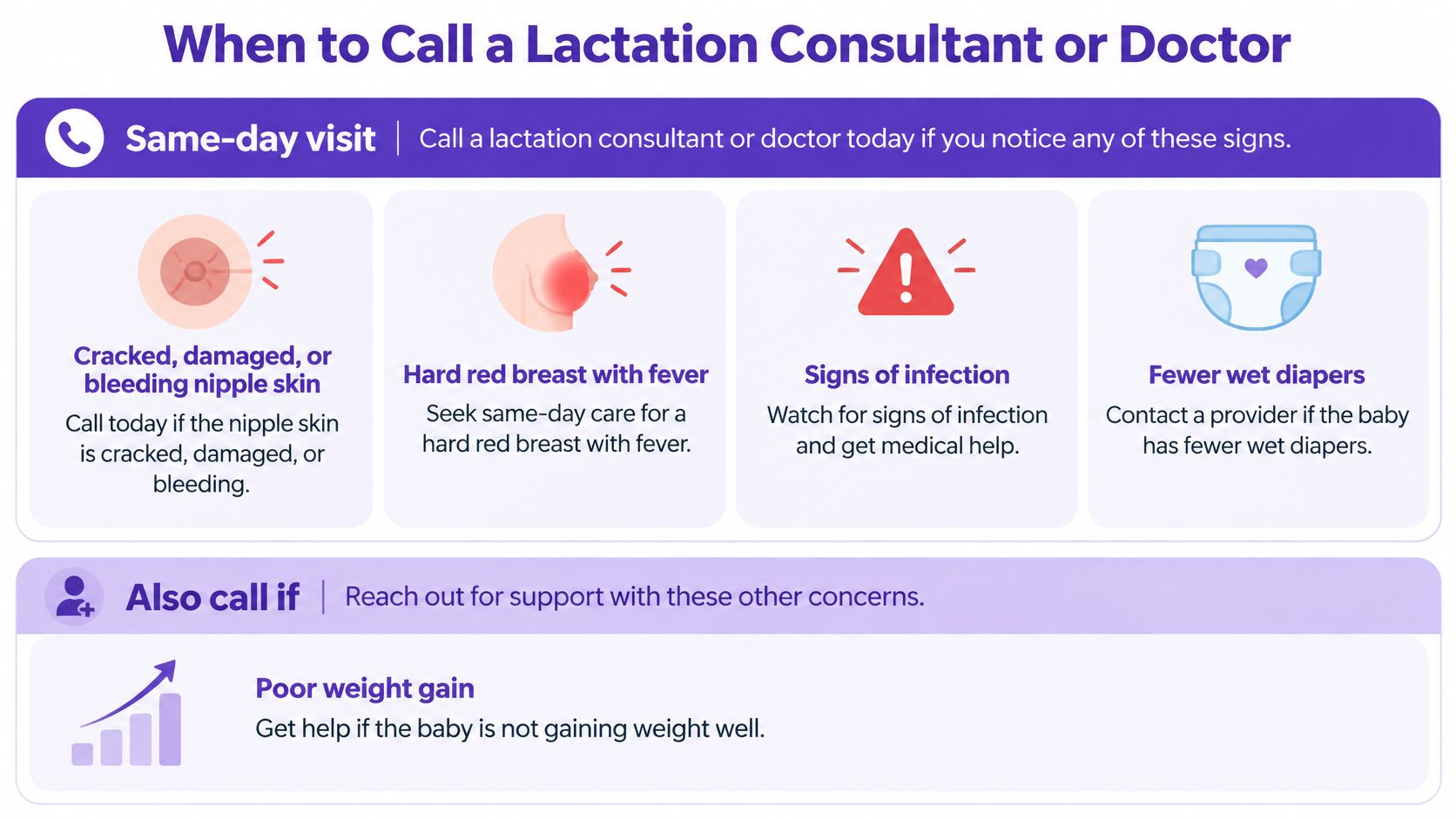
Lower urgency doesn't mean no urgency. Book help within a few days if pain continues after the initial latch at most feeds, if your baby rarely seems satisfied afterward, or if pain hasn't improved within 1 to 2 weeks. You're not overreacting by asking. The UK Department of Health and Social Care infant feeding survey for England in 2024 reported that 25% of mothers experienced difficulty with their baby latching on or sucking, while 73% experienced at least one breastfeeding difficulty.
Who to call and how to book
An IBCLC, an International Board Certified Lactation Consultant, is the right first contact for persistent latch pain, suspected tongue restriction, and questions about milk transfer. A midwife, pediatric clinician, or doctor should see fever, suspected infection, and weight concerns. Bornbir lists lactation consultants who are IBCLCs, and its doula interview checklist makes the same split. Basic latch help and reassurance are within a doula's scope, while persistent pain or weight concerns should trigger a referral to a lactation consultant.
- Search and check credentials. Look for an IBCLC or local lactation service, and verify certification and licensure before you book. You can explore lactation consultants on Bornbir alongside its Find a Doula, Find a Midwife, Find a Lactation Consultant, and Find a Night Nanny features.
- Message before you book. Ask about availability, home or virtual visits, and whether they assess tongue function or refer for that.
- Bring evidence, not just a summary. Take a short video of one feed, your notes on pain timing, wet and dirty diaper counts, a simple feeding log, and a list of fixes you've already tried.
- Take the first slot if a same-day trigger is present. Don't wait for a preferred provider when there's fever, bleeding, or a drop in wet diapers.
While you wait to be seen, keep feeding if you can, and express milk if direct feeding is too painful. Expressing keeps supply steadier and gives you milk to offer your baby by cup, syringe, or bottle as your clinician advises.
Follow-Up Care Until the Latch Settles
After two days of changes, run the first comparison again at one calm feed. Progress looks like this. Pain fades within the first minute, swallowing is audible, your baby settles after feeds, the nipple comes out round and heals between feeds, and wet diapers stay steady.
Keep nipple care simple while skin recovers.
- Air dry nipples after each feed before you close your bra.
- Apply expressed breast milk or a lanolin product to sore skin, and stop any product that makes burning worse.
- Change nursing pads often and keep skin clean and dry.
- Check pump flange fit and suction if you're pumping, since pump trauma can undo good latch work.
Keep a short log of feeds, pain timing, and wet diapers, and take it to weight checks. If a feed hurts badly, pause, break suction, and re-latch rather than pushing through. If same-day triggers appear, or pain passes the 1 to 2 week checkpoint without improving, home care stops and a visit comes next.
If latch pain is making every feed something you dread, you don't have to sort referrals out alone at midnight. Bornbir connects you with vetted IBCLCs, midwives, and doulas for in-person or virtual feeding support, and lets you compare services, availability, and real parent reviews side by side. Share what you need once and get matched with local providers who can watch a feed, check your baby's latch, and help you feed without pain.