
You're pregnant, you have Medicaid, and you've decided a birth center fits what you want. You search for a birth center that accepts Medicaid, call the first result, and spend ten minutes on hold with billing. Then someone says, “Yes, we take Medicaid,” but can't tell you whether they take your managed-care plan, whether the facility fee is covered, or what happens if labor ends at a hospital.
That answer isn't enough. A center may bill Medicaid for the midwife's professional services but not have a contract for the birth-center facility. It may be in-network with Medicaid generally but not with your exact plan. It may accept your plan and still have no opening for your due date.

Medicaid is required to cover eligible services at freestanding birth centers that are licensed or otherwise recognized under state law. In practice, access still depends on state rules, facility licensure, managed-care contracts, reimbursement, capacity, and local availability. A birth center accepting Medicaid can exist on paper while remaining difficult for a particular family to use.
If billing language gets confusing, find OB/GYN billing help before you assume a verbal “yes” means every part of your care is covered. You can also use the Bornbir doula insurance guide to separate birth-center coverage from separate support services.
Why Finding a Birth Center That Takes Medicaid Is Harder Than It Looks
The phrase accepts Medicaid hides several different questions. The first center you call might accept traditional Medicaid but not your managed-care organization. Another might contract with your plan for prenatal appointments but not the facility fee charged for labor and birth. A third may be fully contracted but not taking new patients with your due-date window.
That's why a directory result is only a starting point. You need to confirm four things before you invest time in a tour:
- The exact plan: Give the center the name on your insurance card, not just “Medicaid.”
- The licensed facility: Confirm that the birth center itself is licensed or recognized under state law.
- The available slot: Ask whether the center is accepting new patients with your expected due date.
- The complete bill: Ask about midwife services, facility charges, labs, newborn services, postpartum care, and hospital transfer.
Practical rule: “We accept Medicaid” is not the finish line. It's the moment you start asking more precise questions.
The coverage framework is real. Medicaid financed approximately 42% of U.S. births in 2020, yet 99.4% of Medicaid-financed births occurred in hospitals, while fewer than 1% occurred in freestanding birth centers, according to MACPAC's maternity provider analysis. That gap doesn't mean birth centers are automatically unavailable. It means a family often has to do more checking than a search result suggests.
A phone call should leave you with names, billing details, and a clear next step. If the staff member says “it depends,” ask what it depends on, who can verify it, and when you'll receive the answer in writing.
Where to Search for a Birth Center That Takes Medicaid
Start with your state Medicaid website or managed-care plan portal. Use the provider search tool and look for facility types such as birth center, clinic, midwife, maternity provider, or women's health provider. The label may not say “birth center,” so search several categories and call the plan if the results look incomplete.
The Medicaid portal is useful for identifying contracted providers, but it may not show current capacity. A center can appear in the directory while having no openings for your due date. Ask the plan to verify the facility's contract, not just the individual midwife's participation.
Next, check your state health department. You can confirm that a freestanding center is licensed or otherwise recognized under state law there. Medicaid coverage rules depend on that status, but a health department list usually won't tell you whether the center accepts your exact managed-care plan or has space for new patients.
The American Association of Birth Centers directory can add another layer of verification. Treat it as a way to locate possible centers, then confirm current licensing and insurance details directly.
Use local platforms for the questions directories miss
A parent-focused platform can help you find nearby midwives and birth practices, compare profiles, and contact providers before you schedule anything. You can find a midwife near you and ask directly whether the practice works with your plan, whether it has openings, and which services it bills separately.
This approach is especially helpful when state directories are outdated or too broad. A direct message won't replace insurance verification, but it can save you a long drive to a center that isn't accepting patients. Before a tour, use a practical childbirth planning guide to organize your preferences and questions.
Use at least two sources before booking. For example, verify the center through your plan portal, confirm its license through the state, then contact the center with your member information. The plan portal tells you about network status, the licensing source tells you whether the facility qualifies, and the center tells you what's happening now.
How State Rules and Reimbursement Shape Real Access
The federal rule creates a floor, not a simple appointment system. Licensed birth centers can qualify for Medicaid coverage, but states control licensing details, managed-care arrangements, reimbursement policies, and practical administration. Your ZIP code can change the answer.
A 2025 state review found freestanding birth centers covered in 78% of states. Coverage was reported in 83% of Medicaid-expansion states and 60% of non-expansion states, according to the AIR Medicaid postpartum brief. Those figures describe state coverage, not guaranteed access to a nearby center or an appointment with your plan.
| State category | Birth-center coverage | Typical facility fee range | What it means for you |
|---|---|---|---|
| Medicaid-expansion states | 83% | Varies by state and contract | A covered benefit may be more common, but you still need to verify the specific plan and center. |
| Non-expansion states | 60% | Varies by state and contract | Your local options may be narrower, and plan verification matters even more. |
| States overall | 78% | Published fees vary widely | State coverage doesn't guarantee a nearby facility, transportation, or an opening. |
Facility reimbursement also affects whether centers can keep Medicaid contracts. A 2025 analysis of nine states reported published Medicaid facility fees ranging from $1,300 in New Jersey to 4.5 times that amount in Massachusetts, with some states paying much less when a patient transferred after admission. The analysis is available through the National Library of Medicine.
That creates a four-part system:
- Federal coverage: The service can qualify under Medicaid.
- State policy: The state defines licensing, payment, and administration.
- Plan contract: Your managed-care plan decides whether it contracts with that center.
- Center reality: The center decides whether it has capacity and can sustain the arrangement.
Low reimbursement can shrink supply. A center may want to serve Medicaid families but struggle to cover staffing, facility operations, and transfer-related work under its contract. That's one reason a neighboring town may have a functioning option while your area has none.
If you're also comparing birth support services, keep separate records for Medicaid doula reimbursement by state. Doula payment and birth-center billing aren't the same benefit.
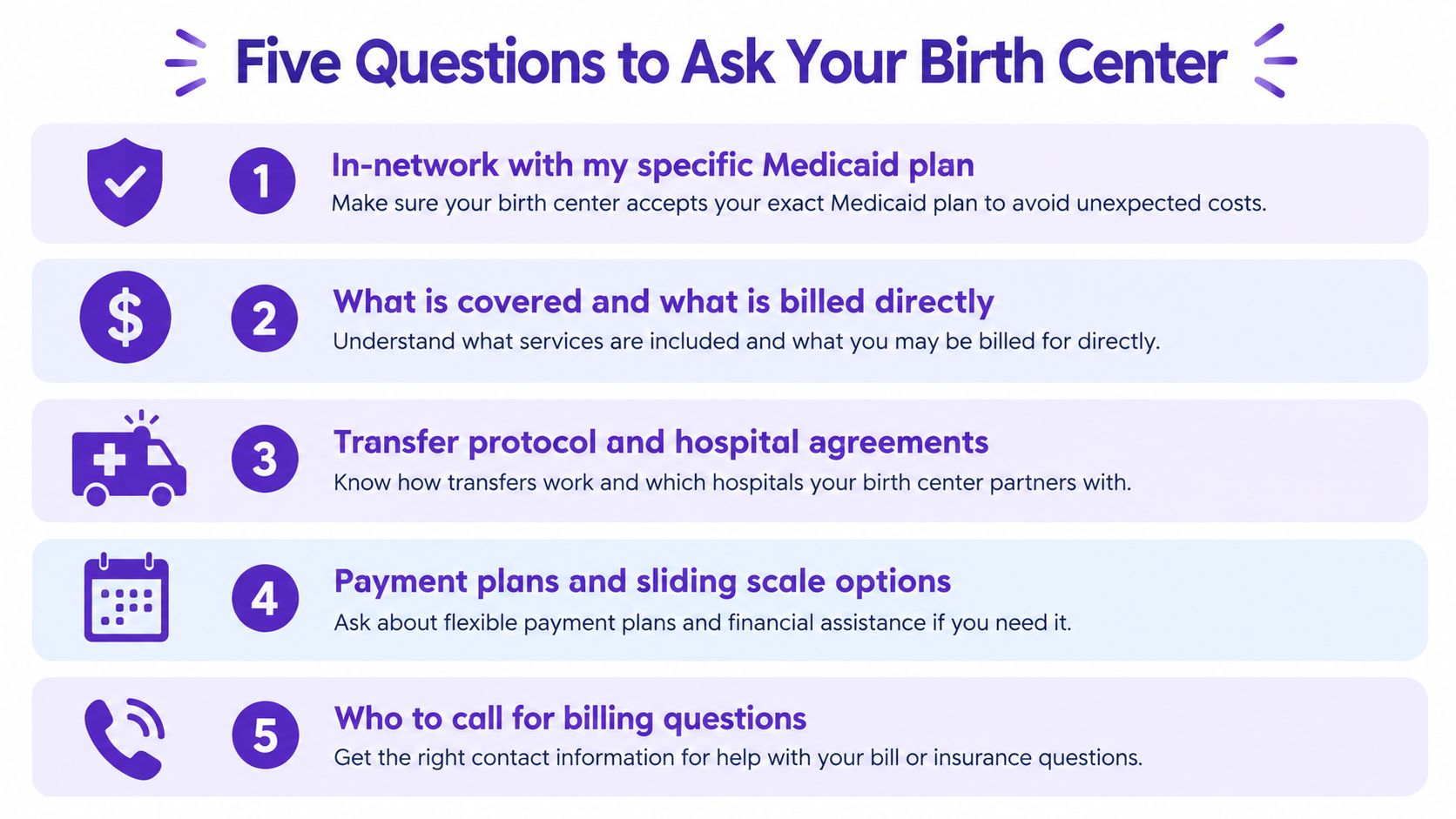
The Five Questions That Decide Whether Your Plan Works Here
Call the center before you book a tour. Have your Medicaid card beside you and ask these questions in order.
1. Are you in-network with my exact Medicaid plan?
Say the plan's full name and provide your member ID. “We take Medicaid” is too broad. Ask whether the facility and the midwife practice are both contracted with your plan.
2. What exactly is billed for the birth?
Ask what counts as the facility fee, what counts as the midwife's professional fee, and whether those charges are submitted separately. Then ask whether prenatal visits, labs, newborn screening, and postpartum visits are included or billed on their own.
3. What happens financially if I transfer?
Ask who bills you if you go to a hospital during labor. Ask whether the center charges a reduced facility fee after admission, whether the hospital and birth center bill separately, and whether ambulance, specialist, anesthesia, and newborn services are covered at in-network rates.
4. Do you have an opening for my due date?
Give your due-date range, not only the month. A center may accept Medicaid and your plan but have no capacity. Ask whether it maintains a waitlist and when it expects to confirm placement.
5. Can you send me a written estimate?
Request a written explanation of what you may owe, including labs, newborn screens, postpartum visits, and services outside a global maternity fee. Medicaid often limits cost sharing, but you still need to identify any service the center doesn't bundle or bill directly.
Write down the staff member's name, the date, and each answer. If the center can't verify something, ask whether its billing office, your plan, or the state Medicaid office should answer it. For complicated coverage checks, insurance verification support can help providers organize the information they need.
You can also bring the Bornbir midwife question guide to your call or tour. Don't accept a vague answer when a specific follow-up can identify the responsible person.
What Happens to Your Bill If You Transfer to a Hospital
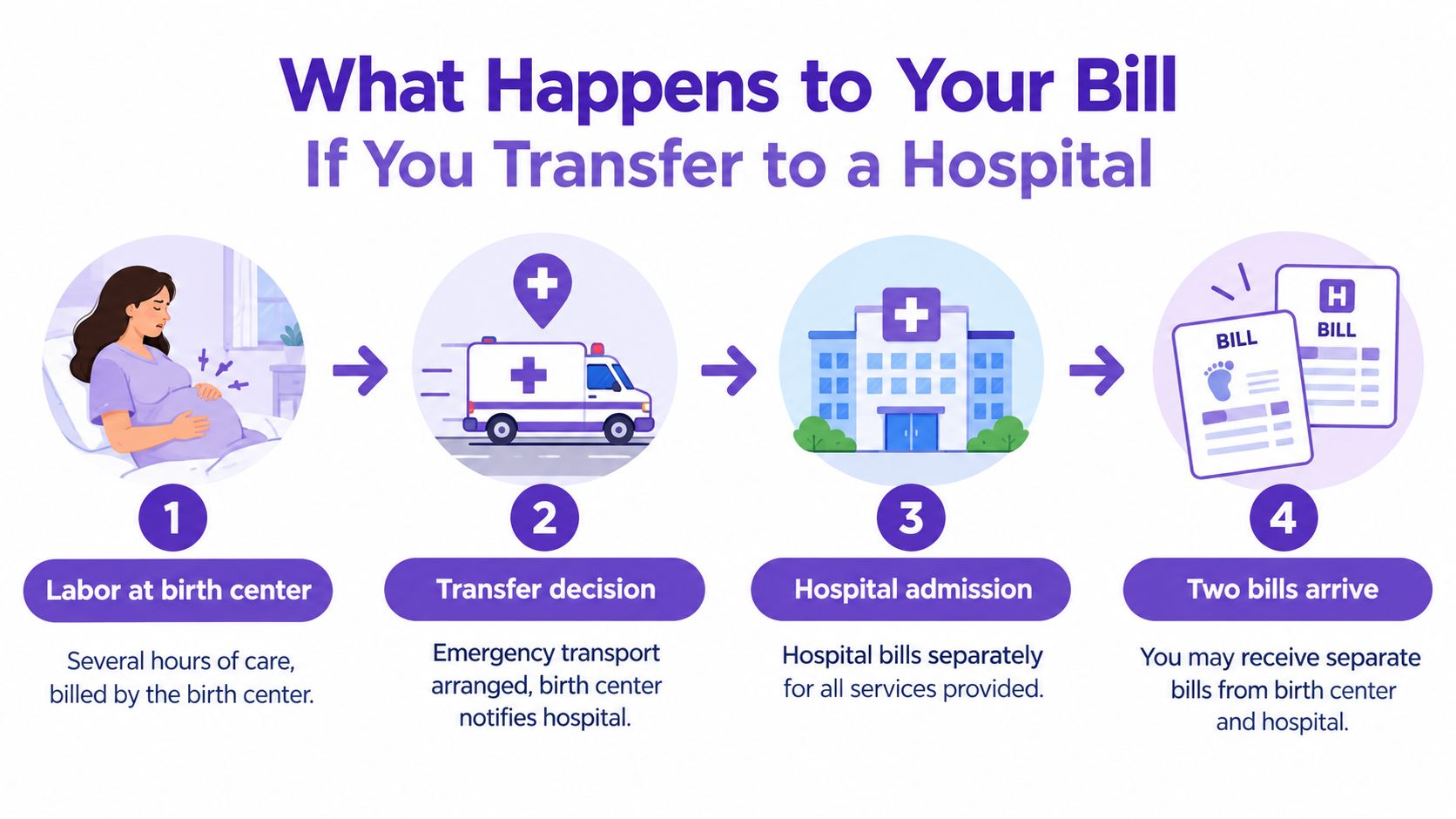
A transfer doesn't mean your planned birth-center care was inappropriate. It means your care moved to a different setting, and the billing can split across several people and organizations.
Suppose labor starts at the center. Your midwife monitors you, then recommends transport. An ambulance takes you to a hospital, where an obstetric clinician evaluates you and the delivery happens there. You may then see separate claims from the birth center, the ambulance provider, the hospital, the clinician, an anesthesiologist if you receive an epidural, and a pediatric clinician for the newborn.
The birth center may charge for care already provided and may apply a different facility fee after transfer. The hospital bills its own facility and professional services. Your plan decides how each claim is processed, whether prior authorization matters, and whether the ambulance and specialists are treated as in-network.
Ask before labor starts
Call the center and ask whether it has a written transfer agreement with a specific hospital. Then call your Medicaid plan and ask:
- Transfer billing: Does transfer change what the birth center can bill?
- Ambulance coverage: Is emergency transport covered, and how is it processed?
- Hospital services: Are the receiving hospital and clinicians in-network?
- Specialist charges: What happens with anesthesia, emergency specialists, and newborn care?
- Member responsibility: Could any part of the transfer create a bill for you?
Federal Strong Start analyses found financial and clinical advantages for participating Medicaid beneficiaries receiving birth-center care. Costs from birth through the infant's first year were $2,010 lower on average per mother-infant pair, with a 25% lower preterm-birth rate, approximately 20% fewer low-birth-weight infants, and a 40% lower cesarean-delivery rate than comparison groups, according to the federal Medicaid guidance. Those findings describe groups receiving birth-center care and don't eliminate the need to understand transfer billing.
For practical preparation, spend time understanding hospital procedures, including admission, transport, anesthesia, and newborn care. Ask for written answers, not reassurance that “the plan usually covers it.”
Scripts to Use, Paperwork to Gather, and Your Next Step
Use this script with the birth-center intake coordinator:
“Hi, I'm pregnant and my due date is around [date]. I have [full Medicaid plan name], and my member ID is [ID]. Are the birth center and the midwife practice both in-network with this exact plan? What facility and professional fees are billed separately? If I transfer to a hospital, who bills what? Do you have an opening for my due date? Can you send me a written estimate of any amount I could owe, including labs, newborn screens, and postpartum visits? Please send me the confirmed answers by Friday so I can compare centers.”
Use this script with your plan's member-services number:
“I'm considering [birth center name]. Please confirm whether the facility and its midwife practice are in-network with my plan. Is the birth-center facility fee covered under my maternity benefit? What would happen if I transfer to a hospital? Are ambulance, hospital, anesthesia, specialist, and newborn charges covered at in-network rates? Do I need prior authorization?”
Have these items ready:
- Medicaid member ID: Keep the card in front of you.
- Plan details: Write down the plan name and any BIN or card information shown.
- Provider information: Have the center's legal name, address, and phone number.
- Existing records: Keep your OB or midwife list available if you already have one.
- Authorization details: Ask whether your plan requires prior authorization for the facility or transfer.
Pick three centers within driving distance. Call all three this week, use the same questions, and put their answers side by side. A directory can find names, but your phone calls will tell you whether the exact plan, facility, due date, and transfer arrangements work.
Bornbir helps expecting parents search for and compare independent midwives and other perinatal providers, then message them about availability, services, pricing, and insurance questions. Visit Bornbir to start comparing local options before you book a tour.