
A birth coach, usually called a birth doula, is a nonclinical professional who gives continuous emotional, physical and informational support during labor and birth, without diagnosing, treating or delivering the baby. Across pooled trial evidence covering 21 trials and 14,369 women, people who received continuous support were more likely to have a spontaneous vaginal birth (risk ratio 1.08) and less likely to have a cesarean birth (risk ratio 0.78).
Your hospital bag sits half packed by the door. Your partner's shift rota is stuck to the fridge with a magnet, and you've already had the conversation about who drives if it happens at 3 a.m. Somewhere in the middle of that planning, a question keeps surfacing. Who is going to be in the room with me, focused on me, for the whole thing?
That question is where the birth coach conversation usually starts. It rarely starts with a clear idea of what the job involves. Most first-time parents meet three or four job titles in the same week, doula, midwife, childbirth educator, night nanny, and assume they're variations on the same service. They aren't. They differ in training, in legal authority, in what they're permitted to do at four centimeters, and in who pays for them.
Here's the honest version. A coach can make labor more comfortable and more understandable, and the evidence for continuous support is real, but it's evidence about presence and advocacy. It isn't evidence that one person can change a medical outcome on their own. Knowing exactly where that line sits is what makes the decision easier.
What a Birth Coach Is and Is Not
A birth coach provides support rather than medical care, and that support can begin in pregnancy, run through labor and birth, and continue briefly afterward. The American College of Obstetricians and Gynecologists describes doulas as continuous support people who can improve communication and patient experience when they work alongside the health care team. The everyday texture of the job is practical: encouraging movement, using counterpressure on a sore lower back, offering physical comfort, and keeping conversation flowing between you, your clinicians and the people you brought with you.

The easiest way to picture the role is a sideline coach at a match. That coach doesn't play, doesn't call the medical shots and doesn't take over the referee's job. What they do is stay with the player, keep them focused when the plan falls apart, adjust the approach, and speak up when a break is needed.
The three core jobs follow from that.
- Continuity. The same person is present from early labor through birth, so you aren't re-explaining your preferences to a new face at every shift change.
- Comfort. Movement, positioning, breathing, massage and counterpressure. Low-tech measures, offered at the right moment rather than read off a list.
- Communication. Helping you understand options, state preferences, and involve a partner or family member instead of leaving them frozen by the window.
Where support stops and clinical care starts
A birth coach does not diagnose conditions, prescribe medication, perform clinical tasks, deliver the baby, or replace a midwife or physician. Those exclusions aren't fine print. They are the definition.
What a coach cannot do: diagnose a condition, prescribe or adjust medication, perform clinical checks, deliver your baby, or make decisions on your behalf.
Answering what is a birth coach properly means separating that support role from the clinical one, because training, certification and legal status vary by country and by provider, as an overview of doula practice and its evidence base sets out. The title on a profile won't tell you what the person will do in the room. The service list does.
If you want one person whose whole job is your comfort and your communication through labor, a birth coach is the role to research first.
What a Birth Coach Does Before, During and After Birth
Take one ordinary case. A 34-year-old first-time parent books a hospital birth, and her partner works rotating shifts, so he might be coming off a night when labor starts. She'd like to avoid an epidural if she can, but she isn't certain, and she doesn't want to be talked into anything either way.
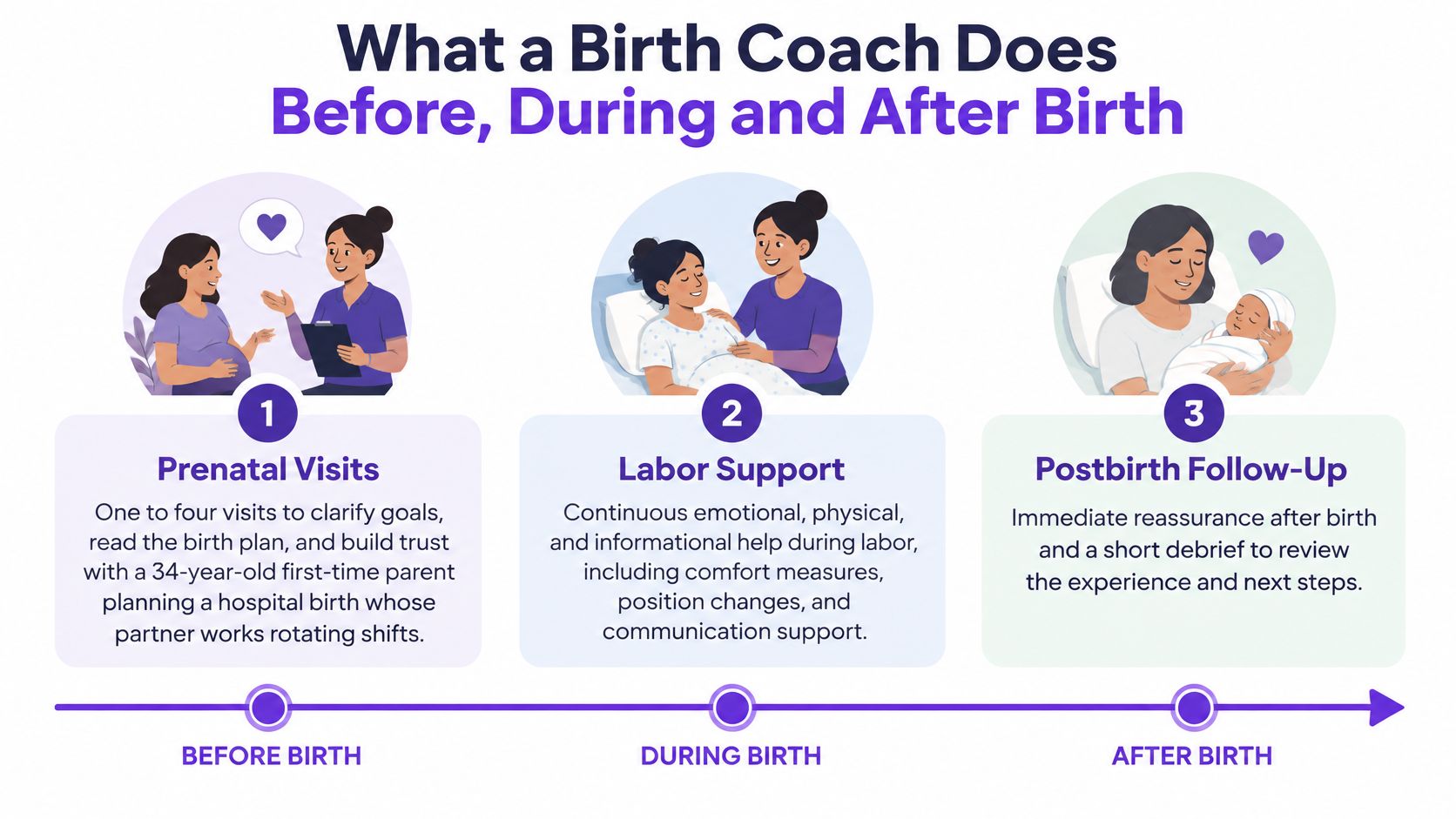
Before labor. Expect one to four prenatal visits. In that time the coach clarifies what matters to you, reads your hospital's written policies with you, practices breathing and comfort techniques, and drafts birth preferences you can hand to a nurse. The concrete output is a document and a rehearsal, not a promise.
Early labor. She's the person you text at midnight with "is this it?" and the person who tells you when to call the care team rather than the other way round. She suggests walking, a warm shower, a snack, and a home routine that keeps you out of the car too early. Some coaches join you at home for this stage.
Active labor. This is where the role earns its place. Continuous bedside presence, counterpressure on the lower back through each contraction, position changes every twenty minutes or so, sips of water and a cool cloth. She also reminds your partner to eat something and sit down, because a supported partner is a more useful partner.
Ask early: "If I call you at 2 a.m. and my labor is moving fast, who else can come, and how quickly can they get here?"
Birth. The coach supports your partner and keeps the language plain without directing clinical decisions. When a clinician says "we'd like to discuss the fetal heart tracing", she's the one who says "that means they want to talk about the baby's heartbeat, do you want a minute to think before you answer?".
After birth. One or two follow-up visits cover feeding questions, an emotional check-in and a debrief of what happened, which matters more than most families expect. If signs of perinatal mood trouble appear, a good coach names them and refers you to a mental health professional rather than managing it herself.
Physical preparation sits alongside all of this. If you want one more lever in the final weeks, The Axelrad Clinic on preparing for labor walks through ways to prepare your body before labor begins, and it pairs naturally with the comfort work a coach teaches.
Birth Coach, Doula, Midwife and Other Birth Professionals Compared
| Professional | Clinical role | Main focus | Prescribes or diagnoses |
|---|---|---|---|
| Birth coach or birth doula | No | Continuous labor and emotional support | No |
| Midwife | Yes | Prenatal, birth and newborn care | Yes, within licensed scope |
| Obstetrician | Yes | Medical and surgical obstetric care | Yes |
| Childbirth educator | No | Classes on labor, pain relief options and birth choices | No |
| Postpartum doula | No | Newborn care and recovery support at home after birth | No |
| Lactation consultant | Some hold clinical licenses, many don't | Feeding support and latch help | Only if the credential is a clinical license |
| Night nanny | No | Overnight newborn care after birth | No |
Read the table by the question you need answered
If your question is "who decides whether I need an induction", you want the obstetrician or midwife row. If your question is "who stays with me while I work through contractions", you're in the first row. If it's "who helps me get a feed established at home on day four", that's the postpartum doula or the lactation consultant.
The roles also run on different clocks. Postpartum doulas and night nannies start after the birth, while childbirth educators work mainly before it, so both complement a labor coach rather than compete with them. Lactation consultant credentials differ enough that you should verify the specific certification rather than trusting the title, and ask whether the person holds a clinical license or a peer-support one.
Where the labels blur most is marketing. "Birth coach" and "birth doula" get used interchangeably, so compare what each provider lists under services rather than what their page is called.
An independent coach can attend alongside a midwife or an obstetrician without any conflict of role: the coach supports, the clinician leads medical care, and both work better when they know the plan in advance. The difference between a doula and midwife comes down to that single word, authority.
Match the professional to the question you need answered, and hire for the gap, not for the job title that sounds most reassuring.
What the Evidence Shows About Birth Coach Support
The evidence base is broader than most parents expect. A Cochrane review of continuous labor support pooled 21 trials involving 14,369 women. The pooled effect sizes below come from the Cochrane Library review of continuous support during childbirth.
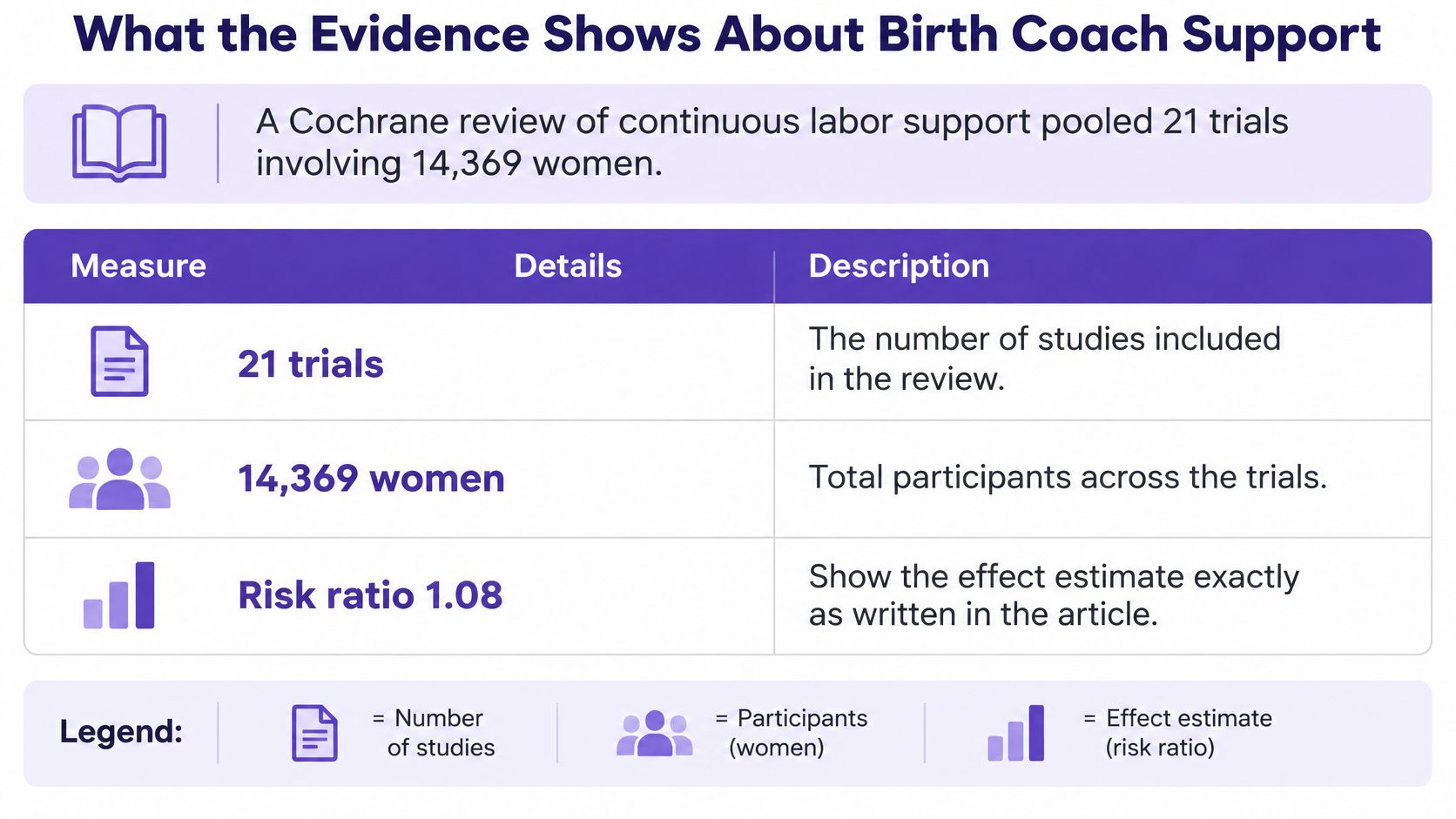
| Outcome | Effect (risk ratio or mean) | 95% confidence interval | Direction for supported group |
|---|---|---|---|
| Labor length | Mean reduction of 0.58 hours | -0.85 to -0.31 hours | Shorter labor |
| Cesarean birth | Risk ratio 0.78 | 0.67 to 0.91 | Lower risk |
| Instrumental vaginal birth | Risk ratio 0.90 | 0.85 to 0.96 | Lower risk |
| Regional analgesia use | Risk ratio 0.93 | 0.88 to 0.99 | Lower use |
| Spontaneous vaginal birth | Risk ratio 1.08 | 1.04 to 1.12 | Higher chance |
| Negative birth experience | Risk ratio 0.69 | 0.59 to 0.79 | Lower risk |
What the numbers mean in plain language
A mean reduction of 0.58 hours is about 35 minutes of shorter labor on average, which in a twelve-hour first labor is a noticeable but not dramatic difference. A risk ratio of 0.78 for cesarean birth means a lower relative risk in the analyzed evidence, not a 78 percent chance of anything. A ratio of 1.08 for spontaneous vaginal birth is a somewhat higher relative chance, and its confidence interval of 1.04 to 1.12 suggests the true effect is unlikely to be zero or negative.
The 0.69 for negative birth experience is the figure most parents underestimate the value of. Fewer supported people described their birth in negative terms, and the interval of 0.59 to 0.79 is tight enough to take seriously.
A confidence interval is just the range the true effect probably falls inside. When a range stays on one side of 1.0, the direction of the finding is stable; when it crosses 1.0, the data can't separate the effect from chance.
What the evidence does not prove
These are associations from pooled studies, not guarantees. Parity, medical risk, hospital staffing, induction policies and epidural access all shape your labor more than any single support decision does. The review also defines useful support narrowly: someone present solely for support, outside your usual personal network, experienced in labor support, and holding at least modest training, such as a doula. A well-meaning friend doesn't automatically fill that slot.
What the evidence points to is a mechanism, continuous presence and advocacy, so the practical question is how a given coach delivers both in your hospital, on your due month. Our guide to the research-backed benefits of doula support breaks that down service by service.
Questions and Red Flags to Check Before Hiring
Certification isn't standardized, and a federal report on doula workforce data notes that training pathways vary widely with no single certifying body. That's exactly why the interview carries more weight than the credential line on a profile.
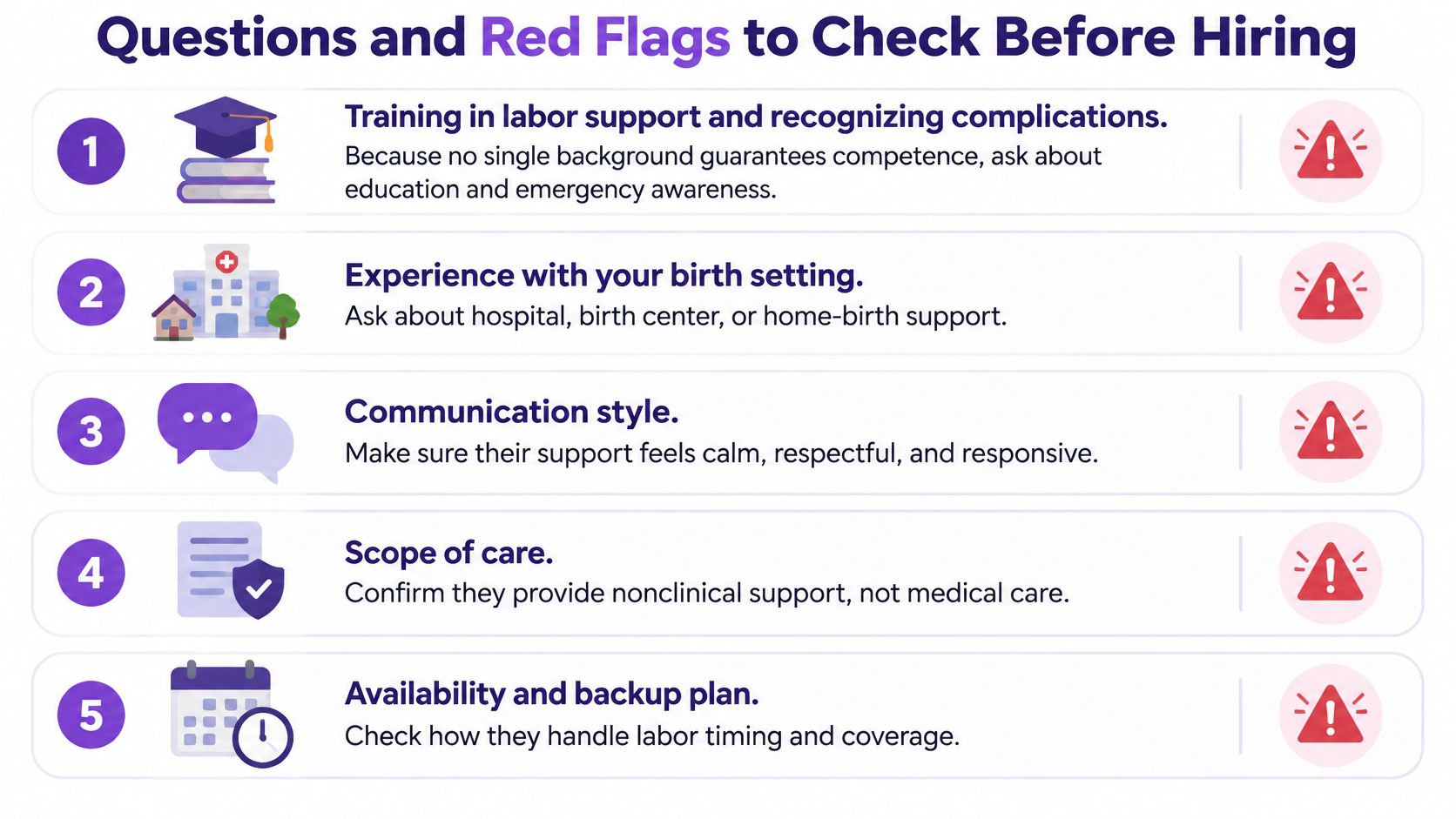
The checklist to run with every candidate
- Training in labor support and in recognizing complications. No single background guarantees competence, so ask what she was taught to notice and what she does when something looks wrong.
- CPR and emergency response preparation. You want someone who can act in the minutes before help arrives, not someone reading a manual.
- A written scope that excludes diagnosis and treatment. If a provider won't put the boundary in writing, assume it's fuzzy.
- The on-call window and a named backup. Labor doesn't schedule itself, and a solo practitioner with no backup has a coverage gap you inherit.
- Whether she attends active labor and stays through birth. Some packages are prenatal coaching only, which is a different service at a different price.
- The number of prenatal visits and what each one covers. Two visits that include your partner are worth more than four that don't.
- Postpartum follow-up and contact between visits. Our free questions to ask a birth doula checklist recommends asking about prenatal visits, the on-call window, continuous labor support, a postpartum follow-up, and text or phone support between visits.
- Familiarity with your hospital or birth center's policies. Rules on eating, monitoring, photography and how many support people are allowed vary enormously between sites.
- References from recent clients. Recent, local, and ideally one whose birth resembled the one you're planning.
- A written contract with cancellation and refund terms. Get the deposit, the balance date and the early-birth clause in one document.
- A stated plan for escalating urgent symptoms. Bleeding, reduced movement, a bad headache at 36 weeks. Ask exactly who she tells you to call.
The red flags worth walking away from
- Promised outcomes. Nobody can guarantee a vaginal birth, an unmedicated labor or a specific experience.
- Pressure toward one birth philosophy. Your preferences can change at seven centimeters, and they're allowed to.
- Vague answers about boundaries. Hesitation about what she won't do is a signal, not a personality quirk.
A good coach won't require you to know what kind of birth you want. The right one asks questions and lays out options rather than pushing a philosophy.
This checklist is general guidance for hiring support, not medical advice. Your midwife or obstetrician remains the person who answers clinical questions.
Costs, Payment Routes and Access for Birth Coach Support
A listed price is rarely the full cost. In 2025, Morgan Health reported that interested respondents were willing to pay an average of $1,400 to $2,200 out of pocket for doula services. That tells you what families expect to spend, not what they end up paying once on-call time and postpartum visits are counted.
| Payment route | Typical cost pattern | What to check |
|---|---|---|
| Private pay | Flat package or per-visit fee; interested respondents reported willingness to pay $1,400 to $2,200 in 2025 | Whether the package covers on-call time, labor and postpartum visits |
| Medicaid in select states | Set reimbursement, such as $1,500 for birth support and eight home visits in New York City | Whether your state covers doula care and which providers are enrolled |
| Employer or benefits plan | Reimbursement through a health account or plan benefit, where the plan offers one | Whether the plan reimburses doula care and how claims are filed |
| Community or sliding scale | Reduced fee set by the program, often below private rates | Eligibility rules, waitlists and the training of the support provider |
| Virtual sessions | Priced below in-person packages in most listings | Whether virtual contact supplements in-person labor support rather than replacing it |
Why the same service costs different amounts
Public payment shows both the promise and the gap. New York City public health reporting describes Medicaid-funded doula services that included a $1,500 payment for birth support and eight home visits, while describing that rate as low for the city, according to the New York City doula report. A rate that's low in Manhattan travels very differently in a rural county with two practicing coaches.
Then come the questions that move the number.
Before you sign: ask what happens to the fee if your baby arrives two weeks early, or if a planned home birth turns into a cesarean after twelve hours.
Package structure matters as much as the total. A flat fee that includes unlimited on-call time, labor attendance and two postpartum visits is a different purchase from a per-visit rate with a fixed attendance window. Ask whether the price is per visit or per birth, and what is refundable if timing goes sideways.
Structural limits decide who gets support. Rural areas may have few providers within an hour's drive, reimbursement varies by program and state, and cancellation rules can shrink availability. Virtual sessions can carry preparation and reassurance, but they rarely replace a person in the room during active labor.
Three actions cover most of it. Ask for the package in writing, check your state's coverage before you assume it doesn't exist, and raise sliding-scale options early rather than at signing. Bornbir's guide to affording a doula compares the routes side by side. Families in rural areas, Medicaid-covered households, racially marginalized communities and pregnancies with medical complexity face the steepest access limits, so check coverage and local availability before you count on support being within reach.
Decide Whether a Birth Coach Fits Your Birth Plan
A birth coach fits if you want one person focused on your comfort and communication through labor, if your partner will need relief during a long first labor, or if your hospital's staffing may leave you alone for long stretches. It matters less if you already have a trusted, continuous companion and your care team has clear continuity plans, though prenatal preparation still adds value. If the answer is no, prenatal classes with a childbirth educator may meet your needs at a lower cost.
If the answer is yes, work through four steps.
- Write the three questions you need answered. Not "are you good", but "how do you handle a coach who's already at another birth" and "what's in the contract if I transfer care".
- Shortlist two to four providers and compare scope, rates and availability in the same sitting, so the differences are visible.
- Book a consultation and run the verification checklist above with every candidate, in the same order.
- Share the plan with your midwife or obstetrician before the final month, so nobody meets your coach for the first time in triage.
Bornbir's birth support matches for expecting parents lets you compare local coaches by scope, rate and availability, alongside midwives and lactation consultants, so the comparison happens in one place rather than across a dozen tabs. Whichever route you take, verify credentials, licensure and fit yourself before you sign anything.
Bornbir connects expecting parents with birth doulas, midwives, lactation consultants and night nannies across the United States and Canada, and you can compare profiles, pricing and availability side by side before you message anyone. Share what you need once and you'll get matched with local providers who offer prenatal visits and continuous labor support, so you're not assembling a care team from scratch at 36 weeks. Start your search at Bornbir and go into labor knowing exactly who's on the other end of that 2 a.m. call.