
Nearly 15% of people who planned a community birth transferred to a hospital, and that group carried the highest observed rates of cesarean birth, ventilation, NICU admission, lower Apgar scores and fetal death among nearly 350,000 U.S. births planned between 2012 and 2020, according to a University of South Carolina analysis of planned community births.
That figure is the right place to start a birth center vs hospital comparison, because it changes what the comparison is about. A birth center isn't a hospital that left the equipment out. It's a setting built on the expectation that most low-risk labors proceed without surgery, with a written plan for the ones that don't.
Families usually arrive at this decision with two questions tangled together. Is it safe, and will I get the birth I want. The evidence answers the first one differently depending on how the pregnancy is screened and how far the hospital is. The second is a preference, and it belongs to you.
What the evidence can settle. For screened low-risk pregnancies, planned birth-center care produces fewer routine interventions with broadly comparable newborn outcomes. What no study can do is predict your labor.
Birth Center vs Hospital at a Glance
Birth center and hospital care side by side
| Factor | Birth center | Hospital |
|---|---|---|
| Typical patients | Low-risk pregnancies screened in advance | Full range of risk, including high-risk pregnancies |
| Clinicians | Midwives with physician backup | Obstetricians, nurses, anesthesiologists and neonatal teams |
| Cesarean surgery on site | No | Yes |
| Neonatal intensive care on site | No | Often yes, depending on hospital level |
| Room style | Home-like room, often with a tub | Labor and delivery suite with monitoring equipment |
| Transfer happens when | Complication or change in risk during pregnancy or labor | Not applicable |
| Usual postpartum stay | Discharge within hours to a day | Usually one to two days, longer after cesarean |
Scan those rows in order and a design logic appears. The birth-center column assumes most labors will stay normal and organizes care to protect that. The hospital column assumes any labor might need a surgical team and keeps one within reach.
The staffing row explains most of the rest. At a birth center, the clinician in the room is usually a midwife, with physician backup named in an agreement and a defined route to a hospital. At a hospital, the team can include an obstetrician, a labor and delivery nurse, an anesthesiologist and a neonatal team, and the operating room sits on the same floor as the labor rooms.
Room style and length of stay follow from that. A home-like room with a tub supports movement and water immersion, which is why discharge often comes within hours to a day. A monitored labor suite supports continuous observation, and the usual stay runs one to two days, longer after a cesarean.
Read this as a description of design, not a scoreboard. Nothing in the table says one setting provides better care. It says each one is built for a different starting assumption.
The first filter to apply
Before comparing tubs or visiting hours, find out whether your provider has screened you as low risk. That single screen decides which column applies to your pregnancy. A center that accepts a patient at 12 weeks can still refer at 36 weeks if blood pressure climbs or the baby turns breech. The setting isn't locked in at booking, which is why the useful question isn't only where you'll give birth but what happens when the answer changes.
Who Qualifies for a Birth Center
Pregnancy situations and typical setting fit
| Pregnancy situation | Birth center | Hospital |
|---|---|---|
| Healthy, term, single baby after a vaginal birth | Usually eligible | Eligible |
| First pregnancy, low risk, term | Often eligible with a planned transfer path | Eligible |
| Twins or other multiple pregnancy | Usually not eligible | Care available with a specialist team |
| Breech or transverse baby at term | Usually not eligible | Care available, including planned cesarean |
| Previous cesarean | Often not accepted, policy set by each center | Vaginal birth after cesarean with monitoring |
| Hypertension or diabetes needing medication | Usually not eligible | Care available with a specialist team |
Each row describes a typical fit, not a national rule. Birth centers write their own admission criteria, and a freestanding center may accept a slightly different list than a midwifery practice attached to a hospital.
A healthy term single baby after an uncomplicated vaginal birth is the easiest yes at a center and equally eligible at a hospital. A first pregnancy at term with normal blood pressure is often accepted when the center has a confirmed transfer path, because the center expects a higher chance of transfer and has somewhere to send you. Twins, a breech or transverse baby at term, and labor before 37 weeks usually move to a hospital, where a specialist team and a planned cesarean are available on site. Hypertension or diabetes that needs medication usually moves care too, since those pregnancies need closer monitoring than a freestanding center can offer.
A review of freestanding birth-center studies found antepartum transfer rates ranging from 13% to 27.2% and intrapartum transfer rates ranging from 11.6% to 37.4%, with intrapartum transfer at 11.6% to 16.5% in studies published from 2011 through 2013 (review of freestanding birth-center studies). In one collaborative program between a birth center and a tertiary hospital, 34% of 1,061 women were transferred before admission and 66% arrived at the center in labor. Of those who arrived in labor, 18% later transferred for a hospital birth.
Why the transfer percentages vary so much
Those wide spans come from different admission rules, different patient populations, and different definitions, including whether a move before labor is counted at all. A center that screens out 34% of callers before admission is running a tighter filter than one that screens out 13%, and its in-labor transfer rate will look different as a result. Comparing two centers by their headline transfer number without knowing which stage it measures tells you very little.
What to ask before you book
Put three questions in writing. How does the center handle a prior cesarean. What happens if the baby is breech at 36 weeks. Which conditions trigger an automatic referral rather than a conversation. The answers define the pregnancy the center expects to keep, and they tell you whether your situation sits comfortably inside it.
Pain Relief and Interventions Compared
Pain relief options by setting
| Option | Birth center | Hospital |
|---|---|---|
| Epidural or spinal anesthesia | Not offered | Available around the clock |
| IV opioid or other systemic pain medication | Not offered | Usually available |
| Nitrous oxide | Not routinely offered | Often available |
| Water immersion in a labor tub | Usually available | Available in some labor rooms |
| Movement, massage and positioning | Central to care | Available, depending on nursing staff |
| Labor induction with medication | Limited, generally not offered | Available |
| Continuous electronic fetal monitoring | Intermittent checks | Continuous when indicated |
Pain relief is the question families ask first, and it's the clearest structural difference between the settings. A birth center doesn't keep an anesthesia team on site, so epidural, spinal and IV opioid pain relief aren't part of its care. What it does offer is the low-intervention toolkit: warm water, movement, massage, breathing, positioning and one-to-one support.
A hospital offers all of that plus the pharmacology. Water and nitrous oxide often exist only on particular units, so ask about the specific labor floor rather than the hospital as a whole. If nitrous oxide is on your list, Bornbir's nitrous oxide explainer compares it with an epidural in plain terms.
In a comparative cohort, 91.9% of people intending a birth-center birth had a vaginal birth, compared with 82.5% of those intending a hospital birth. Induction ran at 11.1% versus 19.6%, epidural use at 11.1% versus 43.6%, and exclusive breastfeeding at discharge at 96.4% versus 74.7% (comparative review of place of birth). A systematic review summarized by the U.S. National Library of Medicine found higher odds of spontaneous vaginal birth, lower risks of cesarean and assisted vaginal birth, and higher breastfeeding initiation and continuation, with intrapartum and neonatal outcomes broadly similar to hospital care.
What the benchmarks show and what they cannot prove
Those numbers describe screened populations, not causes. Families choose their setting, and pregnancies with rising risk tend to end up in hospitals, which is exactly why the hospital column carries a heavier case mix. One cohort also shows how much the answer depends on which comparison you make: a 2025 analysis of U.S. birth-certificate data from 2016 to 2021 found maternal and infant morbidity was 13% more likely after planned birth-center births than after matched planned home births (birth-certificate comparison of birth settings). That compares two out-of-hospital settings, not a birth center against a hospital.
Practical rule. If an epidural or a medical induction is likely or simply wanted, only a hospital can provide it on request. If the goal is an unmedicated labor with few routine interventions, a birth center with a confirmed hospital pathway is built for that.
Ask your provider a direct question before you decide. Which interventions is this pregnancy most likely to need. An answer that includes induction, continuous monitoring or an epidural points to a hospital. An answer of none predicted leaves the choice open.
What Happens During a Transfer to Hospital
A transfer follows a sequence, and knowing the sequence removes most of the fear around it.
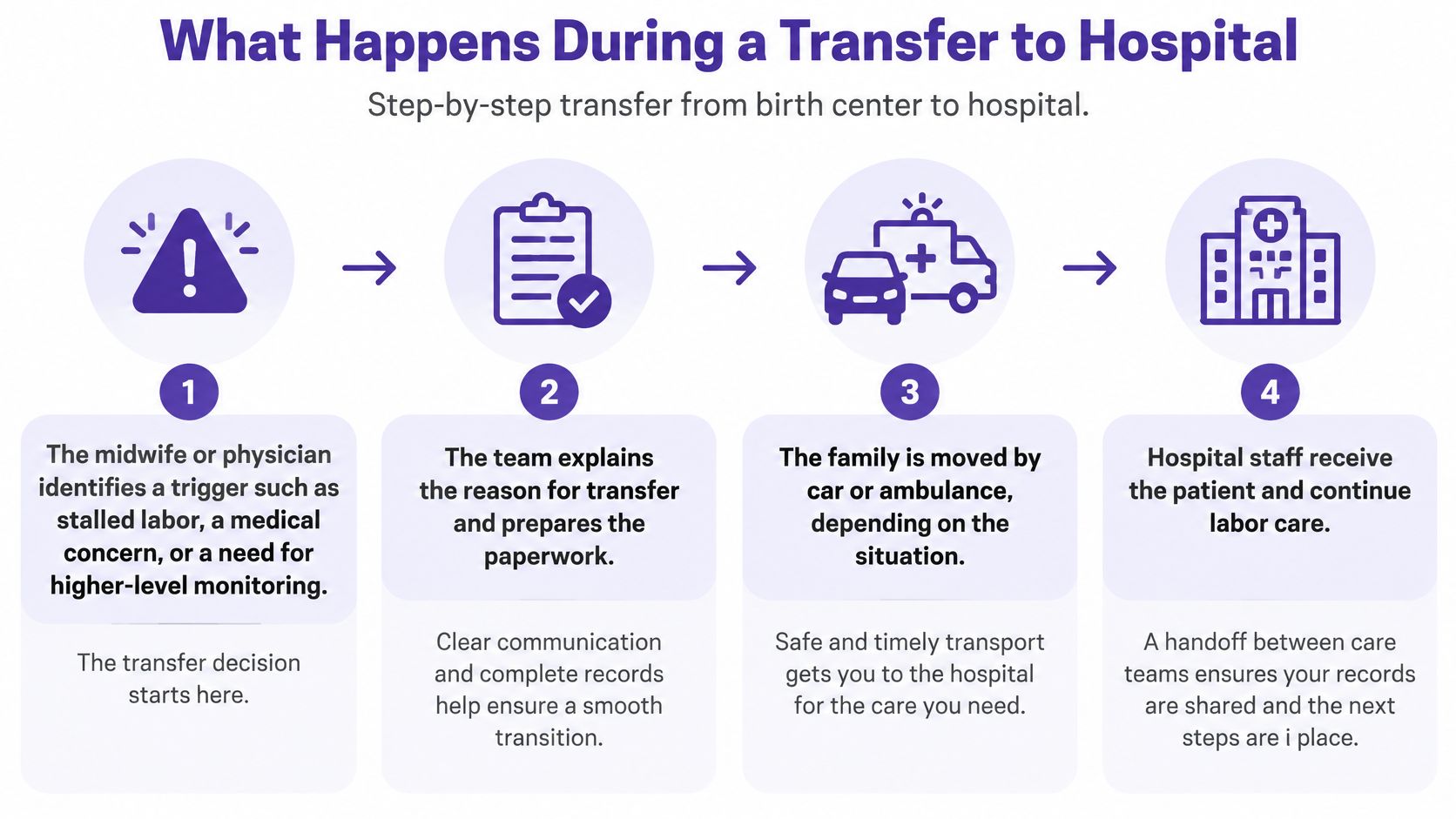
- A trigger is identified. The midwife or physician notices stalled labor, bleeding, concerning fetal heart patterns or rising blood pressure, and names it as a reason to change setting. Naming it matters, because the receiving team needs the reason, not just the arrival.
- The clinician calls the receiving hospital and gives a verbal handoff covering the pregnancy history, labor progress, the concern and the estimated arrival time. That call lets the hospital prepare a room, anesthesia or an operating team before you arrive.
- The family travels by private car or ambulance, depending on urgency. Slow progress or a requested epidural usually means a car. A concern about fetal status or bleeding means an ambulance with monitoring.
- Records travel with the patient, on paper and electronically when the two systems can exchange them. A center that shares a record system with its hospital saves time at the worst possible moment.
- A support person or doula stays with the family where hospital rules allow, so the laboring person keeps one familiar face whose only job is them.
- The hospital team takes over and plans anesthesia or cesarean if needed. Care continues in a new room; it doesn't restart.
The largest foundational U.S. picture of how often that happens comes from the National Birth Center Study, which followed 11,814 women admitted for labor and delivery at 84 freestanding birth centers. 15.8% were transferred to a hospital, and 2.4% needed an emergency transfer. Transfer depended heavily on whether someone had given birth before: 29% of first-time mothers transferred, compared with 7% of women who had given birth previously, while emergency-transfer frequency was similar in both groups.
In the same cohort the cesarean rate was 4.4%, no maternal deaths occurred, and combined intrapartum and neonatal mortality was 1.3 per 1,000 births, with infant mortality and low Apgar outcomes reported as similar to large studies of low-risk hospital births. The authors concluded that birth centers could be a safe option for selected patients, particularly those who had given birth before.
Most transfers are therefore not crises. The emergency share is a small slice of the total, and the rest are planned moves for slow progress, pain relief or a change in risk that the center can't manage. For first births, though, roughly one in three patients in that national cohort ultimately needed hospital care, which is why transfer counseling belongs in early prenatal visits rather than the last month.
Why transferred labors look riskier in the data
People who transfer are, by definition, the labors that ran into trouble. Their records show more cesarean births, more ventilation and more NICU admissions because the complications drove the transfer. The trip to the hospital reflects those complications; it doesn't create them. Read any transfer-group statistic with that direction in mind.
Questions that reveal a strong transfer plan
Ask for the median transport time, not the distance in miles. Then ask what it becomes at 6 p.m. on a weekday.
Add these to the same conversation: which hospital receives transfers and what level of newborn care it provides, whether a support person may ride along, how records are sent, whether the center's midwives hold privileges at the receiving hospital, and who accompanies the patient if the midwife can't. Hospital rules on doulas and support people differ between facilities, and Bornbir's hospital policy guide covers what to confirm before the due date.
What Each Setting Costs and What Changes the Bill
The cost gap shows up in population-level analyses, not in one family's invoice.
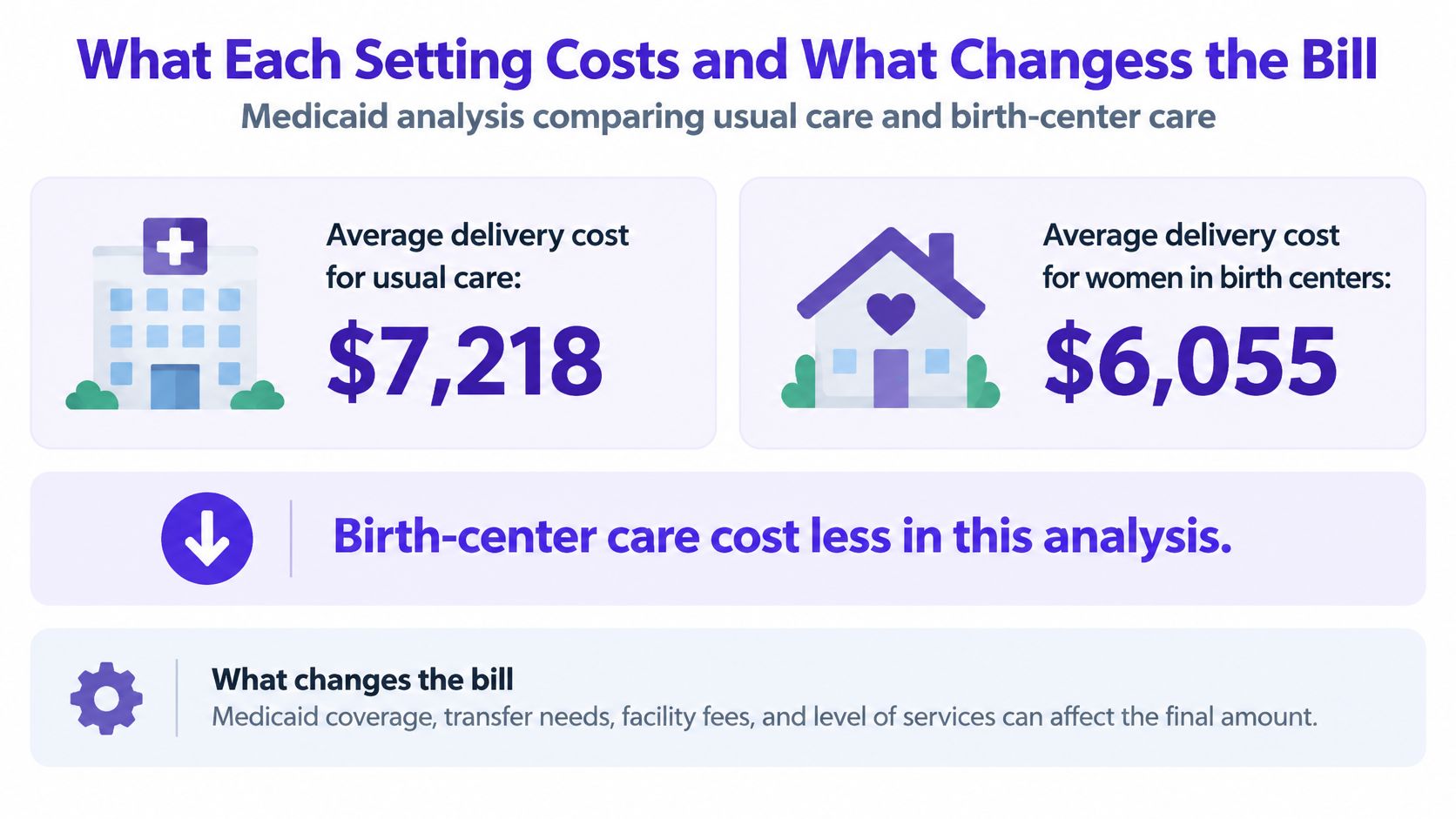
A Medicaid analysis estimated average national delivery costs in 2008 at $7,218 for usual care and $6,055 for women followed at a freestanding birth center, an estimated saving of $1,163 per delivery, or about 16% (Medicaid cost analysis of birth-center care). The same analysis found lower average costs alongside better average results for prematurity, birth weight and cesarean rates in the birth-center group. A separate federal Strong Start report found birth-center participants had costs $2,010 lower per mother-infant pair from birth through the infant's first year.
Those are population averages drawn from older data, not quotes. Prices have moved since, and a family's own total depends on benefits, fees and what happens in labor.
What actually moves your bill
- Network status and benefits. A center outside your plan's network can cost more than a hospital inside it, even with a lower sticker price.
- Package pricing against itemized billing. Some centers quote one all-inclusive figure for prenatal care, birth and postpartum visits; hospitals bill each service. Ask which model you're being quoted.
- Professional fees. The midwife or physician, the anesthesia team and the pediatric clinician may bill separately. Confirm who bills for what.
- Transfer billing. If a planned birth-center patient ends up in a hospital, that hospital stay is billed too. Ask how the center and hospital handle a transfer before it happens.
Costs families forget
Mileage for prenatal visits adds up over roughly a dozen appointments. So does overnight lodging near a distant hospital, unpaid time off for long visits, and childcare for the children already at home. A center that saves on facility fees but requires two hours of driving each visit may not save the family anything at all. Medicaid coverage for birth centers also differs by state, so the plan's rules matter as much as the price list. If that coverage is your deciding factor, this guide to birth centers that take Medicaid explains what to check first.
The practical step is a written estimate. Request an itemized projection for an uncomplicated birth at the center, a second projection that includes a transfer, and a hospital estimate for comparison. Then match all three against your insurer's explanation of benefits.
Which Setting Fits Your Situation
Best-fit setting by situation
| Situation | Usually better fit | Check before deciding |
|---|---|---|
| Low-risk first pregnancy, goal of unmedicated labor | Birth center with a confirmed hospital pathway | First-birth transfer rate and admission policy |
| Planned epidural or likely medical induction | Hospital | Whether the anesthesia team is available around the clock |
| Rural family more than an hour from a hospital | Closest hospital with a suitable birth unit | Transport time in bad weather and at night |
| Previous cesarean or twin pregnancy | Hospital | Whether a center would accept the pregnancy at all |
| Uninsured or Medicaid family with one setting covered | The setting the plan pays for, after comparing estimates | Itemized estimate and state coverage rules |
Three of these rows are decided by medical risk and read the way you'd expect. The other two surprise people, because geography and money often settle the question before risk does.
The rural row where distance decides
A 2026 March of Dimes analysis counted 421 accredited U.S. birth centers, with at least one in only 8.4% of counties; access existed in 1.3% of rural counties against 13.7% of urban counties (March of Dimes birth settings report). A 2025 review reported that more than 35% of U.S. counties were maternity-care deserts, covering over 2.3 million reproductive-aged women and more than 150,000 births a year. For a family two hours from the nearest labor unit, a birth center isn't a lower-intervention option in practice; it's a longer drive for prenatal care, urgent evaluation, transfer and postpartum follow-up. Distance belongs in the decision as a clinical factor, not a convenience.
The first-pregnancy row where the transfer plan matters most
Ask for the center's first-birth transfer rate rather than its overall average, because a low overall number can hide a high rate among first-time mothers. Then ask what the center does differently for first births: extra education, a lower threshold for early assessment, a scheduled conversation about pain relief. A first birth at a birth center is a reasonable plan when the pathway out is short and rehearsed.
When coverage decides before risk does
For Medicaid patients, setting and coverage interact in ways the clinical literature only partly captures. The federal Strong Start evaluation compared Medicaid patients who received prenatal and maternity care through participating birth centers with risk-matched patients in typical care, and found preterm birth at 6.3% versus 8.5% and cesarean delivery at 17.5% versus 29% (Strong Start evaluation). Those results apply to a risk-matched Medicaid population with working referral systems, not to every pregnancy. They do show that a covered, well-connected birth center can be a strong clinical fit rather than a compromise.
If you sit between two rows, use one rule. Choose the setting that handles your most likely complication well, then build the transfer plan for the setting you chose, not the one you hoped for.
Confirm the Right Setting Before Your Due Date
The last weeks of pregnancy are when paperwork decides whether a plan holds.
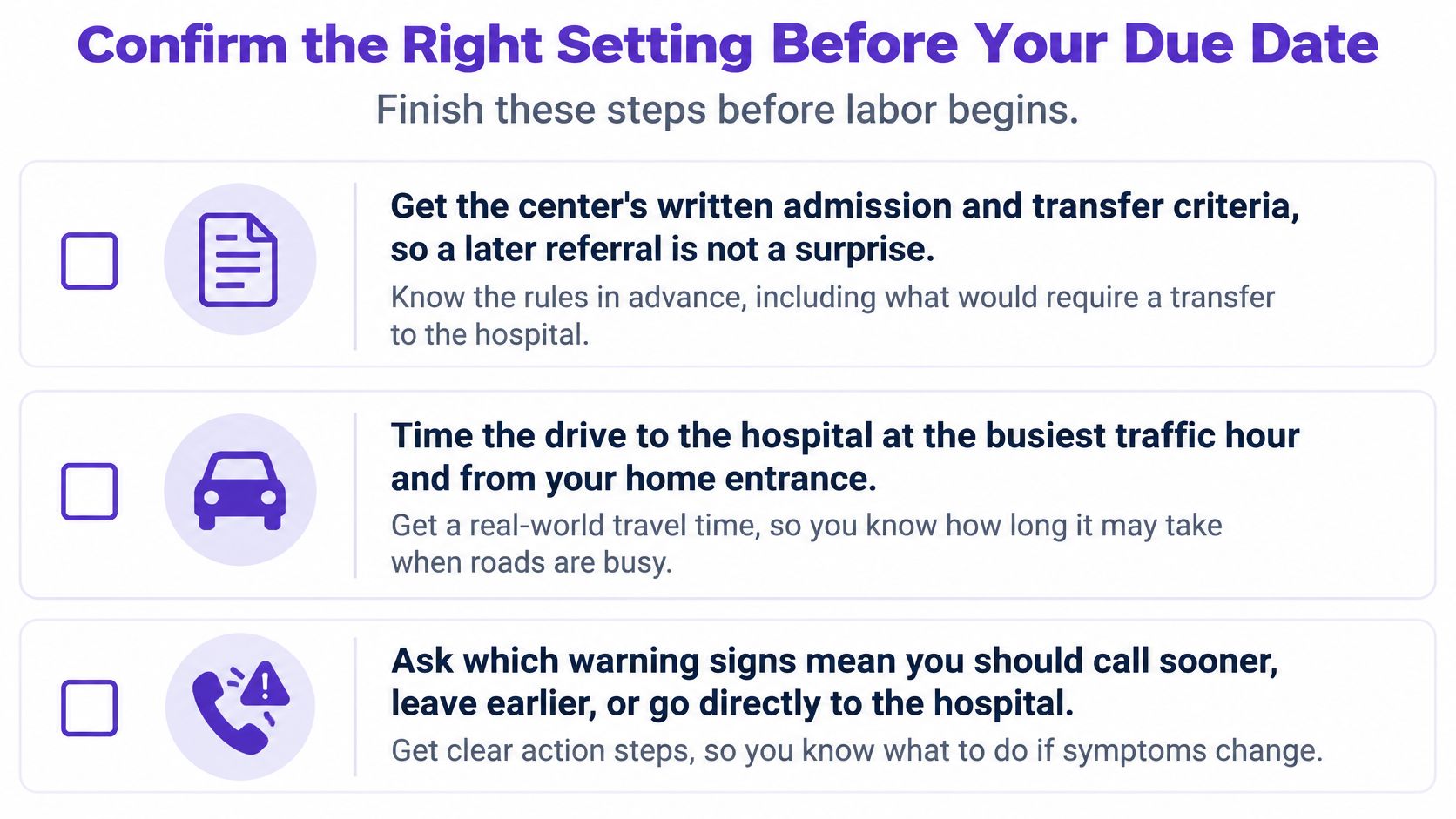
Seven checks close the gap between a preference and a plan.
- Get the center's written admission and transfer criteria. A rule you read in March is easier to work with than a referral you hear about for the first time in labor.
- Time the drive to the receiving hospital in daytime traffic, at night and in bad weather. The number that matters is the worst realistic trip, not the map estimate.
- Confirm the hospital relationship, including whether records travel electronically and who may come with you.
- Check clinician credentials and ask whether a physician backup is named and reachable.
- Confirm accreditation, including whether the Commission for the Accreditation of Birth Centers accredits the center.
- Request two estimates, one for an uncomplicated birth and one that includes a transfer, then match both to your insurer's network rules and your state's Medicaid coverage.
- Tour the labor room and drive the route once, so the first time you see the hospital entrance isn't in active labor.
Use the answers to test the situation you already picked, not to rank the settings from scratch. If a written rule blocks your pregnancy or the timed drive is too long for the backup you planned, change the booking while prenatal visits can still move to another practice.
A useful test. If the backup plan only works on a dry Tuesday afternoon, it isn't a backup plan.
Physical preparation runs alongside the logistics. Planning perineal care before delivery covers the weeks before labor and the recovery after it, in either setting.
Provider credentials are the piece families most often check last. Bornbir lists midwives who provide prenatal and delivery care, which makes it possible to compare providers who work in the setting you've chosen. You can search midwives on Bornbir and post a request with your due date, location and planned setting; the platform is free for parents, and providers reply directly, usually within 24 hours. The final booking stays with you and your provider.
Bornbir gives you a way to compare the people who will attend your birth, not just the building. You can search midwives by location and setting, read reviews from other parents, and message providers directly to ask about transfer rates, hospital relationships and credentials. Start your search at Bornbir and bring the answers to your next prenatal visit.