
You arrive with a feeding log and a plan. The parent hasn't eaten, the baby's last feed was stressful, and a partner wants to know whether the bleeding sounds normal. Before you start washing bottles, you need to work out what needs attention now, what needs a clinician, and what can wait.
A useful doula postpartum visit checklist helps you make those decisions without turning the visit into an interview. Keep it flexible enough for the family's priorities, but firm about safety, consent, and follow-up.
Visit Schedule for the First Six Weeks
A family may need support soon after leaving the birth setting, then again as feeding, recovery, and sleep change. Plan a series of contacts rather than a single catch-up appointment. The WHO postnatal care recommendations call for care within the first 24 hours for every mother and newborn, whether the birth happened at home or in a facility, followed by at least three additional contacts for healthy families at the recommended windows.
The AAP newborn assessment guidance recommends a newborn assessment within 24 hours, with the first office visit generally at 3 to 5 days. ACOG's postpartum care guidance recommends maternity-clinician contact within 3 weeks and a thorough visit no later than 12 weeks.
Postpartum contact windows and checklist focus
These are clinical care milestones, not a required doula booking schedule. The table follows the WHO, AAP, and ACOG recommendations. Checklist tasks are practical ways to support those contacts.
| Visit window | Timing after birth | Checklist focus | Guideline anchor |
|---|---|---|---|
| Initial postnatal contact | Within 24 hours | Check how the mother and newborn are doing; identify any need for clinical care | WHO postnatal care |
| Early postnatal contact | 48 to 72 hours after birth | Bleeding, pain, temperature, first feeds, rest, emergency plan | WHO postnatal contacts |
| Newborn office visit | 3 to 5 days | Weight, feeding, jaundice signs, diapers, sleep | AAP first office visit |
| Early follow-up | 7 to 14 days | Feeding progress, recovery, mood, household support | WHO postnatal contacts |
| Sixth-week check | Around week 6 | Recovery, contraception questions for the clinician, sleep, emotional health | WHO sixth-week contact |
| Clinician contact | Within 3 weeks | Confirm the family has booked and attended a clinician visit | ACOG postpartum contact |
| Thorough postpartum visit | No later than 12 weeks | Review physical, social, and psychological well-being | ACOG postpartum visit |
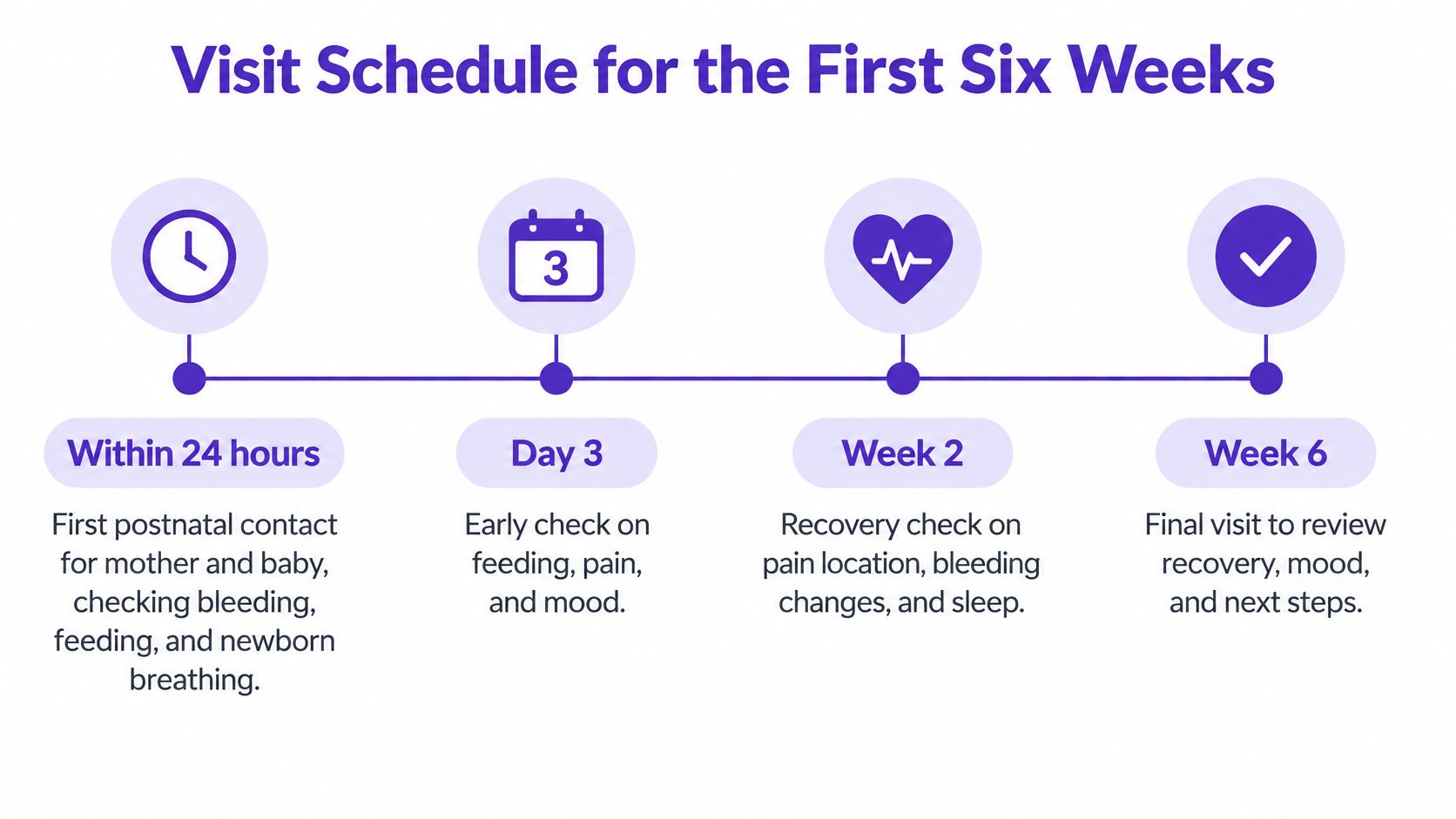
Use the timeline as a planning aid, not a discharge rule. Support may continue after the last milestone, and clinical needs may call for earlier contact.
Early visits should make room for immediate recovery concerns and practical relief. Later visits can focus more on changing feeding needs, sleep arrangements, and household help. Families can use postpartum support advice from Bornbir to decide what support would help at home.
After each visit, the family should know the next contact date and who will arrange it.
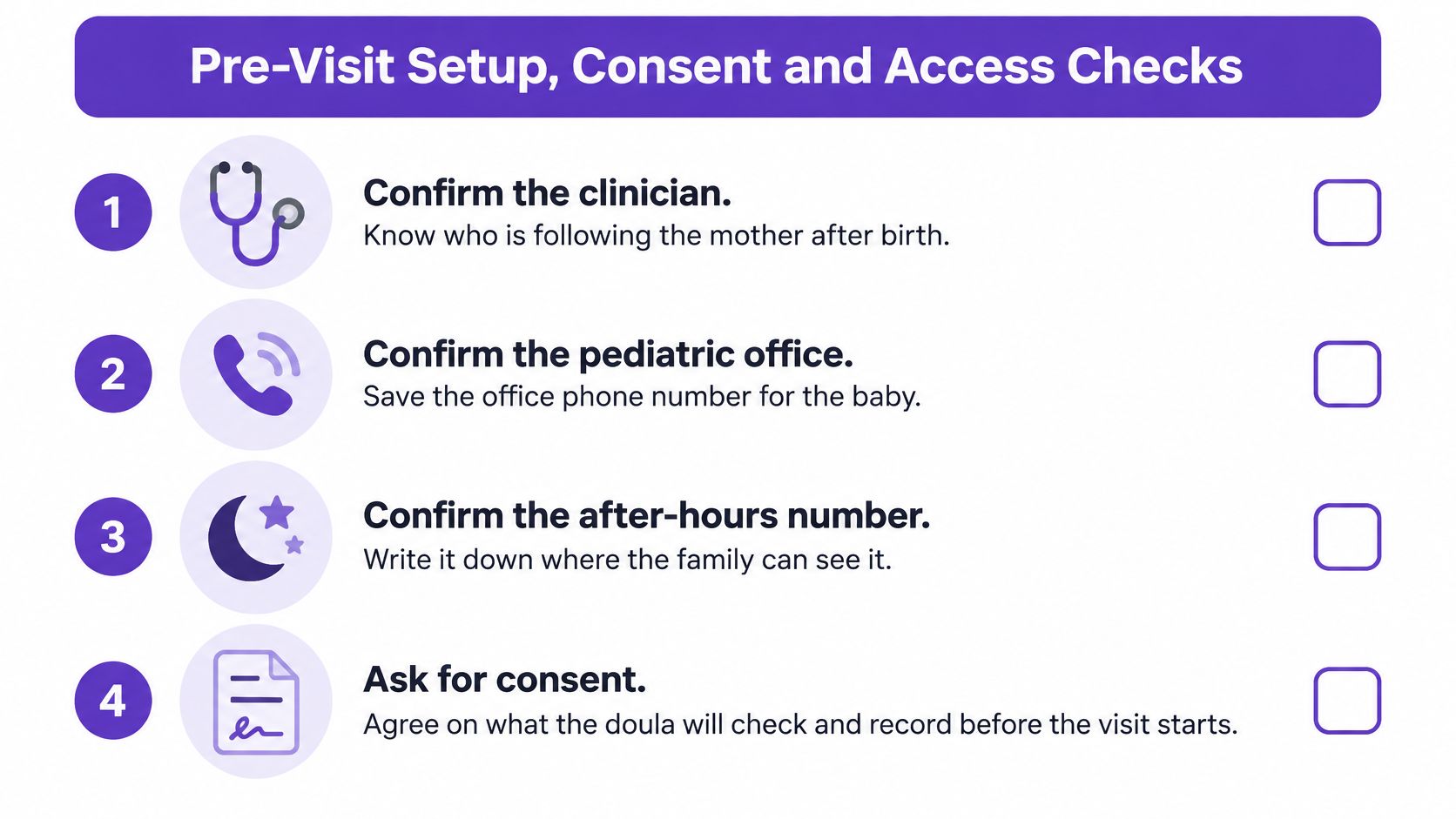
Pre-Visit Setup, Consent and Access Checks
Settle the working agreement before you ask personal questions or pick up the baby. A family shouldn't have to guess what you'll record, whether you'll answer overnight messages, or who can receive their information.
Confirm the care contacts. Put the maternity clinician, pediatric office, after-hours number, and local emergency contact on the first page of your notes. Check that the family can find them without opening your records.
Agree on between-visit contact. Explain whether you offer text or phone support, your response expectations, and where urgent concerns must go. In our doula interview checklist, we recommend discussing prenatal visits, the on-call window, continuous labor support, a postpartum follow-up, and text or phone support between visits. Separate birth-package arrangements from ongoing postpartum availability.
Get consent for notes and sharing. Explain what you'll document, where you'll keep it, and who can see it. Ask permission before sending information to another professional, subject to applicable safety and reporting obligations.
Ask who should participate. Confirm preferred language, pronouns, communication needs, and who the parent wants present. Don't assume a partner or grandparent should answer for them.
Check whether the plan is workable. Ask about feeding privacy, food, internet, transport, affordability, and backup help. Leave room for disability access, immigration worries, limited paid leave, and culturally preferred postpartum practices.
Adapt the visit before arrival
Use postpartum doula intake questions as a conversation starter, not a form the parent must finish before receiving support. Ask which details they'd rather discuss privately.
For example, a mother who works night shifts might request a midmorning visit so her partner can participate and sleep afterward. That's a scheduling constraint to build around, not a lack of commitment. A disabled parent may need a different seat, more time to communicate, or written instructions instead of a hands-on demonstration.
Maternal Recovery Checks and Red Flags
Start with what has changed since the last contact. Record the parent's words rather than translating everything into “doing well” or “struggling.”

Ask about recovery without examining
- Bleeding. Ask about pad changes, how quickly pads become soaked, clots, heavier flow, and unusual smell. Record the description rather than deciding the blood loss is normal.
- Pain. Ask where it hurts, including the perineum, belly, or cesarean incision, and whether it's easing or worsening.
- Temperature. Ask about fever, chills, sweating, and access to a thermometer.
- Breathing and circulation. Ask about chest discomfort, breathlessness, dizziness, fainting, and a racing heartbeat.
- Fluids and urination. Check whether drinks are within reach and whether urination is painful or difficult.
- Rest. Ask about uninterrupted sleep and who handles care around feeds.
- Food and bowels. Ask whether the parent has eaten and whether constipation or discomfort is making recovery harder.
- Movement. Ask how stairs, bathing, and lifting the baby feel. Don't turn observation into an examination.
The WHO guidance cited earlier includes uterine contraction, fundal height, temperature, pulse, and blood pressure among clinical monitoring areas. Record whether clinical checks happened, rather than performing them under your doula role. Separate clinical qualifications require a clearly defined role and consent.
Red-flag symptoms and the action to take
The maternal symptoms below follow the CDC's urgent maternal warning signs, including its fever threshold of 100.4°F (38°C). The newborn row is a separate pediatric referral prompt.
| Symptom reported | What the doula does | Who to contact |
|---|---|---|
| Fever of 100.4°F (38°C) or higher | Record it, don't diagnose, ask for care now | Urgent medical care or clinician now |
| Trouble breathing, chest pain, or fast heartbeat | Record it, ask for emergency help now | Emergency services now |
| Severe belly pain that doesn't go away | Record it, ask for urgent care now | Urgent medical care now |
| Fainting or ongoing dizziness | Record it, ask for urgent care now | Urgent medical care now |
| Vision changes or a severe headache that persists or worsens | Record it, ask for urgent care now | Urgent medical care now |
| Heavy vaginal bleeding or bad-smelling fluid | Record it, ask for urgent care now | Clinician or urgent medical care now |
| Severe swelling or pain in one leg | Record it, ask for urgent care now | Urgent medical care now |
| Thoughts of harming self or baby | Stay with the parent if safe, ask for emergency help now | Emergency services or crisis line now |
| Baby hard to wake, feeding poorly, or few wet diapers | Record counts, help the parent call; don't wait for another visit | Pediatric clinician the same day, emergency help for immediate danger |
Overwhelming tiredness is also on the CDC list. Its list isn't exhaustive: a parent's strong sense that something is seriously wrong deserves prompt attention.
If a parent reports severe headache and blurred vision during a visit, pause the household tasks. Help them seek care now, stay for the next step if they agree, and record when and whom they contacted. Don't wait for the next booking.
Mild tiredness, breast soreness without fever, or passing low mood can be documented and revisited when there are no warning signs. Don't use those descriptions to dismiss worsening symptoms. Families can also review when postpartum fever needs medical attention.
Our doula interview checklist is written and maintained by the Bornbir team. It's general guidance for hiring support, not medical advice.
Newborn Feeding and Output Checks
Expected newborn output by day
Count wet diapers and stools separately. Age-specific counts give a clearer picture than asking only whether feeding seems to be going well. The early counts below follow the AAP newborn assessment guidance cited earlier.
| Baby's age | Expected wet and soiled diapers | Signs to note alongside | Action if below |
|---|---|---|---|
| Day 1 | At least 1 wet and 1 soiled diaper | First stools, alertness, feeding attempts | Contact the pediatric clinician the same day |
| Day 2 | At least 2 wet and 2 soiled diapers | Feeding frequency, how easily the baby wakes to feed | Contact the pediatric clinician the same day |
| Day 3 | At least 3 wet and 3 soiled diapers | Feeding frequency, weight check status | Contact the pediatric clinician the same day |
| Days 4 and 5 | At least 4 wet diapers and 3 soiled diapers each day | Feeding frequency, weight gain, signs of jaundice, sleepiness | Contact the pediatric clinician the same day if output is below either count or feeding is concerning |
For the 3-to-5-day visit, the AAP's feeding guidance for the 3-to-5-day visit notes that more than 5 wet diapers and at least 3 soft stools daily, alongside appropriate weight gain, can indicate adequate intake. The visit window does not mean families should wait to report low output or a feeding concern. These counts help organize observations; they do not let a doula medically assess or clear a baby.
Turn observations into a feeding plan
A parent texts after birth because the baby has had only one wet diaper since the previous night. Ask about the full-day diaper count, feeding pattern, alertness, and whether the baby wakes to feed. If output is below the expected count or feeding is concerning, help the parent contact the pediatric clinician that day. Don't wait for the next visit.
A doula can offer basic latch help and reassurance. Persistent pain or weight concerns call for referral to a lactation consultant. Nipples that are not healing also need qualified feeding support, rather than repeated reassurance. Bornbir's doula interview checklist recommends discussing feeding support and these limits of the doula's role.
Record the handoff clearly:
- Feeding pattern. Note the feeding method, frequency, and what makes feeds stressful.
- Output. Record wet diapers and stools separately, including the period counted.
- Clinical follow-up. Note the last weight-check date and the next pediatric appointment.
- Feeding help. Record the lactation consultant's contact details and whether an appointment is arranged.
Families can use baby feeding checks from Bornbir to organize observations. Poor output, unusual sleepiness, poor feeding, or weight concerns still need attention from the baby's clinician.
A diaper log helps describe a concern. It doesn't explain the cause or replace a clinical assessment.
Mood, Sleep and Partner Check-Ins
“How are you sleeping when someone else has the baby?” can open a different conversation from “Are you tired?” A parent may have help available but still feel unable to rest.
Follow with questions that don't require them to label their experience. “Has anything felt heavier than you expected?” and “Who can you call on a hard afternoon?” leave room for an honest answer. ACOG's guidance, cited earlier, places emotional health alongside sleep, fatigue, physical recovery, and the family's wider circumstances.
Listen before offering a solution
If a parent describes anxiety, intrusive thoughts, fear of being alone with the baby, appetite changes, or withdrawal, write down what they say. Don't decide from a conversation whether they have a mental-health condition. Use a formal screening tool only when you're trained and authorized to administer it, and don't treat a score as a diagnosis.
Ask whether they'd like help contacting their clinician or a mental-health professional. Follow the urgent pathway above if safety is in question. Practical emotional support for new parents can sit alongside professional care, not replace it.
A partner might answer every question with “We're fine.” Bring the conversation back to the recovering parent, then offer a private check-in. Speak with the partner separately too, rather than letting their account stand in for the parent's.
Make rest a shared task
Ask the partner or other caregiver about fatigue, confidence with feeding or bathing, feelings about the birth, and what they expected their role to be. Keep the recovering parent's needs central without overlooking the person helping them.
Turn the conversation into an arrangement the household can realistically carry out:
- Around feeds. Name who handles changing, bringing the baby over, and settling afterward.
- During the day. Identify who can cover care while the parent rests.
- Backup support. Write down whom the family will contact if the planned helper can't come.
Don't promise uninterrupted sleep that conflicts with the feeding plan. Finish with teach-back: ask the parent to explain the next rest or feeding step in their own words, then check that the caregiver understands their part.
Document the Visit and Confirm the Next Step
Write notes that another support professional could understand without guessing. Separate what the parent reported, what you observed, and what you did.

Record the date, visit number, who was present, and the parent's account of recovery, feeding, mood, and sleep. Include the support provided, information shared, referrals, contact times, and agreed follow-up. Write “parent reports a measured temperature above the urgent-care threshold,” not “parent has an infection.”
Share a short, plain-language summary with the family. Send information to their clinician only with consent, subject to applicable safety and reporting obligations. Don't bury the next action in a long account of household tasks.
Close with a consistent routine
- Check unanswered safety questions. Confirm that the warning-sign questions were addressed. Don't mark a blank answer as a negative.
- Name the referral owner. Record who was contacted, when, and who will check the response. “Suggested calling” isn't a completed handoff.
- Use teach-back. Ask the parent to describe the next feeding or recovery action. Clarify anything that sounds different from the agreed plan.
- Write down the caregiver's role. Include the task they accepted, not just that they attended.
- Confirm the next contact. Once an urgent concern has been handed over, confirm the next support date and any clinical follow-up still pending.
For practice review, track completed visits, response time to warning signs, feeding-plan follow-up, parent-reported confidence, and referral closure. Don't judge the checklist only by breastfeeding or mental-health outcomes. A randomized doula-home-visiting trial found an early breastfeeding-initiation benefit that wasn't sustained and no demonstrated reduction in postpartum depressive symptoms, which is a reason not to promise clinical effects.
Closing rule: An open urgent referral isn't a task for the next routine visit. Confirm that the family reached care or that a clinician has taken over the concern.
Don't move straight from an unresolved warning sign to booking another visit. Stay focused on the handoff, then agree on ongoing doula support.
Bornbir lets families browse postpartum doulas, compare profiles and pricing, and message providers directly for free. Visit Bornbir to find support, then use this checklist to discuss visit priorities, feeding boundaries, and follow-up before care begins.