
You've agreed to support a family, sent your contract, and started planning prenatal visits. Then the parent asks about insurance reimbursement, a hospital requests proof of coverage, or a referral partner wants access to your intake records. Suddenly, your legal setup needs to cover more than a signed agreement.
The legal basics for doula entrepreneurs start with how you work. Build around your services, payment arrangements, and referral channels, not a checklist copied from a practice that operates differently.
Why Legal Setup Is a Channel Question, Not a Checklist
Suppose you've been working directly with private-pay families. A prospective client then asks whether you can accept payment through a Medicaid managed-care plan. That's not a different way to send an invoice. Before accepting, you need to check enrollment, contracting, documentation, and payment requirements.
Ohio's Medicaid materials, for example, distinguish independent doulas from doulas working under a group, describe electronic claims through managed-care portals, and address protected health information in payment workflows. Those are channel-specific requirements, not universal instructions for every doula business. See the Ohio Medicaid doula contracting guidance.
Ohio is one of 28 states, plus Washington, D.C., whose Medicaid programs paid for doula care as of September 2026, and each state sets its own enrollment and training rules. Bornbir's state-by-state guide to Medicaid doula coverage lists start dates and rates. If a private-pay family plans to use HSA or FSA funds, read whether doula services are HSA or FSA eligible before you promise anything about reimbursement.
Map the relationship before accepting the work
Use these questions as your starting decision tree:
- Who pays you? Separate direct family payment from insurance reimbursement, Medicaid billing, and institutional contracts. Ask for the actual payer requirements before promising reimbursement.
- Who contracts with you? A family, group practice, hospital, and marketplace can create different responsibilities. Identify who owes payment and who controls records.
- Where will you provide support? List the jurisdictions and settings involved, including home visits, hospitals, birth centers, and virtual care.
- What are you offering? Describe birth support, postpartum support, and feeding-related services separately rather than treating them as interchangeable.
- What information moves between parties? Map what you collect, who receives it, and whether you're handling information for a health-care organization.
Practical rule: Before adding a payment or referral channel, ask what new agreement, credential, insurance evidence, or data-handling duty comes with it.
A hospital referral isn't necessarily a hospital contract. Likewise, helping a parent understand an invoice isn't the same as becoming an enrolled payer provider. Get the relationship clear before deciding which requirements apply.
Your business may be permitted to operate locally but still fail a partner's onboarding requirements. Certification and a marketplace profile also don't replace government registration or client consent. The useful question isn't whether your practice is generally compliant. It's whether you're ready for this service, through this channel, in this location.
Choosing a Business Structure That Actually Protects You
Choose your structure before you register the business. The U.S. Small Business Administration identifies that sequence and explains that structure affects personal liability, taxes, registration duties, and administrative cost. This isn't merely a naming or branding decision, as the SBA's business-launch guidance makes clear.
Don't choose an entity because another doula chose it. Start with the obligations you're taking on, your tolerance for administration, and the advice you need about local law and taxes.
Compare the trade-offs, not the labels
| Structure | Main consideration | Question to resolve |
|---|---|---|
| Sole proprietorship | A straightforward solo-business option without an entity-based separation of personal and business obligations | Are you comfortable with the personal-liability implications? |
| Limited liability company | May separate business obligations from personal assets, with registration and ongoing administration | What protection, filings, and tax treatment apply locally? |
| Corporation | A structure to assess when ownership, fundraising, or organizational needs justify it | Do your plans warrant the additional formalities? |
The SBA explains that entity choice affects taxes, filing obligations, fundraising capacity, and personal liability in its business-structure comparison. Use those factors to make the decision, rather than assuming the most elaborate structure is the safest choice.
For a solo practice, start by comparing a sole proprietorship with an LLC. Consider a corporation when you have a concrete ownership or financing reason, not because it sounds more established. Ask an accountant to explain the tax consequences before filing anything you don't understand.
Make the decision location-specific
Bring your planned services, payer relationships, and any group-practice arrangements to a local attorney, so the advice fits how your practice will actually operate.
Use the Bornbir doula business guide alongside that legal review to organize the broader setup work. Your final choice should be something you can maintain correctly, with clear ownership, accurate filings, and no confusion about which business signs the client agreement.
Registration, Names, and Local Compliance Triggers
An entity filing isn't permission to ignore every other registration question. A jurisdiction may have no specific doula license while still requiring a general business license, assumed-name registration, tax registration, or credential tied to particular services.
Treat verify locally as a research task with a written result. Identify the government offices responsible for business registration, local licensing, taxation, and any regulated services you plan to offer.
Compare your operating contexts
| Practice context | Registration and name checks | Other triggers to investigate |
|---|---|---|
| U.S. solo, private-pay practice | State registration as applicable, local business requirements, assumed-name use | Tax registration and service-specific credentials |
| U.S. group or institutional work | Your entity's filings plus the contracting party's onboarding requirements | Credentialing, payer enrollment, and documentation duties |
| U.S. practice serving multiple jurisdictions | Requirements where the business is based and where services are delivered | Whether travel or a new service location changes obligations |
| Canadian practice | Applicable federal, provincial, and municipal requirements | Provincial service rules and separate Canadian privacy obligations |
This is a comparison of questions to investigate, not a claim that every listed registration applies everywhere. Don't file for sales-tax registration just because a generic startup checklist mentions it. First establish whether your services or any products you sell create that obligation.
Ask questions that officials can answer
Give the office a concrete description of your work. Explain whether you provide non-clinical birth support, postpartum home visits, virtual consultations, or services through a clinic.
- Business name: Does using your chosen trading name require an assumed-name filing? If you haven't picked one yet, start with these doula business name ideas.
- Operating location: Does your city or municipality require a general business license?
- Service type: Does any part of your advertised work require a professional credential?
- Tax treatment: Must you register to collect tax on the specific services or products you offer?
- Expansion: What needs checking before you serve families in another state or province?
Keep dated notes of the answer, the office contacted, and any written guidance received. If the official can't resolve a scope or cross-jurisdiction question, take it to local counsel.
For Canadian providers, don't translate a U.S. checklist word for word. Start with the relevant Canadian authorities and assess provincial differences separately. A U.S. registration or privacy conclusion doesn't settle the Canadian question. For the licensing side, see Bornbir's answer to whether doulas are licensed in Canada.
Get an EIN, and skip the BOI report
An employer identification number (EIN) is free from the IRS and takes minutes to get online, as the IRS EIN page explains. A sole proprietor with no employees can work under a Social Security number, but an EIN lets you give agencies, hospitals, and Medicaid plans a business number on tax forms instead of your SSN. Banks typically ask for one before opening an account for an LLC. Don't pay a third-party site to get it for you.
If you form an LLC, ignore older checklists that tell you to file a beneficial ownership information (BOI) report. FinCEN's final rule of August 11, 2026 made permanent the exemption it first granted in March 2025: companies formed in the U.S. no longer file BOI reports, according to FinCEN's BOI page.
Building a Contract Package That Survives Real Scenarios
Suppose two clients go into labor at the same time. Your backup is available, but one family thought they were paying for your personal attendance. The other hasn't agreed to share intake information with anyone else.
That's the kind of situation your agreement needs to address before it happens. The National Doula Certification Board identifies business registration, insurance, client management, contracts, and fee schedules as core competencies in its doula certification content outline. A signature alone doesn't settle those operational questions.

Make the documents agree
Build a consistent client-facing package:
- Advertised service description: State what the package includes, what it excludes, and whether backup support may be used. Avoid promising attendance without explaining its limits.
- Intake and consent forms: Obtain relevant permissions, including authorization for information sharing with an approved backup.
- Client agreement: Define services, fees, deposits, cancellations, refunds, travel charges, confidentiality, and communication expectations.
- Invoice: Use service descriptions that match what the client bought. Don't relabel supportive care as a clinical service for billing convenience.
Then compare the package with your actual insurance policy. Ask the insurer to confirm whether the described activities, settings, and backup arrangements fit the coverage. A waiver isn't a substitute for that check.
Write for the difficult appointment
Specify the on-call window, how clients contact you, and what happens if you're unavailable. Explain who arranges backup, whether the family can decline, and how backup attendance affects payment or refunds.
A useful agreement answers what happens when the original plan becomes impossible, not just what happens when everyone follows it.
Keep non-clinical scope boundaries explicit. Doula support isn't medical diagnosis or treatment. Define emergency escalation and what you'll do if a client requests clinical advice or declines recommended medical care, without presenting yourself as the person making treatment decisions.
Bornbir's free birth doula contract template is a drafting starting point. Replace generic terms with your actual availability, backup process, and payment rules, then have local counsel review the provisions that affect consent, liability, and jurisdiction.
Send the package for signature
Bornbir Premium and Business providers can send the agreement and consent forms for e-signature from the portal. The family signs from an emailed link, with no Bornbir account needed, and you both get the signed PDF.
- Start from a template: Bornbir's templates include a birth doula contract, a postpartum doula service agreement, a client authorization to release health information, and a text communication consent form.
- Or upload your own PDF: Send the agreement your attorney reviewed as it is. The family types or draws a signature on a page added at the end.
- Keep copies private: Uploaded and signed PDFs sit in private storage, and each download link works for only a few minutes.
The release-of-information form fits the backup scenario above: get it signed before a backup doula needs the intake details. Compare the Premium and Business plans.
Liability, Insurance, and When Privacy Laws Actually Apply
Separate entity protection, insurance coverage, and privacy duties. They address different problems, and completing one doesn't complete the others. Your entity choice doesn't tell you whether a home visit is insured or whether you can share a client's intake record.
For insurance, compare professional liability with general liability and check the actual policy wording. Coverage can differ for birth support, postpartum work, home visits, and specific service descriptions. Bornbir's guide to whether doulas need liability insurance can help you organize questions, but your policy and insurer's written clarification are what you need to examine.
Check the privacy relationship
HIPAA doesn't automatically apply to every independent doula. HHS says its rules apply to covered entities and business associates. A business outside both categories doesn't have to comply with HIPAA, although other privacy laws, contracts, and professional duties may still apply under the HHS covered-entity guidance.
If you handle protected health information on behalf of a covered health-care entity in a qualifying business-associate relationship, a written business associate agreement, or BAA, is required. It must limit permitted uses and disclosures and require safeguards; the 2009 HITECH Act also made business associates directly liable for certain obligations, including breach notification, according to HHS business-associate guidance.
Liability and Privacy Triggers at a Glance
| Layer | Trigger | Minimum Response |
|---|---|---|
| Entity liability | Business obligations and potential claims | Maintain the entity correctly and get advice about its limits |
| Insurance | Activities, settings, or partner coverage requirements | Confirm covered services, exclusions, and required evidence |
| HIPAA | Covered-entity or qualifying business-associate status | Assess duties and execute a BAA where required |
| Non-HIPAA health technology | A qualifying health app or similar technology holding identifiable health information | Assess FTC Health Breach Notification Rule applicability |
| Everyday confidentiality | Collecting or sharing sensitive family information | Obtain consent, restrict access, and define retention |
The FTC Health Breach Notification Rule can apply to qualifying health apps and similar technologies outside HIPAA. Using scheduling software doesn't automatically make your practice subject to that rule. Assess the tool, information, and business relationship rather than assuming either coverage or exemption.
Privacy boundary: A parent's willingness to text you sensitive information isn't permission to forward it to a partner.
Collect only what you need. Secure files and messages, disclose third-party storage, restrict access, and establish deletion and incident-response procedures. Canadian practices need a separate assessment of applicable federal or provincial privacy law.
Staying an Independent Contractor When You Work Through a Marketplace
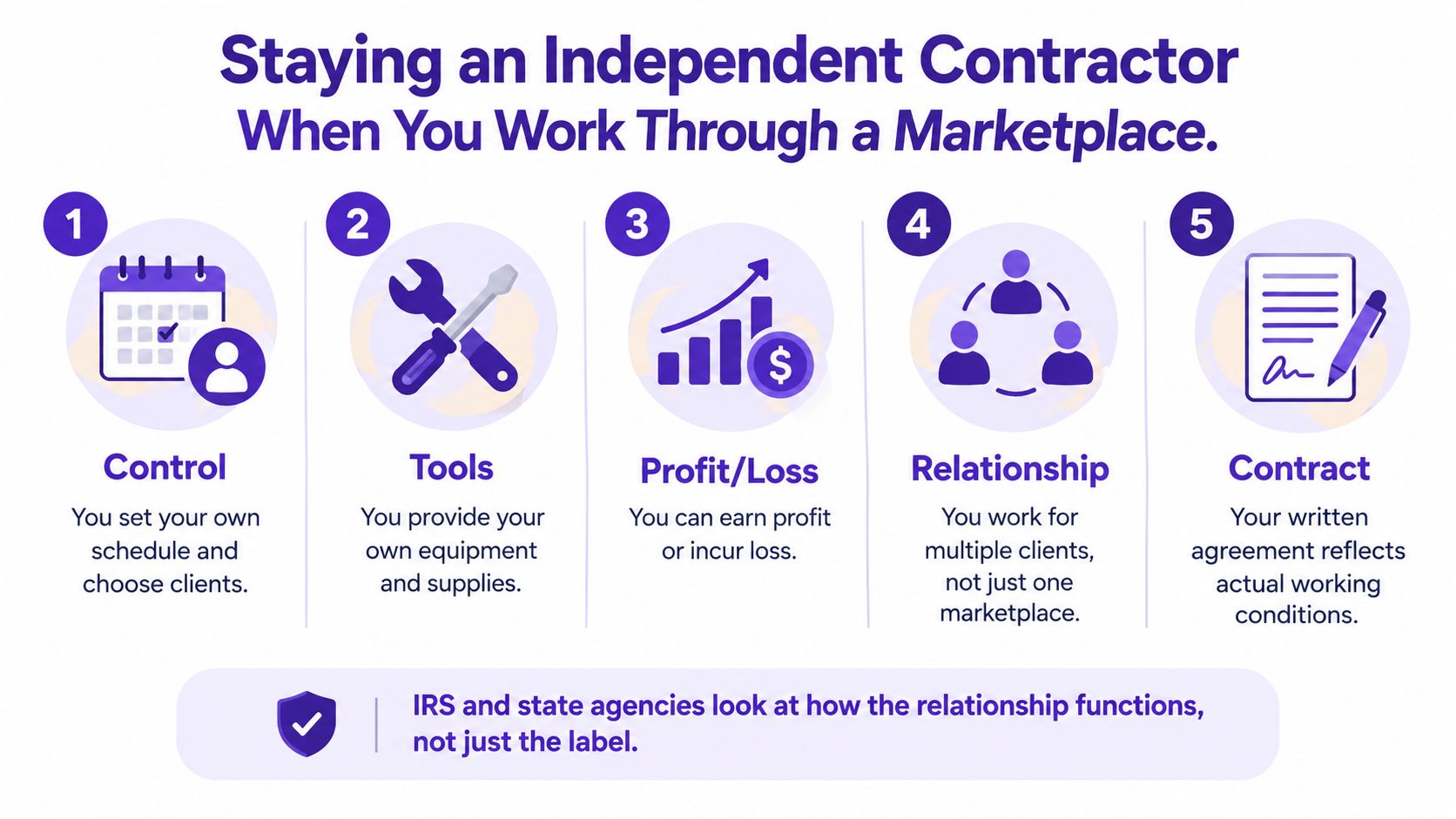
Read a marketplace agreement alongside the way the platform operates. A contract calling you independent won't settle classification if the business relationship functions like employment.
The IRS evaluates behavioral control, financial control, and the parties' relationship in its worker-classification guidance. Mandatory scripts, fixed schedules, detailed service instructions, financial arrangements, and the permanence of the relationship all deserve attention.
Keep independence real
Set your own rates and availability. Maintain your client relationships, provide ordinary work tools, and preserve your ability to work through other channels. Keep evidence of those business decisions rather than relying only on the agreement's wording.
The IRS describes independent contractors as self-employed and distinguishes control over the result from control over how work is performed in its independent-contractor definition. That federal explanation doesn't resolve every state employment test or Canadian classification question.
- Service delivery: Check whether you control how you provide support within legal and safety boundaries.
- Financial decisions: Review who sets prices, pays expenses, and carries the possibility of profit or loss.
- Outside work: Question exclusivity requirements that prevent you from operating your own practice.
- Actual relationship: Compare the written terms with onboarding instructions and daily expectations.
Review the operational terms
A provider agreement should allocate payment, cancellations, refunds, taxes, insurance, confidentiality, complaints, and records responsibilities. Reject wording that attempts to waive rights the law doesn't allow you to waive. If the platform treats you like scheduled staff while describing you as an independent business, get classification advice.
Invoicing software can organize your records, but it can't fix an employment-like relationship.
If you use Bornbir, read how Bornbir works for providers. You set your own packages, prices, availability, and service area, families reach out to you, and the agreement and payment terms are between you and the family. Still examine the provider terms and your own working arrangements separately.
Tax Basics That Keep the IRS and Your State Happy
Don't wait until filing season to understand your federal obligations. The IRS says net self-employment earnings of $400 or more generally trigger a federal income-tax filing requirement. Self-employed people generally pay income tax and self-employment tax, use Schedule C for business income or loss and Schedule SE for Social Security and Medicare taxes, and generally pay estimated taxes quarterly, as explained in the IRS self-employed tax center.
The threshold concerns net earnings, not the total payments arriving in your account. It also isn't a blanket exemption from other filing requirements or state obligations. Have an accountant assess your whole tax situation.
Know the federal numbers
- Self-employment tax: The rate is 15.3%, made up of 12.4% for Social Security and 2.9% for Medicare, and you owe it on top of income tax, per the IRS self-employment tax page.
- Quarterly estimates: You generally need to pay estimated tax if you expect to owe $1,000 or more when you file. The four payments fall due around April 15, June 15, September 15, and January 15 of the following year; a due date on a weekend or holiday moves to the next business day.
- Forms 1099-NEC and 1099-MISC: A business, agency, or health plan that pays you $2,000 or more in 2026 generally sends you a 1099, usually a 1099-NEC, though health plans may report medical payments on a 1099-MISC. The threshold was $600 through 2025, according to the IRS instructions for Forms 1099-MISC and 1099-NEC. Families paying you personally don't send one.
- Form 1099-K: Payment apps and online marketplaces must send one when your payments for goods or services total over $20,000 in more than 200 transactions, though some send one below that, according to the IRS Form 1099-K page.
A missing 1099 doesn't make income tax-free. Report every client payment, whether it arrived by check, card, or app.
Keep a usable record of each transaction
Use a dedicated business bank account and keep personal spending separate. Maintain dated invoices, expense records, and supporting receipts so you can explain what happened without reconstructing it from messages.
- Client payments: Record the payer, service, invoice date, amount received, and any balance.
- Refunds and cancellations: Keep the reason and related agreement or correspondence.
- Business expenses: Save documentation and describe the business purpose. Ask your accountant about tax treatment rather than guessing.
- Estimated payments: Track payment confirmations and the calculation your accountant used.
- Outstanding invoices: Reconcile unpaid amounts with your invoicing system so your records remain consistent.
For help organizing rates alongside recordkeeping, use these doula pricing and bookkeeping tips. Keep pricing decisions separate from assumptions about what you'll owe in tax.
Know when your setup needs help
A spreadsheet is useful while you can reconcile it accurately. Move to a more structured bookkeeping system when deposits, refunds, multiple payment channels, or missing receipts make the records difficult to trust. The deciding factor is reliability, not how professional the software looks.
State and local taxes need their own review, including sales-tax collection where applicable. A few states tax most services, such as Hawaii through its general excise tax and New Mexico through its gross receipts tax, and selling products such as birth kits or teas more often creates a sales-tax obligation. Canadian providers should use Canadian tax guidance rather than these IRS filing mechanics. Ask for professional help before an unfamiliar payer arrangement becomes a pile of transactions you can't explain.
Your 30-Day Launch Checklist and When to Call a Professional
Use this 30-day plan as a proposed work schedule, not a legal deadline or a promise that every registration will finish within it. If approval or professional review takes longer, adjust the launch date. Don't accept work that depends on requirements you haven't resolved.
30-Day Legal Launch Checklist
| Week | Focus | Key Outputs |
|---|---|---|
| Week 1, days 1 to 7 | Map channels, choose an entity, research names | Written service map, entity decision, name checks |
| Week 2, days 8 to 14 | Registrations, EIN, insurance quotes, banking | Filing records, coverage questions, dedicated account |
| Week 3, days 15 to 21 | Build the contract package | Aligned service copy, intake, agreement, invoice wording |
| Week 4, days 22 to 28 | Tax tracking and privacy procedures | Recordkeeping system, disclosures, access and retention rules |
| Final review, days 29 to 30 | Test marketing and intake | Checked profile, working intake flow, resolved launch questions |
Begin contract drafting while you shop for insurance, so you can compare service language before committing. During the final review, test the client experience from inquiry through payment. Check that your marketing promises match what the agreement and policy cover.
Pause at the limits of DIY
Call a local attorney before cross-state or cross-province delivery, Medicaid enrollment, hospital or clinic contracting, or a data arrangement that may create a business-associate relationship. Also get advice before hiring or accepting terms that raise worker-classification concerns.
Call an accountant when entity tax treatment, estimated payments, sales tax, or your records stop being clear. Bring the actual agreements and transactions, not just a general description of your business.
Your launch decision should be practical: are the unresolved questions cosmetic, or do they affect permission to operate, payment, coverage, consent, or client safety? Resolve the consequential ones before opening that channel.
When your legal setup and client paperwork match the services you'll offer, list your practice on Bornbir. A free profile shows your services, pricing, credentials, and reviews to expecting and new parents. Replying to parent requests and sending contracts for e-signature are part of Premium.